

AI SEO has two common meanings: using artificial intelligence to help carry out SEO tasks, and improving how a website or business appears in AI search experiences. Those meanings overlap, but buying help with one does not automatically solve the other.
A tool that helps classify search queries can save research time. A system that checks whether ChatGPT cites your website can help monitor visibility. Neither result, by itself, tells you whether more suitable buyers discovered your business.
This guide explains the terminology, what the platforms document about finding sources, and how to decide which work your situation needs. Platform documentation was checked on 5 October 2026. Open the task exercise above to review a query grouping or keep a record of one search answer.
The two meanings of AI SEO
AI-assisted SEO uses AI within research, analysis or other search-optimization tasks. Examples include grouping queries for human review, identifying patterns in crawl exports, and preparing a first pass at a content brief. Judge the workflow by its accuracy, useful output and total effort, including corrections.
SEO for AI search concerns visibility in experiences that generate answers, including Google AI Overviews, AI Mode and ChatGPT Search. The practical questions include whether relevant pages can be discovered, what information gets referenced, and whether the business is described accurately.
The language varies. Semrush’s AI SEO guide emphasizes AI-assisted workflows, while Google describes optimization for its generative search features as part of SEO. Ask a tool vendor or provider which meaning they use and what their work produces.
What stays the same, and what changes?
The foundations still include useful pages, accurate information, discoverable links and an accessible website. AI introduces additional ways to perform work and additional places to observe its results. Neither removes the need to understand the reader’s task.
| Work | Practical example | Evidence to retain |
|---|---|---|
| Established SEO | Improve a service page that does not answer buyers’ questions | The original page, the change, the reason and subsequent search and enquiry records |
| AI-assisted SEO | Ask a model to group supplied queries, then review the proposed page roles | Inputs, prompt, output, corrections and the final decision |
| Observing AI search | Inspect whether a generated answer cites a relevant page and represents it accurately | Exact question, product/mode, date, context, answer and linked sources |
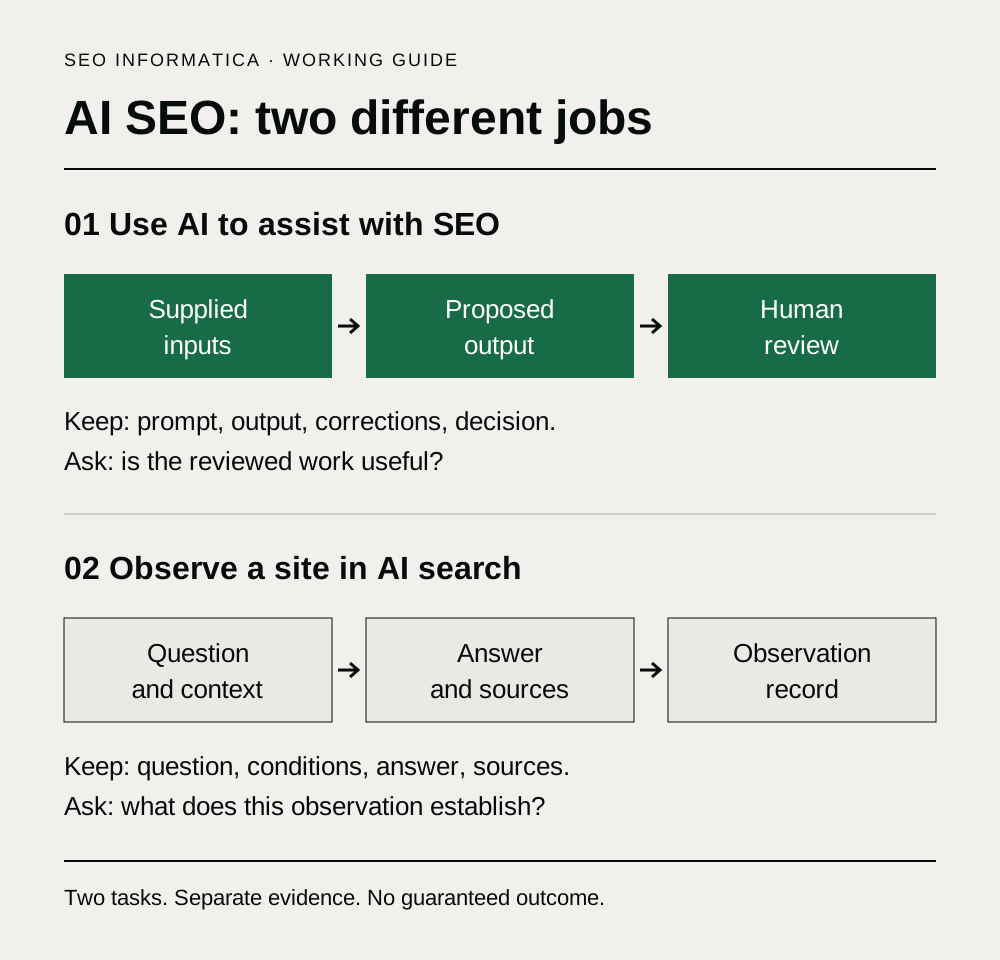
Open the two-task diagram full size. It describes two kinds of work, not a guaranteed path to visibility.
A practical AI-assisted example: review a query grouping
Suppose your input contains six illustrative queries: “what is ai seo”, “how does ai seo work”, “ai seo tools”, “best ai seo software”, “ai seo companies” and “ai seo agency”. These are teaching inputs, not a search-volume dataset or a recorded customer brief.
A proposed group named “AI SEO” could contain all six because the words are similar. The useful review question is different: can one page satisfy the same reader task for every query in that group?
We would separate the initial decisions into understanding the topic, choosing software and finding a provider. The two software phrases can begin with one tools comparison rather than two nearly identical articles. The two provider phrases can begin with one shortlist guide. A detailed how-to question may eventually justify deeper coverage, but the wording alone does not establish that.
| Review stage | What to do |
|---|---|
| Supply inputs | Use a known query set and state its source. Provide existing page roles if available. |
| Inspect the proposal | Ask for the reader task and an uncertainty note for each group. Do not accept invented demand or ranking figures. |
| Check the decision | Read the current results and relevant existing pages. Identify differences in audience, required answer and buying stage. |
| Keep a record | Retain the proposed group, your correction or reason for keeping it, and the resulting page decision. |
The interactive task exercise includes the complete prompt, the reviewed example and a downloadable working record. This is an illustrative review, not a claim that we tested a named product or measured a time saving. If you want to compare speed, include preparation, checking and correction time for both the assisted and existing process.
AI can help produce candidates. Someone still needs to check facts, interpret the search evidence and approve changes. The intent-routing guide explains that page decision in more detail.
For a retained 30-candidate exercise with prompts, evidence and reviewed decisions, use the AI keyword research guide.
SEO, AEO, GEO and LLM visibility
These are useful working definitions, not a universally agreed classification.
| Term | Common focus | A useful question to ask |
|---|---|---|
| SEO: search engine optimization | Making relevant information discoverable and useful in search engines | Which pages and searches are we trying to improve? |
| AEO: answer engine optimization | Helping information serve answer-oriented experiences, including direct answers | Which answer needs our information, and how will we observe inclusion? |
| GEO: generative engine optimization | Visibility and representation in generated answers | Are we tracking a linked source, a brand mention or a recommendation? |
| LLM visibility | Whether and how a business or its information appears in language-model responses | Was this a web-search answer, another retrieval context or an answer without web search? |
There is substantial overlap. An acronym does not specify a deliverable, a separate budget or an outcome. A proposal should identify the pages, research, technical work and measurement involved.
How AI search finds information to use
For web-search answers, separate finding possible sources from selecting material for a response. The public documentation describes parts of that process, not a complete formula for winning a citation.
Google AI Overviews and AI Mode. Google describes retrieving pages from its Search index and sometimes issuing related queries to address different parts of a question. Its search ranking and quality systems remain involved. That explains why ordinary search foundations still matter; it does not establish that the highest ordinary result will always be cited. Google’s explanation.
ChatGPT Search. OpenAI explains that ChatGPT can rewrite a question into targeted searches, use search providers and show source links. Conversation context and location can affect searches. A response to one person’s question is therefore an observation in a particular context, not a universal ranking for the business. How ChatGPT Search works.
Crawler access is another part of the picture. OpenAI documents separate controls for its search crawler and training crawler. Allowing search access does not require treating training access as the same decision. OpenAI crawler documentation.
Other platforms have their own retrieval systems, policies and reporting. Check the named platform before applying advice. A recommendation from Google should not silently become a claim about every assistant.
Six observations that should stay separate
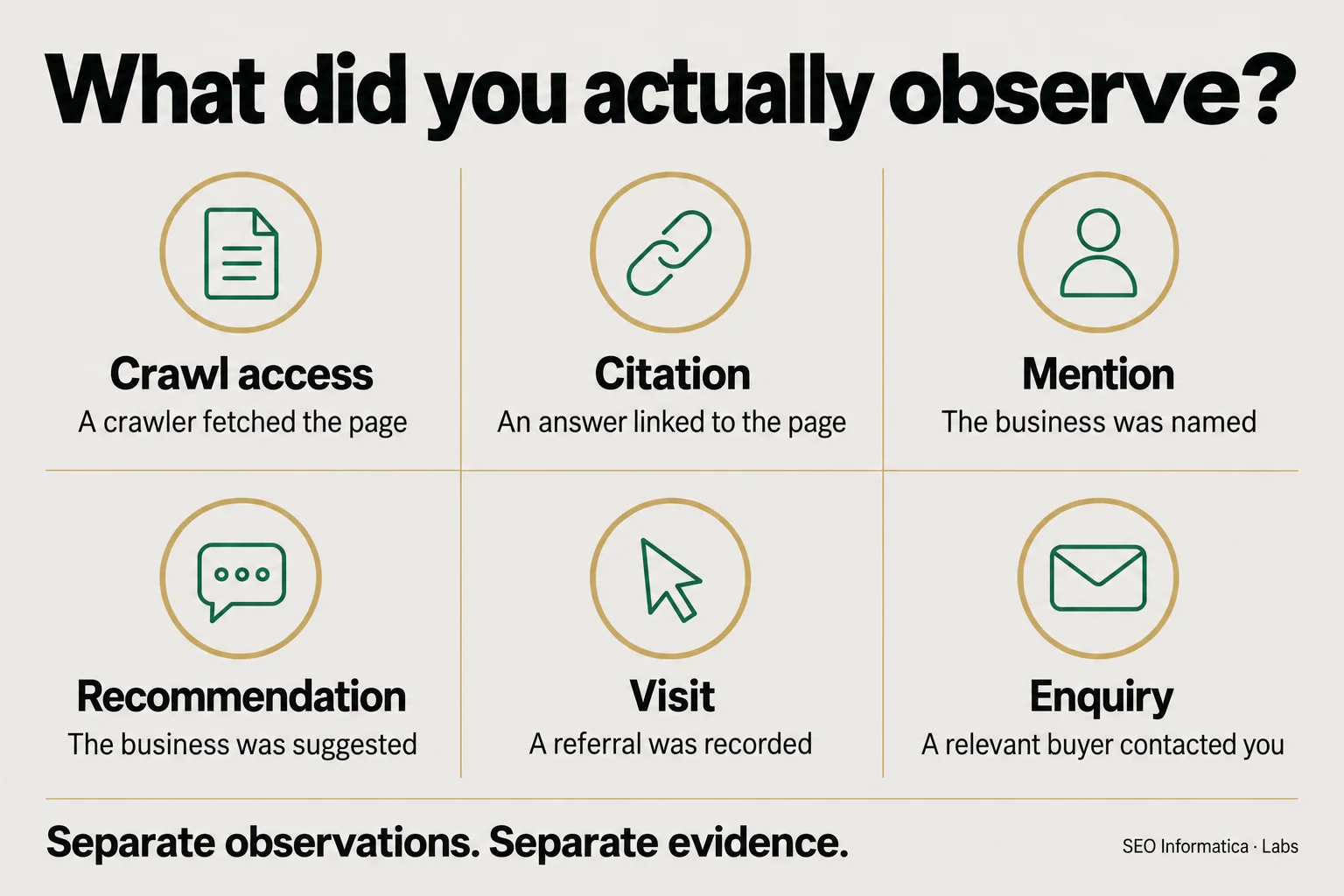
Open the evidence infographic full size. Each observation needs its own evidence; the diagram is not a sequence or a measured result.
When someone reports an AI SEO result, ask which of these they actually observed. This is a way to read evidence, not a ranking model or a required sequence.
| Observation | What it establishes | What it does not establish |
|---|---|---|
| A verified crawler fetched a page | That crawler accessed that response at that time | The page was included in an answer |
| A page appeared as a linked source | The observed answer displayed a citation to it | The answer represented it accurately, or recommended its publisher |
| A business was named | The name appeared in that response | It was endorsed or linked |
| A business was recommended | The response suggested it for that question | The recommendation is stable, appropriate or responsible for a sale |
| A referral visit was recorded | An analytics record attributed a visit to that source | Every AI-driven visit was captured, or the visitor was a suitable buyer |
| A suitable enquiry was received | Someone with a relevant need contacted the business | A particular content change caused the enquiry |
Inspect the surrounding answer when checking a citation. A source link can accompany an incomplete or mistaken interpretation. Record both inclusion and accuracy.
A worked example: the research is cited, but the firm is not recommended
Consider a hypothetical HR consultancy that publishes a useful comparison of payroll providers. An assistant cites the comparison when answering a software question. Later, a question asking for an HR consultancy does not name the firm.
The first observation supports a narrow conclusion: the comparison was referenced in that answer. It does not show that the platform considers the publisher a suitable HR provider for every market or service.
The next investigation should follow the missing outcome. For a consultancy recommendation, inspect the stated service, geography, relevant experience and the sources behind the answer. For the comparison resource, inspect whether it answers the software question accurately and offers evidence worth checking.
We would record the citation and the absent recommendation separately. Adding the phrase “best HR consultancy” to the comparison would not resolve what is still unknown.
This example illustrates reasoning. It is not a client result or a measured platform experiment.
Choose work from the problem you can observe
If SEO tasks take too long: evaluate one AI-assisted workflow against the current process. Keep the inputs comparable and record correction time. Faster first drafts can still create more total work.
If an important page cannot be found: investigate technical access and indexing before commissioning more content. Our Google AI eligibility guide and ChatGPT Search readiness guide explain the platform-specific checks.
If a relevant question has no useful answer on your site: decide whether an existing page should answer it or whether it needs a separate resource. Use an example, analysis or evidence your reader can inspect. More topic labels do not complete the reader’s task.
If a tool reports weak AI visibility: first inspect its prompt set, platforms, locations, dates and metric definitions. A narrow sample can be useful, but it is still a sample. Our AI SEO tools guide compares what different tools can help establish.
If discovery improves but enquiries do not: check visitor fit, the information buyers need and the actual enquiry route. The visibility and enquiry scorecard connects those records without assuming they measure the same thing.
What is worth publishing for AI search?
Our editorial test is straightforward: does this resource help someone understand, verify or decide something important to the topic?
A useful tools comparison can explain differences in measurement. Our AI SEO companies guide helps someone form a shortlist. A study can contribute observations another writer or researcher wants to examine; our AI SEO statistics reference shows why the sample, date and denominator belong beside a reported finding. These resources do not all need to sell a service directly.
Their value depends on what they add. Describe the question, the sources or method, the finding and its limits. Label hypothetical examples. Separate hands-on observations from vendor descriptions. Update a claim when its supporting information changes.
Google emphasizes original, useful contributions and does not prescribe special AI files, mandatory tiny content chunks or special AI schema for its generative search features. It also says increasing page quantity does not inherently increase relevance or quality. Google’s guidance.
Treat clear headings, tables and direct answers as ways to help readers inspect the material. They are not promises that a platform will select it.
Write a short brief before choosing a tool or provider
Start with one bounded action:
| Your question | First action | What to keep and decide |
|---|---|---|
| Can AI help with this SEO task? | Try a small, fixed input set and inspect every proposed result | Keep the prompt, output and review. Decide whether the corrected work is useful enough to repeat. |
| Does our information appear in an answer? | Run one neutral question in a named product and inspect its sources | Keep the conditions and answer. Decide what requires further checking; do not turn one run into a visibility rate. |
| Should we buy software or hire help? | Name the missing responsibility and available internal capacity | Keep a task brief. Compare tools for a workflow or providers for accountable delivery. |
Use these five prompts:
Download the plain-text investigation worksheet for a blank working copy and a completed hypothetical example.
- The audience and question: who needs what information or service?
- The observed gap: what is missing, and where did we see it?
- The proposed work: what will someone investigate, produce or change?
- The evidence: which record would show whether the work helped?
- The review decision: what would justify continuing, changing the approach or gathering more evidence?
For example: “We want our payroll advisory service to be considered by UK employers. We have saved several relevant answers that omit us. First we will check the service information, access and the sources used in those answers. We will then repeat a defined set of questions and review the resulting references alongside received enquiries.”
That is an investigation you can review. “Increase our AI authority score” needs more definition before it can guide the work.
Find the next useful resource
Compare AI SEO tools by what they measure, create a shortlist with the AI SEO companies guide, or use the provider evaluation guide to turn a proposal into specific responsibilities and evidence.
If you need implementation support, our AI SEO service explains the work. You can bring an unresolved question to a Clarity Call.