

AI SEO companies sell different combinations of research, content, technical work and visibility monitoring. A useful shortlist starts with the work your team needs someone to own. The AI SEO, AEO or GEO label alone does not describe that responsibility.
This guide compares DEJAN, iPullRank, Omniscient Digital, SALT.agency, SEO Informatica, Siege Media and WebFX through their official public material. The initial six-provider review was on 5 October 2026. We rechecked the sources and added our disclosed entry on 7 October. SALT’s pages remain subject to the access limit explained below. This is a service-provider comparison. For software to support your team’s work, start with the AI SEO tools comparison.
Our interest and the limits of this review: SEO Informatica publishes this comparison and sells AI SEO services. Our own entry is included with that commercial interest and has not been independently reviewed. We apply the same fields and evidence questions to our offer. We have not purchased the listed services, interviewed the providers or independently verified their client results. The entries are alphabetical, with no performance ranking or initial selection.
Use the provider research desk to filter the documented work, select conversations and download the questions still worth asking. All seven records, source links and current CSV/JSON downloads remain available without JavaScript. The filters identify explicit descriptions in this sample; a missing match does not establish that a firm lacks the capability.
What this comparison includes
The original six examples had an explicit service offer, enough detail to describe the work, and supporting material that helps examine delivery or evidence. We have retained that sample and added our own offer transparently so readers can examine us on the same terms. Inclusion does not establish equal experience, proof or suitability. This is a limited English-language documentation sample, not a complete directory or a finding that other firms are weaker.
The table summarizes published offers. Every desk record covers fit, scope, delivery, engagement basis, evidence, unknowns and a question to ask. The questions are our editorial judgment about what a buyer should confirm. Each profile links to the material behind it. Service availability, geography, language, capacity and contract terms still need checking for your situation.
| Company | Published work to examine | Confirm before shortlisting |
|---|---|---|
| DEJAN | Visibility investigation, content and technical work | How internal evaluations connect to live answers, and which changes it deploys |
| iPullRank | Strategy, content and technical execution options | Which work its team delivers and which requires your team |
| Omniscient Digital | B2B content, external mentions and technical implementation | Expertise inputs, approvals and the implementation scope |
| SALT.agency | Enterprise visibility, technical and content services | Whether the agreed scope is advisory, production or both |
| SEO Informatica | Agreed research, content and website work for service businesses | Our comparable evidence, delivery capacity and exact implementation scope; publisher entry |
| Siege Media | Content, original research and third-party distribution | Which workstreams are included and who deploys technical changes |
| WebFX | Managed SEO/GEO work with proprietary monitoring | Deliverable allowances, technical deployment and data access |
Download the original provider evidence table (CSV). It preserves the 5 October six-provider edition. The research desk contains the current seven-provider CSV and JSON with source access dates and our disclosure. For an offline conversation, download the 7 October blank shortlist worksheet. The original 6 October worksheet remains available as a historical edition that excludes our offer.
How to read the evidence
A public service description establishes what a provider advertises. A delivery description can help identify who produces the work, but your written scope must settle the actual responsibilities.
A provider-reported case study describes work or outcomes the provider reports for a client. Naming the client improves traceability; it does not independently validate the result or show what caused it. A published study or methodology helps you inspect an approach. It is not automatically evidence of successful client delivery.
SALT’s pages were readable during the initial review. Rechecks on 6 and 7 October returned HTTP 403 for its service, content-delivery and research pages. Its last readable source review remains 5 October; current details need confirmation with the provider. Each source in the desk records its last readable date and latest access attempt separately.
A detail absent from the pages we reviewed remains unknown here. Do not turn that gap into a claim that the provider lacks a capability. Likewise, a proprietary score or explanation of AI systems should be examined as the provider’s method, not assumed to be an official platform measure.
Starting fees in the desk describe the published package, not a quote for your business. A dollar symbol without an explicit currency code is marked unresolved. A suggested investment horizon or programme timeline is not automatically a minimum contract. Compare the full commitment and delivery responsibilities before treating two fees as comparable.
DEJAN
Published offer. DEJAN’s GEO service describes visibility audits, entity work, changes to content, external presence and crawler configuration. Its emphasis includes proprietary evaluation methods alongside website work.
Evidence to inspect. The OWAYO case study describes content changes, source analysis and outreach, with its own tracker supplying the observations. It identifies a tracked subject set and observation period, distinguishes several visibility measures, and discusses areas that did not improve. This is a provider-reported case, rather than an independently audited comparison of agencies.
Before shortlisting. Ask how internal model evaluations are checked against the live products your buyers use. Request the relevant platforms, questions, markets and raw answer records. Confirm which content and technical changes DEJAN would deploy and which require your team. An evaluation result, a live citation and a received enquiry should remain separate observations.
iPullRank
Published offer. The AI Search programme describes strategy, content architecture, technical implementation, distribution and measurement. Its flexible programmes include hands-on content options; production capacity and the agreed scope need checking for your engagement.
Evidence to inspect. The AI Search Manual provides a substantial description of its approach. That gives a buyer material to question and discuss. It is a provider methodology, not independent validation of every explanation or a comparative service-performance test.
Before shortlisting. Ask which recommendations become delivered work in the proposed engagement. Identify who writes, edits the CMS, ships code and secures approvals. A strategy programme can depend on internal capacity, even when the company also offers execution. Confirm the actual team, production allowance and evidence you receive for each agreed workstream.
Omniscient Digital
Published offer. Omniscient’s GEO service addresses B2B organisations. It describes assessment, competitor and citation analysis, a roadmap, content production, external brand mentions, technical implementation and ongoing monitoring.
Evidence to inspect. Its Convert case study describes a Peec AI baseline, a selected question set and work combining owned content with external mentions. A buyer can inspect the described workflow and client context. The reported visibility changes concern that monitoring setup; they are not a market-wide audience count or independently verified revenue outcome.
Before shortlisting. Establish what your experts must supply, who approves the content and who makes the website changes. Ask to see how questions were chosen and how underlying answers support the summary metrics. For external placements, confirm the work involved, any commercial arrangements and who controls the resulting assets.
SALT.agency
Source status. Last readable review: 5 October 2026. Rechecks on 6 and 7 October returned HTTP 403. This profile reflects the earlier material; confirm current scope directly with the provider.
Published offer. SALT’s AI Search Optimisation service addresses enterprise brands and describes monitoring, audits, technical investigation and content-related work. Its content delivery page distinguishes agency production from plans and briefs that a client’s team produces and publishes.
Evidence to inspect. Its travel-prompt investigation describes observations from ChatGPT web-client metadata. The author distinguishes observed fields from interpretations of undocumented backend labels. This is published research activity; it is not a client outcome or confirmation of a complete platform architecture.
Before shortlisting. Separate advice, content production and production-system changes in the scope. Ask what any proprietary measure counts and how it was validated. If your decision depends on delivery in a comparable enterprise, request relevant client evidence as well as methodology. Confirm which raw monitoring records your team can inspect and retain.
SEO Informatica
Publisher entry. This is our own offer, included with a commercial interest and without independent review. Apply the same evidence standard to us as to every other provider here.
Published offer. Our AI SEO service addresses service businesses, particularly established B2B providers. We research buyer questions, write reviewed content and implement agreed website changes. Your expertise, access and approvals remain part of delivery. The service has a three-month initial commitment; the current starting fee and continuation terms appear in the desk and service page.
Evidence to inspect. Our Xporate case and confidential HR advisory case describe website work and Search Console observations. Those records do not establish independently verified AI-citation, suitable-enquiry or revenue outcomes caused by our work. Our public evidence is limited, and confidentiality and concurrent work affect what a reader can verify.
Our own site, as evidence. We run seoinformatica.com as a published experiment: the baseline from Search Console, the decision rules written before any reading, and each reading as it lands are on Experiment 001, so you can judge our method on our own site before judging it on yours.
Before shortlisting. Ask us for comparable work records and the measurement limits. Establish the exact outputs, technical coverage, production allowance and current capacity in a written proposal. If we cannot substantiate an outcome relevant to your brief, treat it as unproven rather than inferring it from our service description or this comparison.
Siege Media
Published offer. Siege’s GEO service combines content and research with distribution work. Its published workstreams include digital PR, community participation, affiliate partnerships and content updates. The mix depends on the identified need; do not assume every workstream is included.
Evidence to inspect. Its AI buying-advice study identifies a data source, commercial-question sample, collection window and citation-classification method. That makes the study’s boundaries inspectable. It remains a sampled investigation, rather than proof that a particular placement produces buyers. The Mentimeter case offers a separate provider-reported account of client work.
Before shortlisting. Confirm the content, research and distribution outputs, their approvals and any placement costs or commercial relationships. Establish who handles technical deployment. When reading the case evidence, keep referral sessions distinct from citations, recommendations and sales.
WebFX
Published offer. WebFX’s AI search optimisation service combines managed SEO/GEO work with its OmniSEO monitoring. It describes audits, query research, content, technical improvements and recurring reporting. The published Bronze package names a six-month commitment and three flexible assets monthly. Confirm which package allowances and exclusions apply to your written proposal.
Evidence to inspect. The Thompson Tractor case describes source analysis, content, earned-media activity and tracking within an existing SEO relationship. It is a provider-reported implementation account. The surrounding SEO history matters when interpreting changes; the page does not independently isolate the effect of one AI-search intervention.
Before shortlisting. Ask for concrete production quantities and which technical fixes the team will publish. Confirm the monitored questions, markets and collection method, along with access to underlying observations. Establish what data and accounts remain available at handover, and whether publishing or placement expenses sit outside the quoted scope.
Ask for evidence you can compare
A result percentage is a starting point for questions. Request one example whose underlying records let you inspect the work and interpret the change.
| Record to request | What to examine |
|---|---|
| Starting situation | Client context, dates, relevant pages and the actual business question |
| Measurement setup | Platforms, market, question set, collection method and repeated observations |
| Work delivered | The changed pages or assets, publication dates and who implemented them |
| Before and after | Saved answers or analytics records, metric definitions and consistent denominators |
| Limits and business follow-through | Concurrent work, tracking changes, what did not improve and how enquiries were assessed |
If the question set, model, market or definition changed between periods, ask how the comparison accounts for it. Even a consistent before-and-after record does not isolate causation. A provider can protect client confidentiality while explaining its method and limitations; an anonymous case needs careful examination, not automatic rejection.
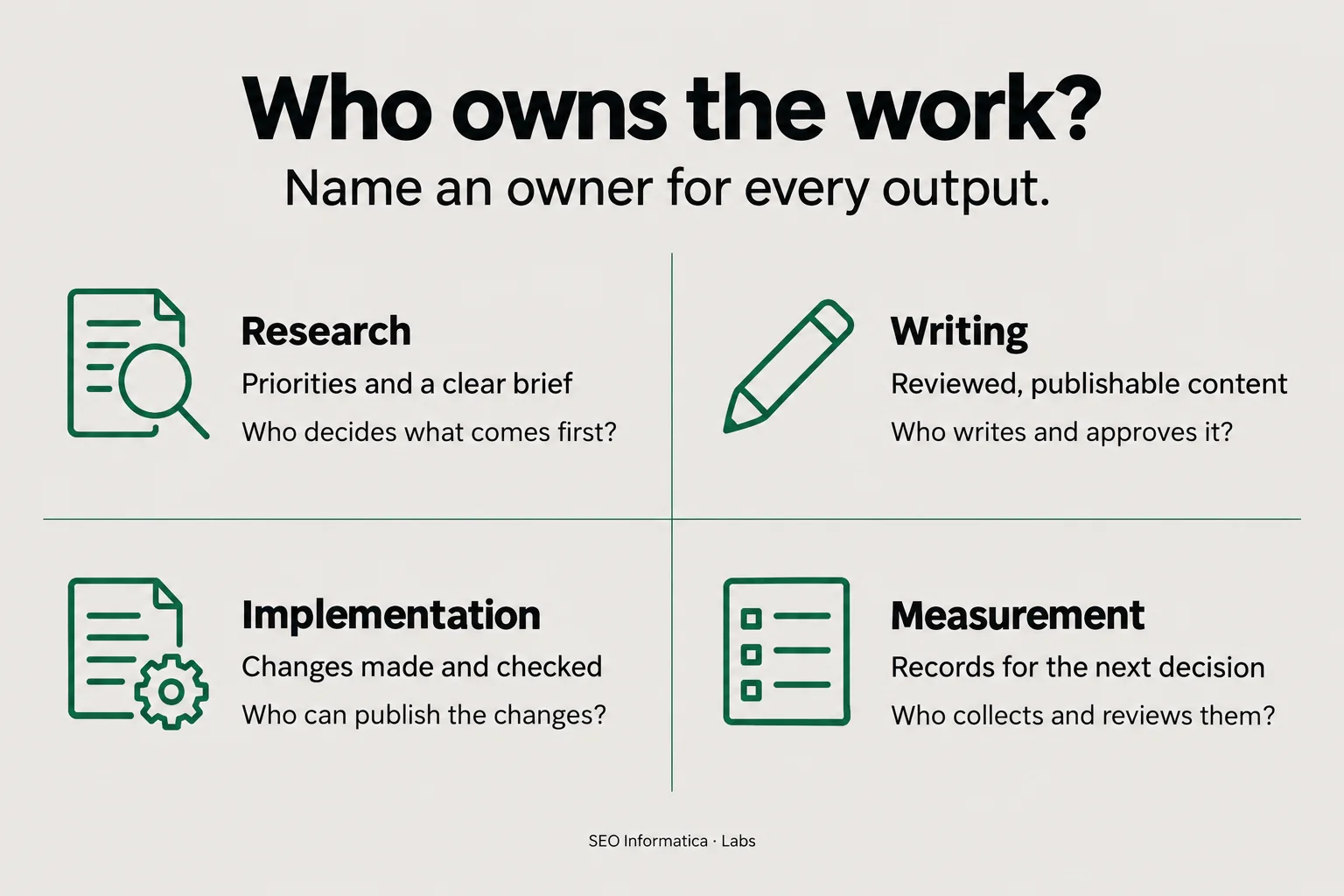
Name an owner for the work
Open the responsibility infographic full size.
Use these four responsibilities to read the offers above. This is our comparison aid; it is not a certification or a capability score for any company.
| Responsibility | Output and question |
|---|---|
| Research | Priorities and a clear brief. Who decides what comes first? |
| Writing | Reviewed, publishable content. Who writes and approves it? |
| Implementation | Changes made and checked. Who can publish the changes? |
| Measurement | Records for the next decision. Who collects and reviews them? |
The agency may perform a task, your team may perform it, or the work may be shared. Name the owner and the approval dependency. A recommendation document is useful only if someone has the capacity and authority to act on it.
A worked example: the team has expertise but no developer capacity
Consider a hypothetical B2B software company with clear positioning and subject experts available for review. It wants useful content and agreed website fixes delivered, but has no spare developer capacity. This is an illustrative brief, not a client story or a record of conversations with the providers.
The technical-execution filter surfaces records whose reviewed pages describe implementation. Omniscient Digital, iPullRank, DEJAN and WebFX are among those conversations; our disclosed entry also describes agreed implementation. That creates a set of questions, not a finding that any provider will accept the work, cover the required platform or deliver equally. The desk leaves every provider unselected.
The first question would be concrete: will your team implement and check the agreed website changes on our platform, or does your scope require our developers? We would also establish which expert inputs and approvals the company must provide.
A proposal that leaves the necessary deployment with the client’s unavailable team would not solve this brief. A higher visibility forecast would not change that dependency. If the investigation instead shows the work is mainly research, content and distribution, Siege’s published offer would be relevant to examine too.
The shortlist changes with the work and available people. Once written scopes arrive, use the existing proposal comparison worksheet to compare the actual commitments.
When enterprise or industry needs change the shortlist
An enterprise brief should identify the websites, brands, markets and internal teams involved. Ask how the provider works with your CMS and engineering process, coordinates approvals and reports to different stakeholders. Request an example with comparable complexity, rather than treating a familiar client logo as sufficient evidence.
Industry fit needs similar precision. Relevant product or subject expertise, claims review and publication workflows may matter more than an “AI SEO for your industry” heading. Ask what the provider has actually delivered in that context, what the client supplied and which parts transfer to your situation.
Country and language coverage also require confirmation. An international service description does not settle availability, local expertise or the languages included in a particular engagement.
Use the deployment planner to keep the collection scope, account requirements and implementation owners together. The purchase decision guide helps check the contribution needed to recover the proposed spend.
Move from a list to a useful conversation
Write a short brief naming the priority, missing responsibility and available internal capacity. Use the linked provider sources and evidence download to identify plausible conversations. Then compare written answers on the same terms.
Compare the total commitment, too: included outputs, your team’s time, publishing access, placement or software charges, contract terms and handover. A quoted fee without those details is not a comparable scope. A broad list of services does not establish that your proposal includes them.
Our hiring guide and worksheet cover proposal evaluation. The cost guide explains how software, advice and implementation differ, and the timeline guide separates work delivered from later results. If the terminology is still unclear, begin with what AI SEO means.
A useful choice is the provider and scope your business can put to work. This comparison supports that investigation; it does not replace it.