

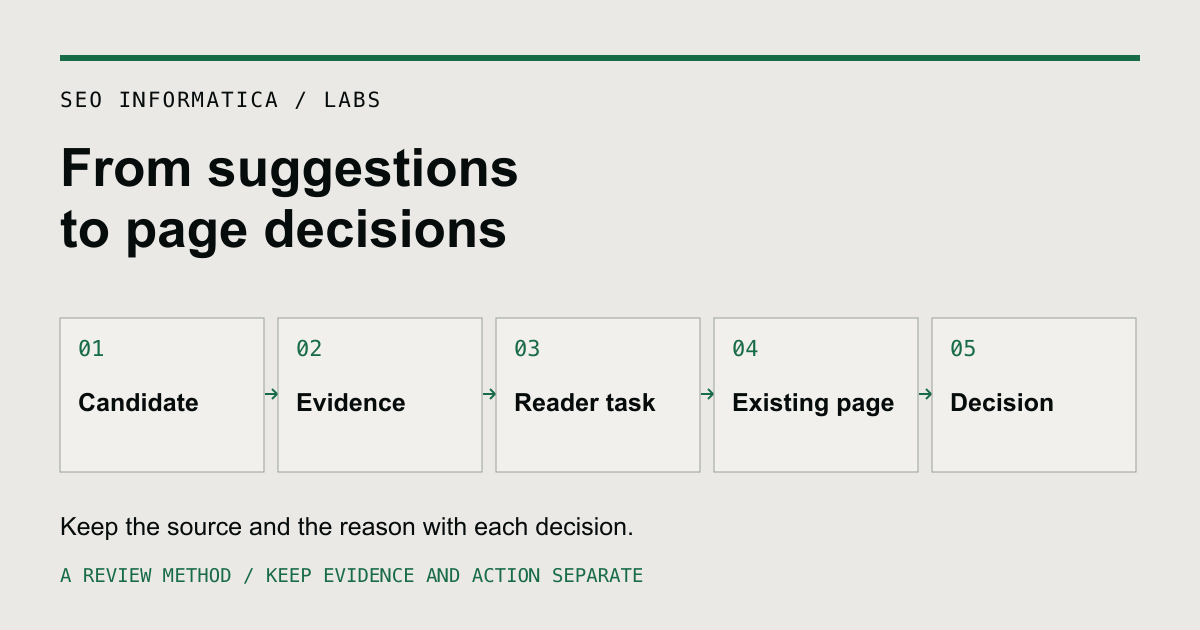
AI keyword research uses AI to suggest phrases, organize supplied queries or examine possible reader needs. A suggestion becomes useful research when you can explain where it came from, what evidence supports it and what decision follows.
Start with a reader’s problem and your existing pages. Ask for candidates. Then check the phrases against search evidence and your own coverage before deciding whether to investigate, improve an existing page or propose something new.
This guide includes a retained 30-candidate exercise, its original prompt and response, and a downloadable decision record. You can inspect what the model proposed and where the review changed the next action. No search volumes or changes in our site’s rankings or traffic were measured in the exercise.
What AI can help with, and what still needs evidence
An AI-assisted workflow can produce alternative phrasings, questions to investigate and a first pass at grouping. Those outputs are useful starting material. A plausible phrase does not establish how often it is searched, which result format satisfies it or whether your site needs a new URL.
Keep four kinds of input separate:
| Input | What it establishes | What to retain |
|---|---|---|
| A phrase suggested by a model | An idea worth considering | Prompt, output, product/model label and date |
| A query in your Search Console report | Recorded exposure or activity for your site under those report settings | Property, filters, period, metric and export context |
| A keyword-tool estimate | That tool’s estimate for its stated conditions | Tool, metric definition, market, period and settings |
| A current result-page observation | What one search displayed in a particular context | Exact query, date, language, location, device and result types |
These can support the same investigation without becoming interchangeable. Your site’s query report is not the whole market, and a manually observed search result is not a demand estimate. Search Console also omits some queries for privacy and has reporting limits. Google’s query-data documentation.
A workflow you can repeat
1. State the reader task and collect your existing owners
Write one sentence describing the decision you want to help someone make. “Choose a suitable research tool” is more useful than “cover AI SEO.” Add the relevant existing pages and a short description of each page’s job.
In our exercise, the inventory included separate owners for definitions, tool selection, provider selection, statistics and citation tracking. That gave the model context for suggesting where a candidate might belong. A summary is still a limited input: the later review needs to read the actual pages.
Use search queries, customer questions or editorial seed ideas as inputs, but identify which kind you have. A question from one conversation can justify answering that person. It does not automatically establish broad search demand.
2. Ask for candidates and the next evidence check
A useful instruction is:
For each candidate, state the likely reader task, a provisional page action, a relevant existing page and the evidence needed before accepting that action. Do not invent demand or ranking data. Different wording may belong on the same page.
The complete retained prompt includes the inventory, six seeds and output requirements. It requested 30 candidates. It did not ask for a keyword score or a finished publishing calendar.
If a tool reports a metric alongside generated ideas, check where that metric comes from. An integrated keyword database and the language model’s suggestion are different parts of the workflow.
3. Check the evidence that could change the decision
For a proposed instructional article, inspect the actual results. Are people being served tutorials, software, service pages, discussions or a mixture? Read the destinations. A title alone may hide a different task or a thin answer.
For the exact query “ai keyword research,” our US English desktop sample on 6 October 2026 included tool destinations, a tool comparison, a how-to guide and a discussion. The location footer showed New York 10007 and Google displayed “Results are not personalized”; the browser was signed in. This is a dated location sample, not a universal US ranking. It supports a practical instructional contribution, while acknowledging that some readers want a tool. It does not establish that every related phrase shares that intent.
Record exact-query observations separately from evidence for a related query. If you have not checked a variant, say so. You can still make a provisional ownership decision from the page inventory, while leaving search intent and demand unresolved.
4. Interpret keyword metrics before using them
Google Keyword Planner’s monthly-search metric includes close variants, uses the selected period and targeting, and is rounded. Its competition field concerns advertisers, not organic ranking difficulty. Advertising forecasts should not be relabelled as expected SEO visits. Google’s metric definitions.
There is also a less obvious export issue. Google says that Search Console values displayed as ~ or -, meaning unavailable or not a number, become zeros when exported. An exported zero therefore needs its report context. Search Console export guidance.
For each useful metric, save its source, settings and date. If you did not collect it, use “not collected.” If a provider has no value, record that condition. Neither means you have proved zero demand.
5. Check whether a useful page already owns the task
Ask whether the candidate requires a materially different answer, audience or decision. A wording variation alone is a weak reason to publish another page.
For example, a question about choosing an AI SEO provider may belong in a provider guide even when the phrase contains “best.” A question about keeping a repeatable citation log may belong in an existing tracking method. First inspect the answer already available and the missing information.
The intent-routing method covers page roles and overlap in detail. Use this research record as its input, rather than asking an AI cluster label to make the final architecture decision.
6. Keep the decision and the unresolved work
End each row with one useful next action: investigate, review an existing page, group with another candidate, propose a distinct page or defer. Name the supporting evidence and the question that remains.
“Review the tools page for an evaluation checklist; exact-query results not yet checked” is a usable handoff. “Publish an AI tools article” hides both the existing owner and the uncertainty.
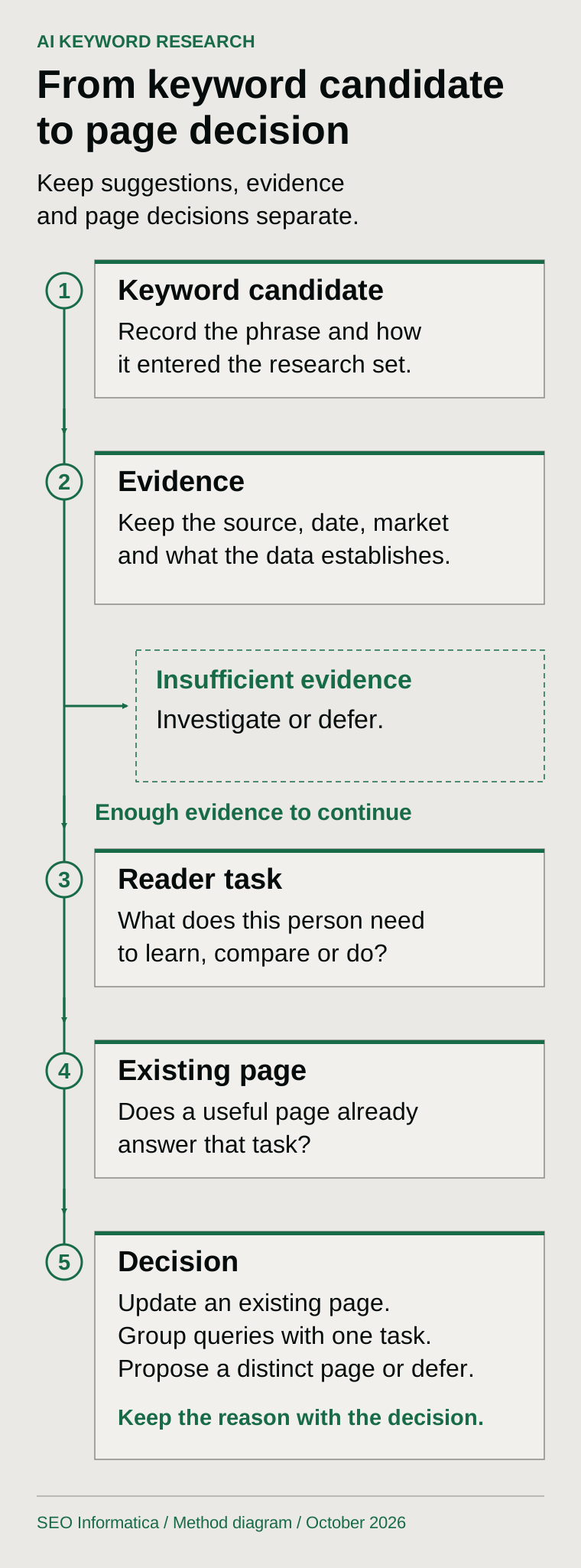
Keep each suggestion connected to its evidence and page decision. When the evidence is insufficient, investigate or defer. This diagram describes a review method, not measured keyword demand or a ranking score.
Open the keyword review diagram. In text: record the candidate and its origin, check what the evidence supports, identify the reader task, inspect existing coverage, then choose the next action. When the evidence cannot support that action, investigate further or defer it.
The retained exercise: 30 candidates, with the decisions exposed
We supplied six editorial seed phrases and summaries of 11 existing SEO Informatica pages to one new ChatGPT conversation on 6 October 2026. The interface showed Latest, 6 and Pro; the exact backend snapshot and generation settings were not exposed. The prompt asked for no browsing, tool use or personal-memory context. Account-level settings were not independently audited.
The response was retained before the review. Six phrases were supplied seeds and the remaining candidates were generated suggestions. None came from a keyword-volume export. The example illustrates a review process, not a comparison of models, a time-saving study or a ranking experiment.
The record distinguishes three questions:
- Did the suggestion describe a plausible reader task?
- Does the inspected site already have a relevant owner?
- Was the exact query checked, or is the decision still based on related evidence or the inventory alone?
Open the keyword decisions above to compare the original proposed action with the resulting decision and next check. The complete row set is also available as CSV and JSON. Each row retains its provenance, evidence scope and unresolved work.
The two new-article topics had their exact queries observed in the dated US sample. The other 28 candidates do not inherit that status. Ownership review is a separate check, and it does not authorize a new page or prove demand. The two article topics were editorial candidates before the model run; the response did not independently discover this batch.
Four decisions worth inspecting
| Retained row | What the model proposed | What the review established | Decision and remaining check |
|---|---|---|---|
| K01, “ai keyword research” | A possible workflow article, after checking instructional versus tool-selection intent | The exact sample contains both, and the inspected inventory lacks a retained end-to-end research example | Propose one practical guide. K02/K03 can be related sections provisionally; their exact queries were not checked. K05’s service-business application needs more investigation. |
| K22/K23, adoption statistics and AI-versus-human content statistics | Review the existing statistics page and inspect appropriate original studies | The eight-finding reference explicitly does not supply adoption or AI-writing return estimates | Defer these additions until suitable studies and a scope decision exist. The existing page’s general title is not evidence that it answers them. |
| K28, “ai mentions vs citations” | Use the monthly tracking page | That page records both. The AI SEO definition explains the distinction itself | Refine the primary route to the definition, then use the tracking method for the practical record. This is an ownership judgment, not a measured ranking finding. |
| K13, “ai writing tools for seo” | Investigate; writing assistants are excluded from the current tools comparison | The stated exclusion is accurate. Reviewing generated claims is also a different task from comparing writing products | Preserve the boundary and defer a new comparison until its research and product evaluation are done. |
The model was already cautious. These are the results of carrying out its suggested checks, not a collection of invented failures. Across the retained review there are two distinct-page proposals, five candidates grouped with another candidate, thirteen existing-page reviews, six investigations and four deferrals. Those categories describe next actions, not demand or model accuracy.
The source and inventory checks in this teaching record were assisted by Codex. The downloadable record keeps reviewer status explicit; a reader must obtain the responsible editor’s approval before turning a proposal into a publishing instruction.
For the full method, inputs and unedited response, download the keyword evidence pack. The pack preserves the original response even where the later review makes a different editorial decision.
Make your own working record
Use the blank CSV worksheet or blank JSON record, or add working notes in the review table. Start with a manageable set that you can actually inspect.
For each candidate, record its origin, the model’s suggestion if relevant, your reviewed task, the existing page, evidence date and market, the decision and the next action. Keep a metric’s source and settings attached if you add one. Preserve unfinished rows; they show what the next researcher still needs to do.
Your notes in the page stay in the current session and are lost on reload. Download them before leaving. The worksheet records your judgments; it does not look up volumes or verify your sources automatically.
Questions that change the workflow
Can ChatGPT replace a keyword research tool?
It can help generate and examine candidates. For measured or estimated demand, use a documented data source and retain its conditions. If a product connects a model to keyword data, inspect that connection and the metric definitions. A confident sentence is not a data source.
Should every AI keyword cluster become an article?
No. Check whether the same page can satisfy the actual reader tasks. Review search evidence, the site’s existing owners and what a distinct page would contribute. A proposed cluster is a hypothesis about organization.
Can we work without search-volume data?
Yes, provided the decision states what it relies on. A clear user question, a missing explanation and a relevant existing owner can justify editorial investigation. Do not turn missing volume into a fabricated estimate or a claim that nobody searches for the topic.
How do we know whether the process helped?
Measure the work you actually performed: candidates checked, decisions revised, useful gaps identified and preparation plus review time. If you want to compare efficiency, retain a comparable baseline. Later search impressions, visits and enquiries are separate outcomes with other influences.
For software that measures visibility or helps diagnose pages, use the scoped AI SEO tools guide. It is not a comparison of keyword generators. If research is becoming a draft, continue with reviewing AI-generated content for SEO before treating its statements or metadata as publication-ready.