

AI-generated content can be useful for SEO when it helps someone and survives factual and editorial review. The production method does not establish whether a page is accurate, original or worth publishing.
Start with the statements a reader might rely on. Find their sources, check what those sources actually support, and record the decision to keep, qualify, correct or remove each claim. Leave unresolved material visible in the review until someone can settle it.
This guide explains the search-policy boundary and a review method you can repeat. Its teaching exercise concerns a short explanation of keyword metrics. It is separate from client copy, and it does not test rankings or measure a model’s general accuracy.
What Google’s guidance says
Google’s 2023 explanation of AI-generated content does not prohibit appropriate AI use or give it an automatic ranking advantage. Its current generative-content guidance, checked on 6 October 2026, calls for manual accuracy review and useful content.
The relevant distinction is the work’s purpose and value. Google’s scaled-content-abuse policy concerns many pages created primarily to manipulate rankings rather than help users, regardless of how they were produced. It gives no safe AI percentage or publishing quota.
That leaves an editorial decision. Does this page answer a real question with reliable information and a useful contribution? A source list can help a reader inspect claims. It cannot make a repetitive page useful by itself. Google’s helpful-content guidance specifically distinguishes attribution from original effort.
Use the method below to make that decision inspectable. It is our working approach, not a Google approval test.
Review claims before polishing sentences
A fluent paragraph can contain several different kinds of statement: a definition, a number, an explanation of cause, a recommendation and a claim of experience. Review them separately. Editing the paragraph’s tone does not resolve whether its evidence fits.
1. Keep the original input and output
Save the draft before correcting it. Retain the prompt, supplied sources, date and product or model label actually exposed. Mark unavailable settings as unavailable. If the tool used browsing, retrieved material or account context, record what you can verify about that access.
This record lets a reviewer distinguish the supplied facts from the model’s additions. It also prevents a revised source pack from quietly changing the standard against which an earlier answer is judged.
Use a new version when a source changes. Preserve the earlier version alongside the output it informed. The purpose is a traceable decision, not a collection of screenshots with no explanation.
2. Split the draft into checkable statements
Give each substantive claim an ID and copy its exact wording into a review row. Identify where it appears: body, title, description, image text or structured data.
Split a sentence when its parts need different evidence. A reported result and the explanation offered for that result are separate claims. So are a tool capability and a claim that the capability improves rankings.
Do not mistake a recommendation for a measurement. You can suggest a sensible next check while clearly identifying it as editorial advice. A claim that a process saved time or improved performance needs an actual observation supporting that result.
3. Open the source and check its scope
Record a source URL and the relevant passage, table or documentation section. Check the original publisher when possible. A citation at the end of a sentence is a pointer to inspect, not proof that every part of the sentence is supported.
For a metric, inspect what was counted, the population, the period, the comparison and any missing information. For a product statement, check whether the documentation describes the relevant feature and version. For first-hand experience, locate the retained work that establishes it.
A statement outside the supplied source pack may still be correct. Verify it independently and record the additional source. Do not silently add that source to the original model input or label an unverified statement false merely because it was absent from the pack.
4. Choose an action and explain it
| Action | Use it when | What the record should show |
|---|---|---|
| Keep | The wording is supported and fits the page’s purpose | Source, scope and why no correction is needed |
| Qualify | The main point is supported but a condition is missing | The missing boundary and revised wording |
| Correct | A check establishes a factual or interpretive error | Original wording, evidence and correction |
| Remove | The claim is unnecessary or cannot responsibly remain | Reason for removal and any useful material retained |
| Investigate | Available evidence cannot settle the claim | Keep its status unresolved and record the next check or responsible person |
These actions are not grades. Several supported rows do not cancel out one unsupported claim that materially changes the reader’s decision. Keep uncertainty attached to the particular statement rather than burying it in a general disclaimer.
5. Review the assembled page
Read the revised page as a reader would. Have the corrections changed its meaning or created a contradiction? Does a conclusion go further than the individual sources? Can the reader distinguish an illustration from an observed result?
Then ask what the page contributes. A worked comparison, an explanation of a difficult distinction or a usable decision record may help someone act. Repeating the same advice with different wording may add little.
For the structure of an individual section, use our answer-block framework. For source presentation, use the answer-source format. Those methods complement this review; they do not replace evidence checking.
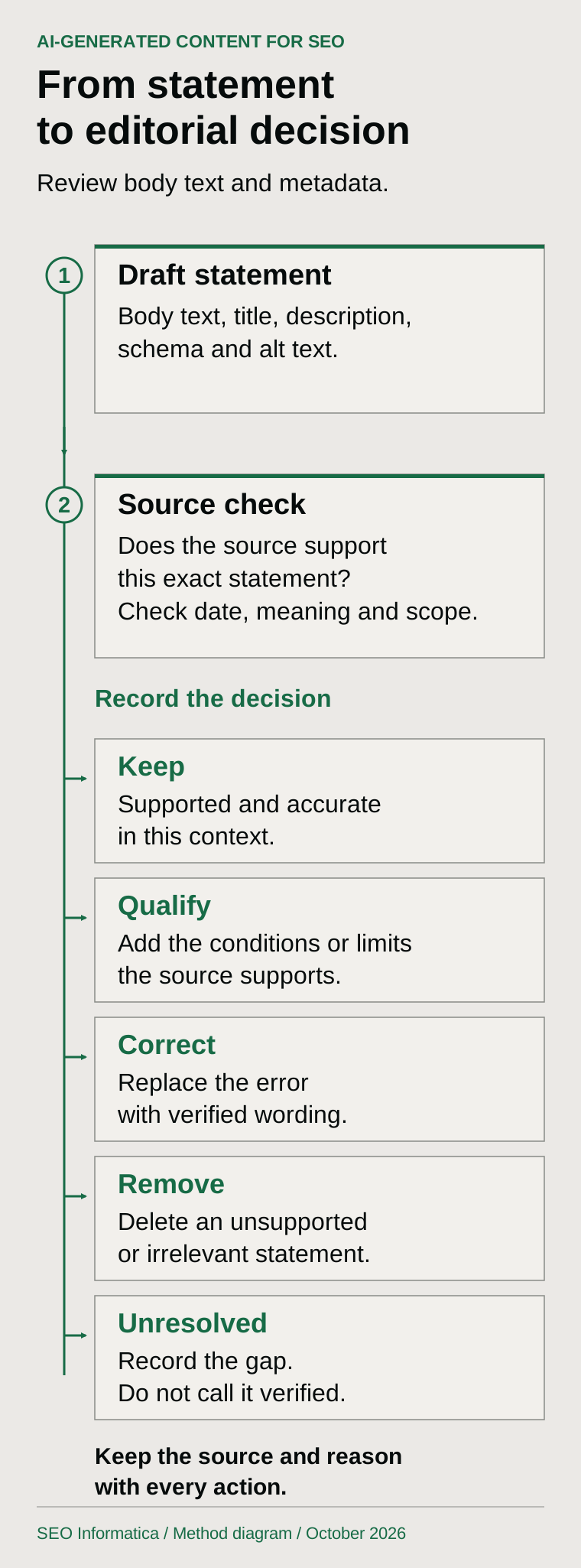
Review titles, descriptions, schema and alt text alongside body claims. Keep evidence status separate from editorial action. Unresolved is a status requiring a next step, not publication approval. This diagram does not automatically establish that a whole draft is factual or ready to publish.
Open the full-size claim review diagram.
The diagram follows the same sequence: capture the statement, inspect its source, check its scope and record an action. An unresolved branch stays open. The workflow includes the visible page and its metadata.
A retained teaching exercise: keyword metrics
On 6 October 2026, we supplied ChatGPT with eight factual notes from Google Ads and Search Console documentation. The retained prompt requested a short explanation, title, description, proposed diagram alternative text and two suggested BlogPosting values. No keyword volumes or performance results were supplied.
The composer displayed Pro; a menu inspected before the paired exercises showed 6 with Latest selected. These interface labels do not independently identify the backend model. The prompt requested no tools, browsing or memory, but hidden account settings were not independently verified. One initial response was retained, without a follow-up correction or selecting a preferred answer from several attempts.
Review record: prepared with Codex assistance on 6 October 2026 and accepted for local implementation. No independent human fact-check is claimed. The review contains 22 rows, including body claims and metadata. It retained 20, qualified one and left one unresolved. No factual correction was identified within this supplied scope. These are editorial row counts, not an accuracy rate.
| Example row | Decision | What the check established |
|---|---|---|
| C07: Keyword Planner competition | Keep | The response correctly distinguished advertiser competition from organic ranking difficulty. |
| C13: Average position | Qualify | The supplied wording was supported. We made averaging across impressions explicit using an additional official source. |
| C19: Exported zeros | Keep | The response preserved the specific conversion of unavailable report values during export. It did not label every zero as missing data. |
| C20: Proposed alt text | Unresolved | The keyword-metrics diagram had not been made, so its match with the proposed description could not be checked. |
| C21-C22: JSON values | Keep within scope | Headline and description matched the draft. Two requested strings are not complete or validated structured data. |
The original average-position sentence was:
Average position uses the topmost result for the relevant site or grouping.
The reviewed sentence adds one clarification:
Average position uses the topmost result for the relevant site or grouping, averaged across impressions.
Google’s metric documentation supports that addition. The source was added during review, with the frozen model input preserved. It is a precision edit, not evidence that the original claim contradicted its source.
The full record also changes the proposed alt text’s punctuation for house style while leaving the image check unresolved. That proposed metrics image is separate from this article’s claim-review diagram. The remaining wording was retained. The title, description and JSON values did not need a forced correction to make the exercise interesting.
Inspect the complete response, reviewed version and source pack in the bundle below. This carefully bounded example does not establish how the product performs without supplied facts, on other subjects or at scale.
Include metadata in the decision
Google’s current guidance extends factual review to titles, descriptions, structured data and image alternative text. A cautious body paragraph does not justify an exaggerated headline.
Check that the title describes what the page actually establishes. Check that the description preserves its scope. Inspect suggested structured-data values against the visible content and the feature’s requirements; a plausible-looking JSON object is not a completed markup validation.
Review image text against the actual image. Proposed alternative text for an unmade diagram remains a proposal. Once the asset exists, verify that the description conveys the diagram’s real purpose and content. Do not describe an illustration as measured evidence.
Treat scores and detectors as limited inputs
A content score needs its own definition. For example, Ahrefs describes its content score through topic coverage against comparator pages. That is not a factuality certificate. We have not tested its scoring in this exercise.
An authorship detector answers a different question again. OpenAI’s guidance for educators reports false positives and reliability concerns in its research, while declining to assess other developers’ tools. That is a reason for caution, not a universal accuracy finding about every current detector or evidence about Google’s internal systems.
Here, provenance comes from retaining the run. Factual support comes from checking claims. A detector result cannot take either record’s place.
Explain the process honestly
Google’s authorship and process guidance recommends explanation when readers would reasonably expect it. Its 2023 FAQ does not prescribe one universal AI badge. Merchant Center has separate rules for generated product data; those should not be presented as general article requirements.
For a teaching exercise, make the method clear: what went in, what came out, who checked it and what remains unsettled. Do not invent experience or a reviewer identity. Keep the raw response distinct from approved copy.
When preparing your own page, identify the person who can approve its business facts and the person responsible for the final editorial decision. Our service-page brief helps gather those inputs. If you are still choosing the subject, start with AI keyword research.