

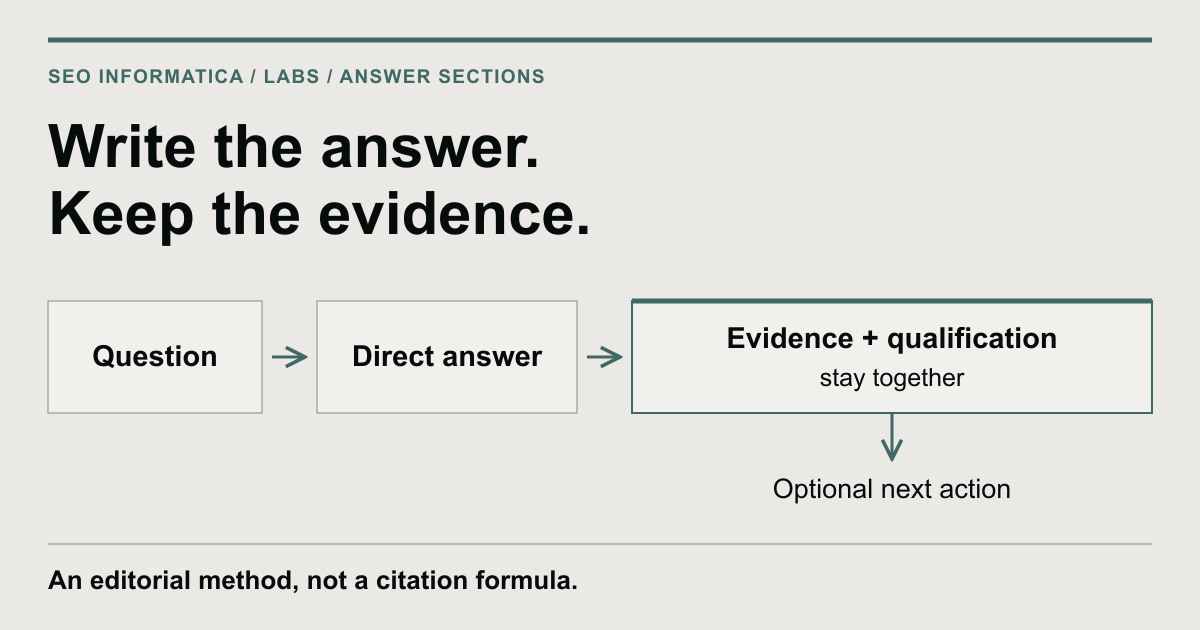
A shorter answer can become a less accurate answer. Remove “starts from” from a price, detach a research limitation or turn a suitable audience into an exclusive rule, and a tidy paragraph can change what the source actually says.
Use an answer block to help someone settle one question while keeping those conditions in view. The task is to choose and organize checked material, then read the section in its page context. If the underlying claims are still uncertain, begin with the content claim review.
The worked examples above use our own service and research pages. They show editorial choices you can inspect, including places where the source was already sound. They are not before-and-after performance results.
What belongs in an answer block?
Start with the question the reader needs answered. Give the direct answer, attach the evidence and conditions that support its meaning, and add a useful next action only when one is needed.
| Part | What to write | What to check |
|---|---|---|
| Question | One real decision, doubt or explanation | Does this question belong on this page? |
| Direct answer | The clearest supported response | Does it still mean what the source means? |
| Evidence | The relevant source, observation or approved business record | Does it support this particular statement? |
| Qualification | Scope, date, exclusions or uncertainty that affects interpretation | Would removing it change the reader’s decision? |
| Optional next action | A source, deeper explanation or appropriate action | Does it answer the reader’s remaining need? |
A process description can explain what you do. A checklist can help someone inspect their own page. Neither automatically substantiates a claim that your work improved results. Match the evidence to the claim: a price needs the approved offer and scope; a performance result needs a dated measurement with the relevant population and comparison.
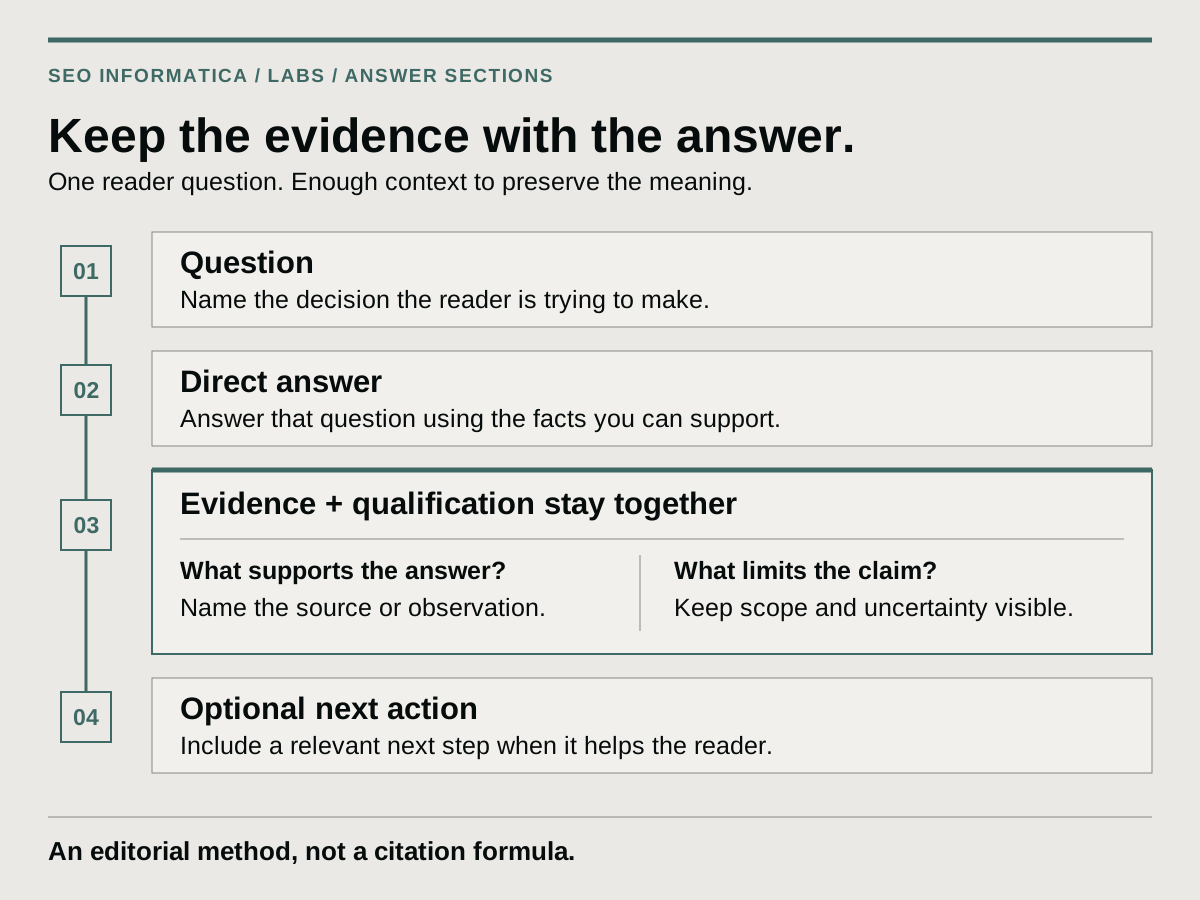
The diagram keeps evidence and qualification beside each other because they determine how the answer can be used. A link to a study does not repair an overstatement in the sentence above it. Open the full-size diagram.
Use a structure, not an AI citation recipe
Google’s current AI optimization guidance emphasizes useful, original contributions and readable organization. It does not recommend splitting content into prescribed tiny chunks or targeting an ideal word count. Its guidance describes Google Search; it is not a universal specification for every assistant.
This framework therefore has no word threshold, citation score or required number of questions. A comparison may need a table. A condition may fit in a sentence. A complex explanation may need several sections. Choose the form that makes the answer usable without stripping out its meaning.
FAQs are one possible format. Repeating the same questions across pages does not establish that each page contributes something useful. Before adding a question, identify what the reader will learn here that the surrounding page has not already answered.
Three teaching adaptations from retained sources
The composer contains three complete examples, with exact source passages, adapted fields and an explanation of the changes. The teaching examples were prepared on 6 October 2026 from our published material. No independent human fact-check or performance experiment is claimed. The source service and benchmark pages remain separate from these teaching adaptations.
1. Pricing: retain what the starting fee means
The AI SEO service FAQ states that the plan starts at $1,111 a month, with three months to begin. It also says the exact fee depends on the layers the business needs and that the proposal names the work, responsibilities and fee.
The teaching section answers the price question early while keeping the initial commitment and scope qualification with it. It does not describe the starting fee as an all-inclusive quote. The optional next action follows the source’s choice: a direct Clarity Call, with the Outside View available as a written first look.
The source already explains those conditions. Reorganizing it is an adaptation, not evidence that it was wrong or that the new arrangement will perform better. Review the exact retained FAQ before using its shorter version.
2. Fit: distinguish a priority audience from an exclusion
The service page describes established advisory, consulting and other B2B service firms as the first focus. It also welcomes suitable launches, rebuilds, local services and businesses elsewhere. Those statements answer different parts of the fit question.
The adapted section keeps both. Changing a priority audience into an exclusive rule would invent a restriction. It also preserves the source’s distinction between an implementation plan and a monitoring tool or advice for an existing team to execute.
A next action is useful here because a reader may still need to discuss scope. That does not make a contact link mandatory in every section on the page. Keep a source link when the reader needs substantiation; use a service or contact route when they need to act.
3. Research: keep an observation within its method
The crawler-access study reports that all 50 recorded primary service pages answered 200 and had the OAI-SearchBot allowed flag set to true. These are historical responses to the study’s collector and stored permission flags. They are not authenticated visits by those platforms.
The teaching answer puts that distinction in the answer itself. It also retains the robots-response exceptions and the fact that the sample selected accessible sites and did not measure actual citations. A shorter statement such as “all major AI crawlers visited these sites” would claim something the study did not establish.
Use the benchmark methodology and limitations when interpreting the dataset. The example demonstrates how to preserve research context, not how to predict which page an assistant will cite.
Write your own section
Choose one question and gather its source before writing. If you cannot identify the relevant business record or evidence, leave that part unresolved. The service-page brief can help gather scope, audience and proof inputs; the keyword research review can help decide which question belongs to which page.
In the composer, begin with an example or a blank draft. Replace the answer, evidence and qualifications together. Keep the source URL and relevant date so another person can repeat the check. Use the reviewer notes for open questions and the person who needs to confirm a business fact.
Read the preview as a buyer would. Does the answer arrive soon enough? Is a condition hidden in the notes when it belongs in the answer? Does the source establish a fact, or merely describe an intention? Is the next action appropriate to the question?
The controls run in this browser and do not send or save your writing. Download the draft before leaving or reloading. The export is a working document, not publication approval. All three examples and the ordinary downloads remain available without the interactive controls.
Review the page around it
A section that reads well on its own can still duplicate or contradict the rest of the page. Check the title, introduction, nearby answers, linked sources and closing action after assembling the draft. Google’s helpful-content questions are a useful final editorial check on contribution and completeness.
Keep the page’s job clear. A service page helps someone understand and assess an offer; a supporting article may answer a narrower research question. A support article ranking above a service page does not by itself establish harmful overlap. Inspect the actual searches and reader decisions before changing either page; the page-overlap guide explains that investigation.
If an assistant later states a business fact incorrectly, keep the answer record and inspect the cited source before changing your copy. The business-information correction guide shows three cases where that comparison leads to different actions. Source maintenance belongs within the wider AI SEO work; a preferred paragraph format cannot guarantee what another system will say.