

If you are a service business, you have probably heard at least one of these:
- Add llms.txt so Google’s AI understands your site.
- Break every page into tiny chunks for AI.
- Rewrite your service pages with AI-friendly keywords.
- Buy mentions so you get cited.
- Add special AI schema.
Most of this is noise.
Google’s own generative AI Search guidance now includes a mythbusting section, and the useful part is blunt: these common “AI Overviews optimization” tactics are not the work that makes a service business easier to find, understand, or choose.
This page is the practical summary for service businesses that want qualified leads, not hype.
If you want the work that actually improves search and AI visibility without gimmicks:
AI SEO: https://seoinformatica.com/ai-seo/
First: AI Overviews are not a separate AI SEO channel
Two points matter before we talk myths:
- AI Overviews and AI Mode visibility still depend on Search eligibility and quality.
- There is no magic file or secret markup layer that bypasses unclear pages.
Google’s guide says its generative AI features are rooted in core Search ranking and quality systems, and that optimizing for generative AI Search is still SEO from Google’s perspective.
If your pages are indexable, clear, and useful, you are doing the core work.
If your pages are scattered, duplicated, or vague, no AI optimization trick fixes that.
Want the 7-minute framing first?
AI Visibility for Service Businesses: https://seoinformatica.com/ai-visibility-for-service-businesses/
The 5 AI Overviews myths to ignore
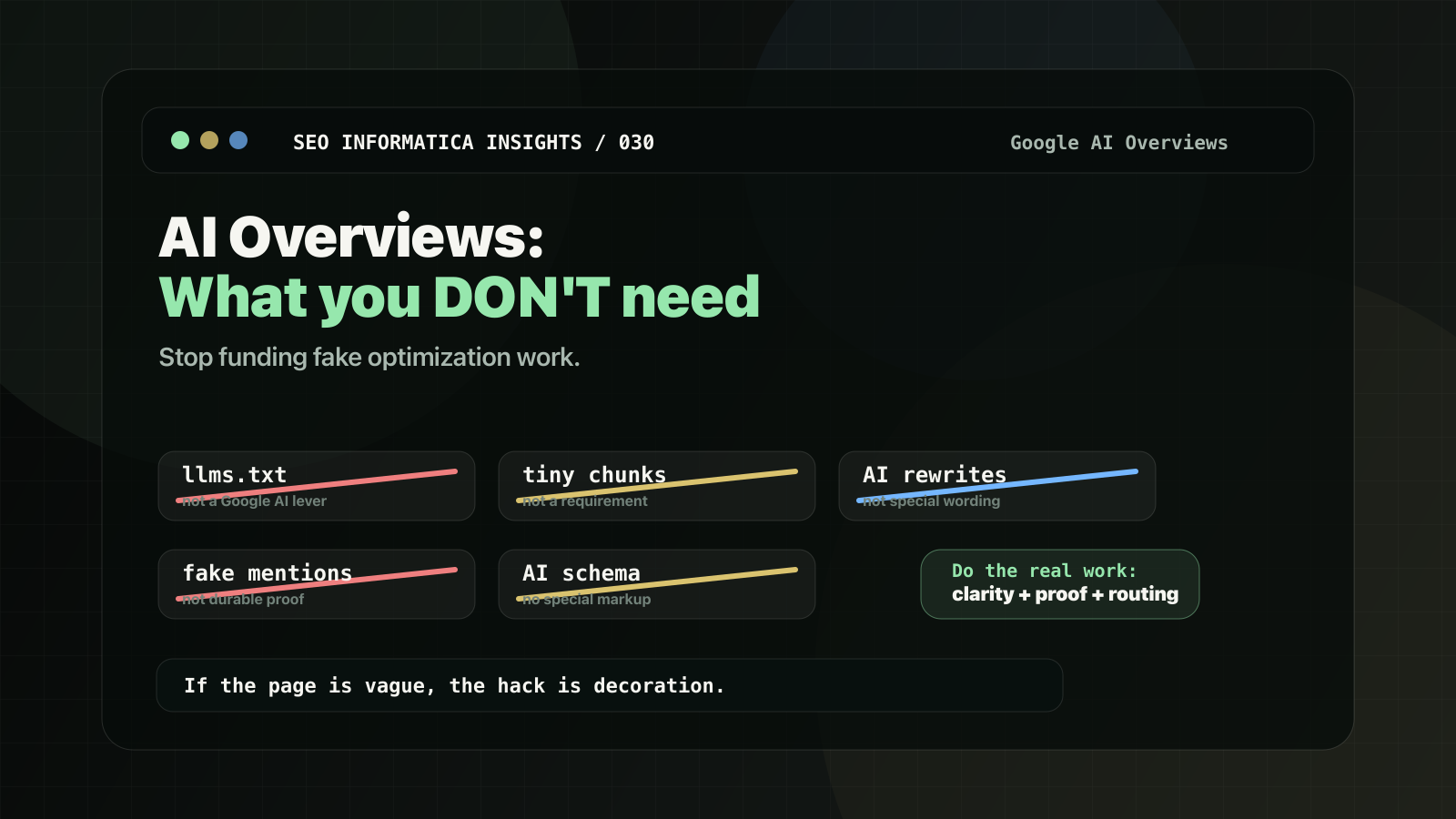
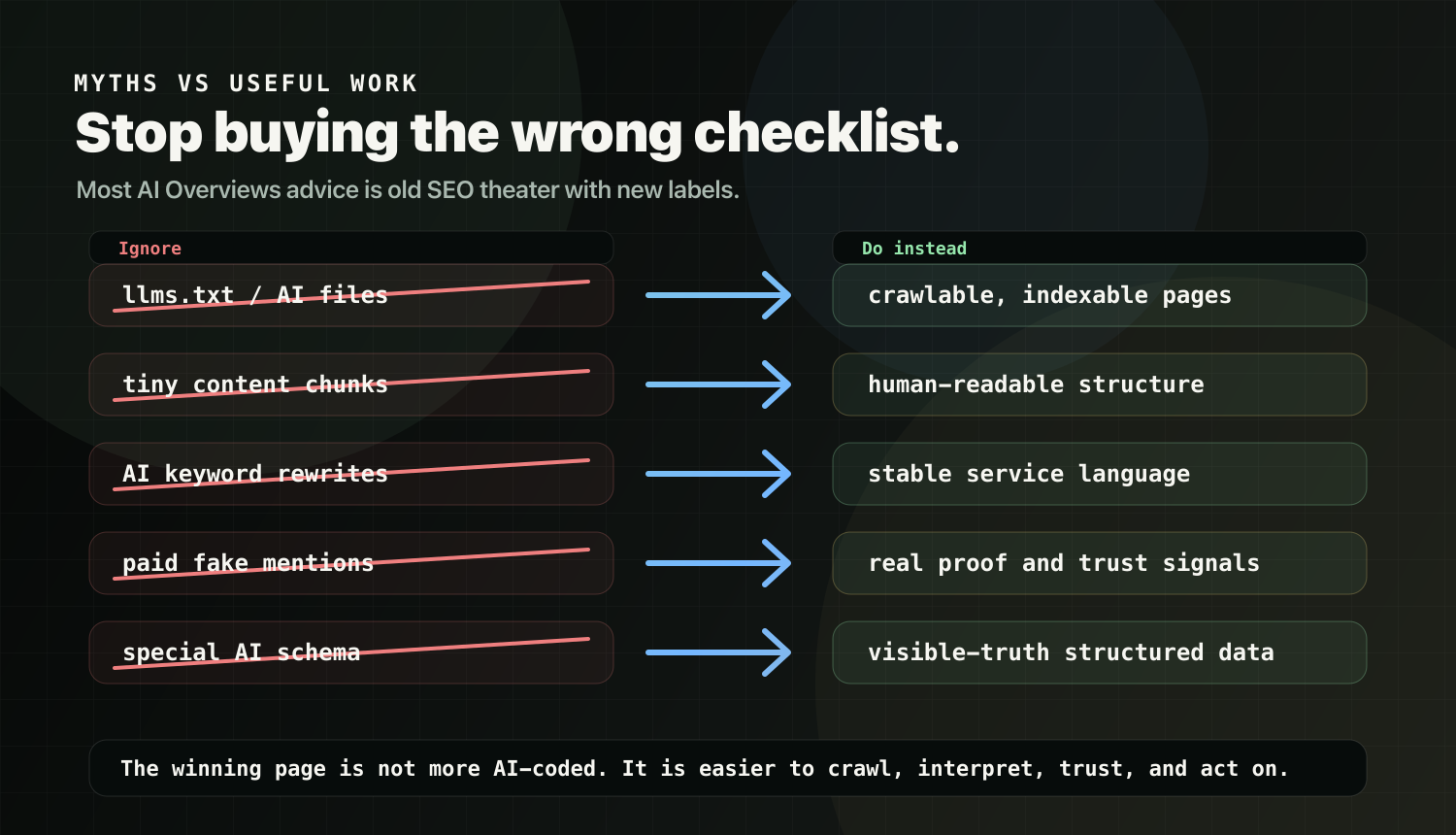
Google’s mythbusting list is useful because it names the exact distractions being sold as “AI SEO”: special files, forced chunking, AI-only rewrites, fake mentions, and special schema.
Here is the service-business version.
Myth 1: You need llms.txt or AI files to appear in AI Overviews
What this usually looks like: someone asks you to publish a new AI-specific file, such as llms.txt, and treat it like a ranking lever.
Reality: Google does not require new machine-readable AI files, AI text files, special markup, or Markdown to appear in generative AI Search.
Do instead: put that energy into pages Google can already crawl, index, and interpret, especially your service pages.
If another agent workflow needs the file, use our llms.txt decision and source-review guide to assess that specific use and its maintenance.
If your foundation is unclear, start here:
Service Page SEO Checklist: https://seoinformatica.com/service-page-seo-checklist/
Myth 2: You must chunk every page into tiny blocks
What this usually looks like: forced micro-sections, unnatural headings, and thin pages split into multiple URLs.
Reality: there is no requirement to break content into tiny pieces for AI. Google says its systems can understand multiple topics on a page and show the relevant part to users.
Do instead: structure pages for humans:
- clear headings,
- clear scope,
- clear decision support,
- clear next step.
Chunking for readability is good. Chunking because someone told you “AI needs it” is usually busy work.
Myth 3: Rewrite your content for AI and chase every long-tail variation
What this usually looks like: rewriting service pages to sound like prompts, stuffing AI Overviews phrases, or creating dozens of near-duplicate pages for query variations.
Reality: you do not need to write in a special way just for generative AI systems. Google’s guidance also warns against creating separate content for every possible variation primarily to manipulate rankings or generative AI responses.
Do instead: rewrite for clarity:
- consistent service naming,
- explicit answers to buyer questions,
- fewer vague claims,
- less overlap across pages.
Related, especially if you are deciding where to start:
SEO Audit vs SEO Diagnosis: https://seoinformatica.com/seo-audit-vs-seo-diagnosis/
Myth 4: You need to manufacture mentions so you get cited
What this usually looks like: paying for low-quality PR, spammy listicles, fake forum chatter, or “mention packages.”
Reality: inauthentic mentions are not a durable visibility strategy. Google’s generative AI features still depend on core ranking and spam systems.
Do instead: earn real signals over time, but prioritize the controllables first:
- site clarity,
- service proof,
- trustworthy process explanation,
- clean internal routing.
If your site already gets traffic but it does not convert, fix the system before buying more visibility:
Why Your Website Gets Traffic But No Leads: https://seoinformatica.com/why-your-website-gets-traffic-but-no-leads/
Myth 5: You need special AI schema for AI Overviews
What this usually looks like: someone sells “AI schema” as a requirement for citations.
Reality: there is no special schema.org markup required for generative AI Search. Structured data can still support normal SEO and rich-result eligibility, but it is not an AI-only lever.
Do instead: keep structured data aligned with visible truth on the page. Do not mark up claims, reviews, services, or FAQs that the reader cannot actually see.
If you need the technical foundation checked, including crawl, indexing, canonicals, duplication, and rendering:
Technical SEO: https://seoinformatica.com/technical-seo/
So what do you actually need?
This post is intentionally the “stop doing this” page.
But here is the short redirect:
If you want a service business to show up more consistently in AI-assisted search experiences, the work usually looks like this:
- Eligibility: indexed, snippet-eligible pages, with inclusion through the Search generative AI control.
- Interpretability: stable service language and clear page roles.
- Extractability: explicit answers, not vague paragraphs.
- Trust: proof where decisions happen.
- Routing: an appropriate next step, including a direct enquiry when the reader is ready.
That is the foundation we build inside:
AI SEO: https://seoinformatica.com/ai-seo/
How to measure AI Overviews impact without buying another tool
Google documents a Search generative AI performance report with impressions for AI Overviews and AI Mode. Those impressions are already included in overall Web Search performance; do not add them again. The report does not provide separate AI click or enquiry attribution, and missing data does not establish zero visibility.
Use the measurement guide and scorecard to read visibility alongside recorded visits, received enquiries and their fit. A citation sample, an impression and a suitable enquiry are different observations.
Can you control what appears in AI Overviews?
In Search Console, check Settings → Search generative AI, including the effective inherited setting. Google’s inclusion-control documentation records worldwide rollout on 31 August 2026. Excluding a site from the covered generative AI features does not change inclusion or ranking in other parts of Search. This is separate from model-training controls.
Crawl access and preview controls still matter. noindex concerns removal from Search; a snippet limit or an exclusion for one section has a different scope. Have the account owner confirm the intended outcome before changing anything.
Use the Google AI eligibility guide to check the current conditions and choose the next action.
Next step: stop the myths, fix the system
If your team is debating llms.txt, chunking or special AI schema, use the eligibility guide to establish what needs checking before choosing more work.
Bring the finding to a free Clarity Call. If you prefer a written starting point, get your free Outside View.
Official references
- Google: Optimizing your website for generative AI features on Google Search: https://developers.google.com/search/docs/fundamentals/ai-optimization-guide
- Google: Search generative AI controls: Control inclusion in generative AI features
- Google: Search technical requirements: https://developers.google.com/search/docs/essentials/technical
- Google: General structured data guidelines: https://developers.google.com/search/docs/appearance/structured-data/sd-policies