

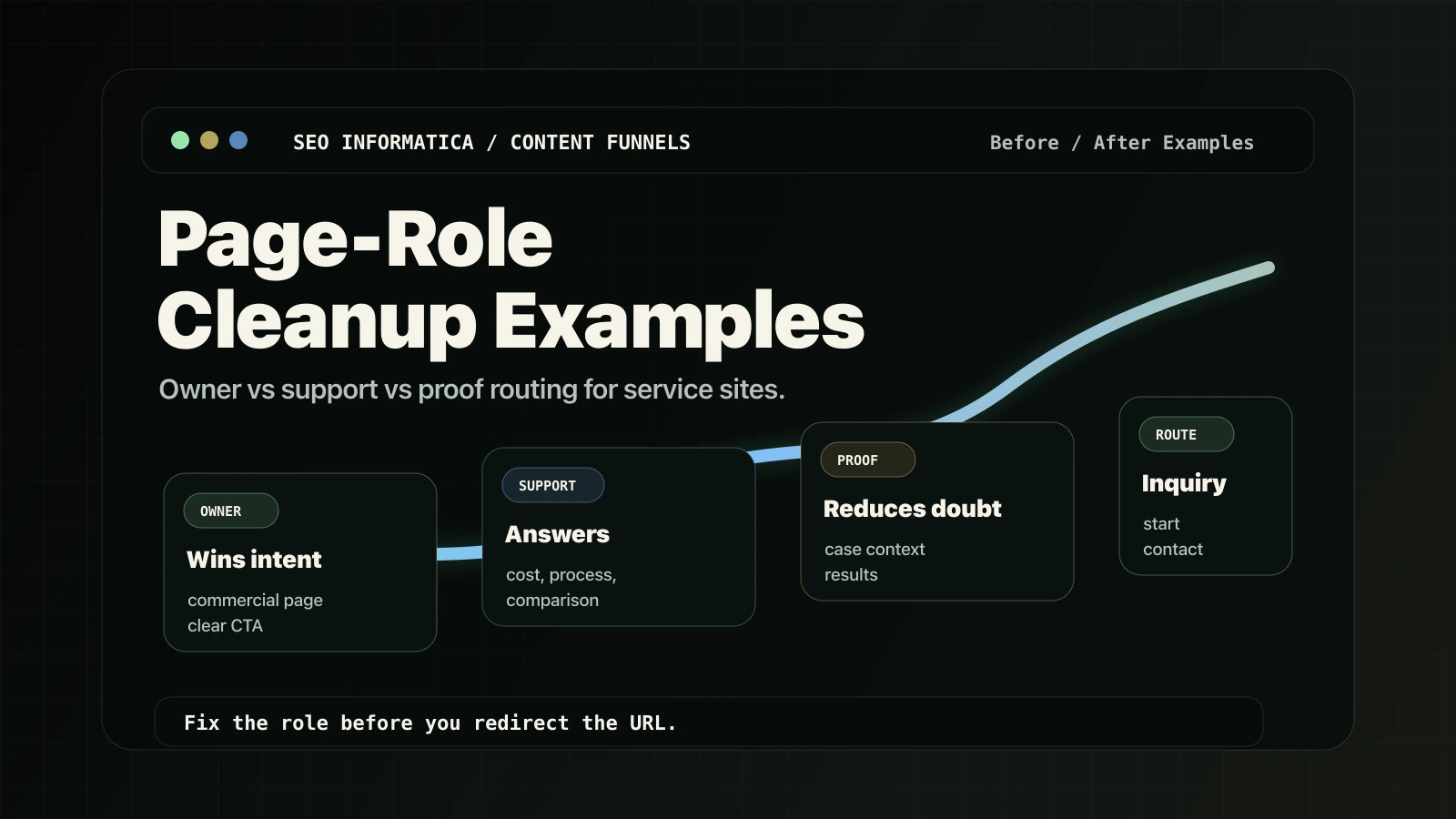
Page-role cleanup fixes overlap when multiple URLs try to do the same job: same intent, same promise, same next step.
The goal is simple:
one page owns the commercial intent, support pages answer adjacent questions, proof reduces doubt, and everything routes toward inquiry.
If you want the full service-page/blog overlap framework first, start with Fix Service Page/Blog Cannibalization.
Diagnosis Summary
- Page-role cleanup is not deleting pages. It is assigning every URL a clear job.
- Fix order matters. Choose the owner first, upgrade it so it deserves the intent, reposition support pages, tighten routing, then consolidate what no longer has a job.
- The owner page should win hire intent. Support pages should answer buyer questions without pretending to be service pages.
- Proof needs placement, not storage. Proof blocks reduce doubt only when they appear near the decision point.
- Routing is the conversion layer. Support -> owner -> proof -> inquiry is the path.
This is also why page-role clarity matters for Search + AI Visibility: the site becomes easier to interpret, cite, and route.
What Page-Role Cleanup Actually Means
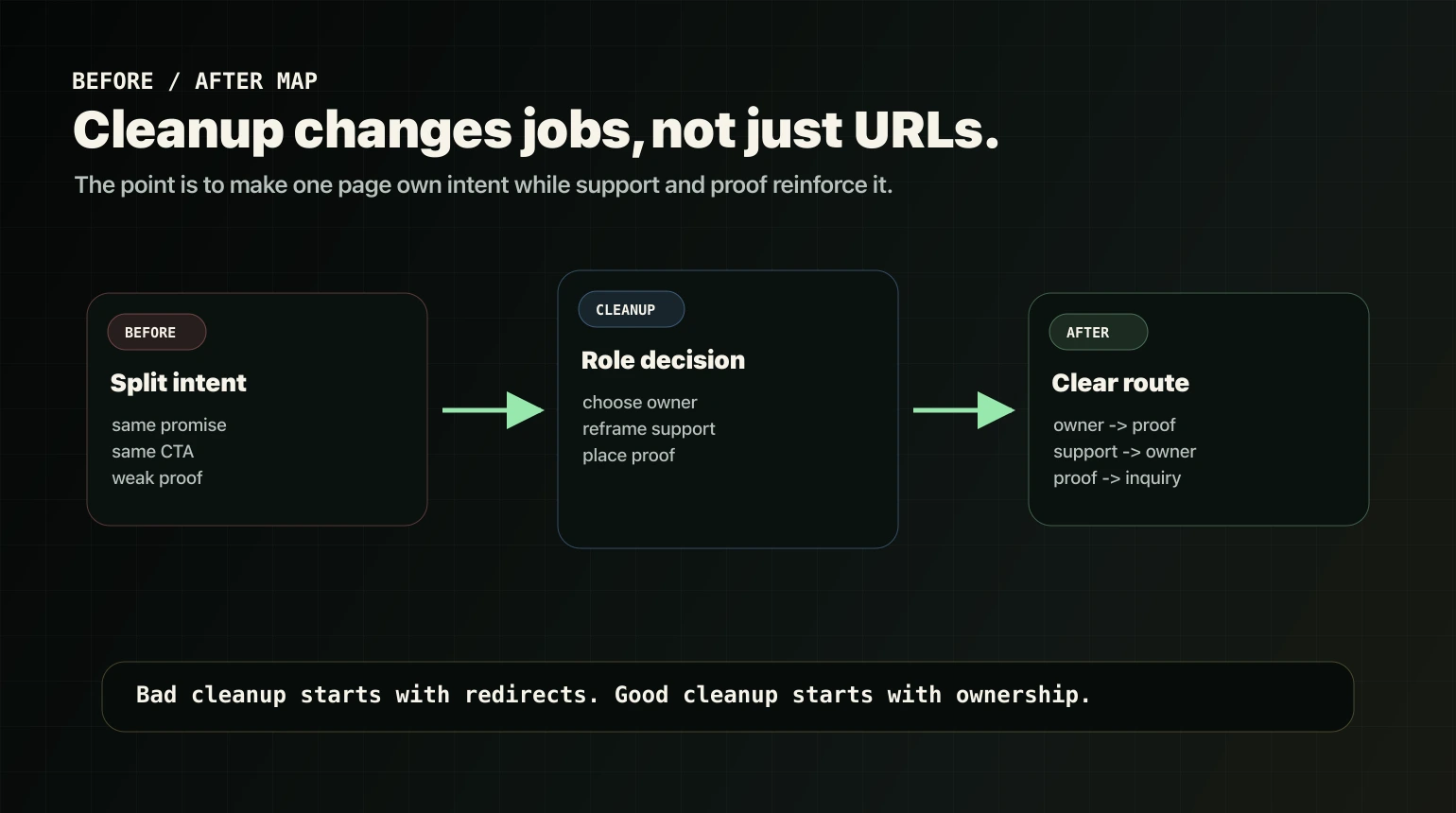
Use four roles to keep a service site clean:
- Owner: the page that should win hire intent for a service or tight service cluster.
- Support: pages that answer cost, comparison, process, mistakes, prep, timeline, and fit questions.
- Proof: case studies, results, testimonials, examples, credentials, and context placed where people decide.
- Router: start, contact, diagnosis, or booking pages that reduce friction.
The cleanup is not finished when the pages are renamed. It is finished when the right page owns the intent and the support pages reinforce it with descriptive internal links.
Fix Order Before You Touch URLs
Most cannibalization fixes fail because the team starts with redirects instead of decisions.
Use this order:
- Choose the owner page first.
- Upgrade the owner page with clarity, process, fit, proof, and a clear CTA.
- Reposition support pages so their intent is clearly different.
- Add routing links from support to owner, owner to proof, and proof to inquiry.
- Only then merge, redirect, or canonicalize what no longer has a job.
If your site gets traffic but leads are weak, this is often the real issue: the wrong page owns the intent or nothing routes to the decision point.
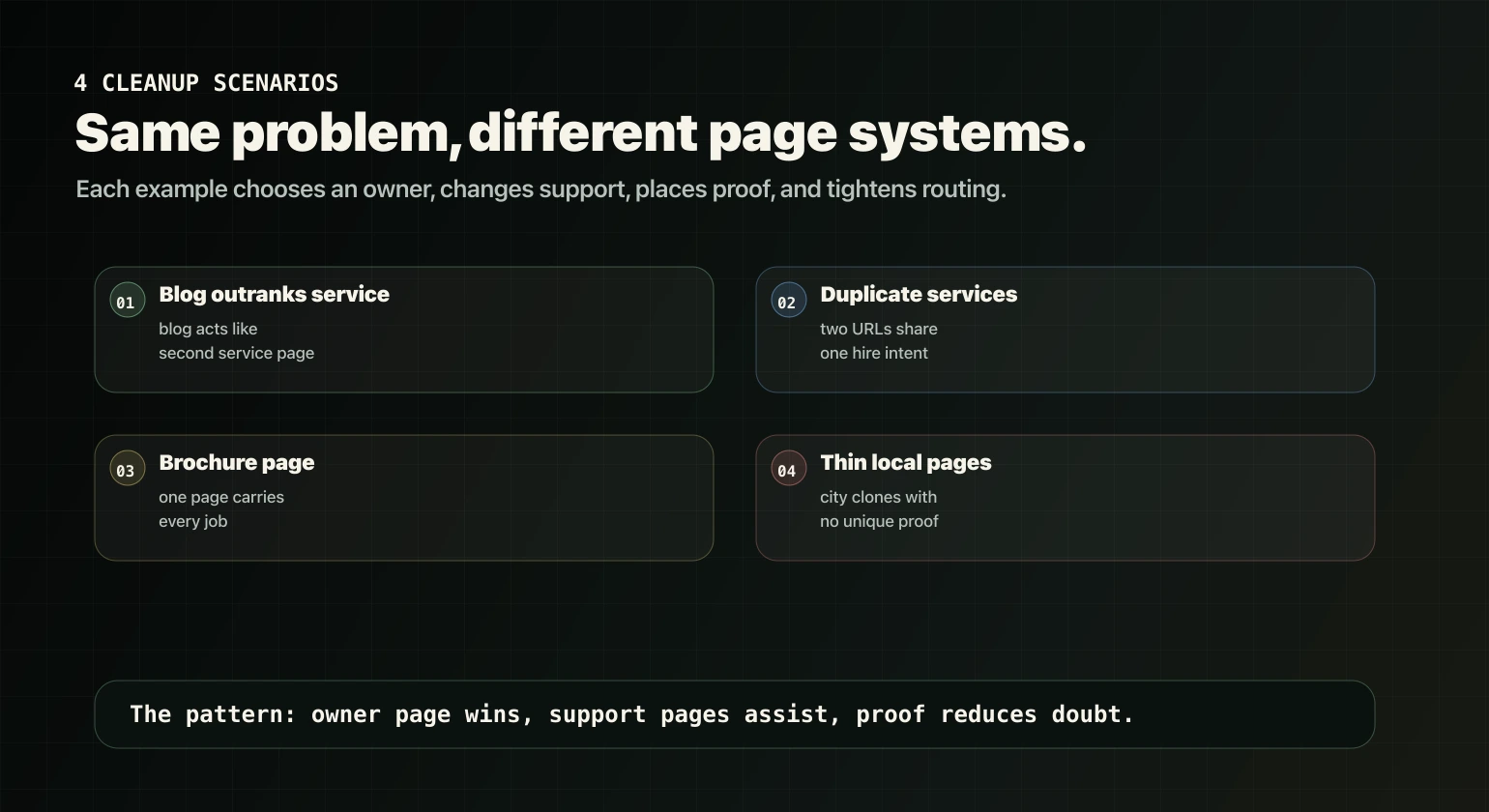
Example 1: Blog Post Outranks the Service Page
Before
- The service page exists, but it is thin, generic, and underlinked.
- The blog post uses commercial language in the title, H1, and intro.
- The blog post acts like a second service page with the same promise and CTA.
- Proof is missing or buried.
After
- The service page becomes the owner with a clear service definition, fit guidance, process, proof, and CTA.
- The blog becomes support by answering a different stage or question.
- Proof appears near the decision point, not only on a separate page.
What To Change
Owner page:
- Make the first screen plain: what you do, who it is for, what outcome matters, and the next step.
- Add process, fit/non-fit, pricing factors, timeline factors, and proof.
- Use consistent internal anchor text pointing to the owner service page.
Support page:
- Change the angle so it is no longer hire-intent.
- Add an early route and an end route to the owner page.
- Use descriptive anchors such as "emergency roof repair service page" instead of "learn more."
If the blog and service page still do the same job after edits, merge the useful material into the owner page and use a permanent redirect. Use the detailed walkthrough in Fix Service Page/Blog Cannibalization and the decision rules in Blog vs Service Page Keyword Placement.
Example 2: Two Service Pages Have the Same Promise
Before
- Two service URLs have near-identical copy and CTA.
- Both target the same hire-intent phrases.
- Rankings switch, or both URLs earn impressions for the same queries.
- Buyers cannot tell which page is for them.
After
- One canonical owner gets chosen.
- The owner is upgraded with distinct scope, fit/non-fit, process, proof, and CTA.
- The other URL becomes a true support page, a proof page, or gets merged and redirected.
- Internal links consistently reinforce the owner.
What To Change
Decide the owner URL based on the commercial intent you want to win:
- Which page should a ready-to-hire buyer land on?
- Which page can you make decision-ready?
- Which URL is already reinforced in navigation and internal links?
Then choose the cleanup move:
- Keep both only if the second page has a different intent or buyer stage.
- Merge when both pages contain useful material for the same intent.
- Redirect when the weaker URL no longer deserves its own destination.
- Canonicalize only for duplicate or near-duplicate variants.
For owner-page quality, use the Service Page SEO Checklist and How to Structure Service Pages for Better Leads.
Example 3: One Brochure Page Is Doing Every Job
Before
- One page carries services, education, proof, FAQs, and every CTA.
- Multiple intents are forced into one URL.
- Support content cannot route buyers into a real decision page.
- The homepage becomes a weak owner for everything.
After
- The homepage becomes an overview/router.
- Each core service cluster gets one owner page.
- Proof destinations support decision points.
- Cost, comparison, process, and mistake content routes into the correct owner.
What To Change
Create a simple page system:
- owner page for the service,
- support pages for buyer questions,
- proof blocks or case studies near the CTA,
- a route into inquiry.
This is the structure behind Content Funnels and the Service Business Content Funnel Map. For larger foundation issues, the Website Rebuild path is usually cleaner than patching one page at a time.
Proof examples:
Example 4: Local City Pages Become Thin Clones
Before
- Dozens of city pages swap city names into the same template.
- Every page routes to the same generic contact form.
- There is no local proof or local decision support.
- The site becomes harder to interpret and trust.
After
- The local architecture matches the business model.
- Real branches, service areas, and multi-location structures get different page roles.
- Only local URLs with a real job stay.
- Thin duplicates are consolidated or removed.
- Local pages route to owner service pages, proof, and inquiry.
What To Change
Keep local URLs only when they provide unique value:
- real location/service coverage,
- relevant proof,
- local decision support,
- a clear next step.
If you are building or cleaning local pages, use Build Location Pages Without Doorway SEO and the Local SEO service overview.
Keep vs Merge vs Redirect vs Canonical
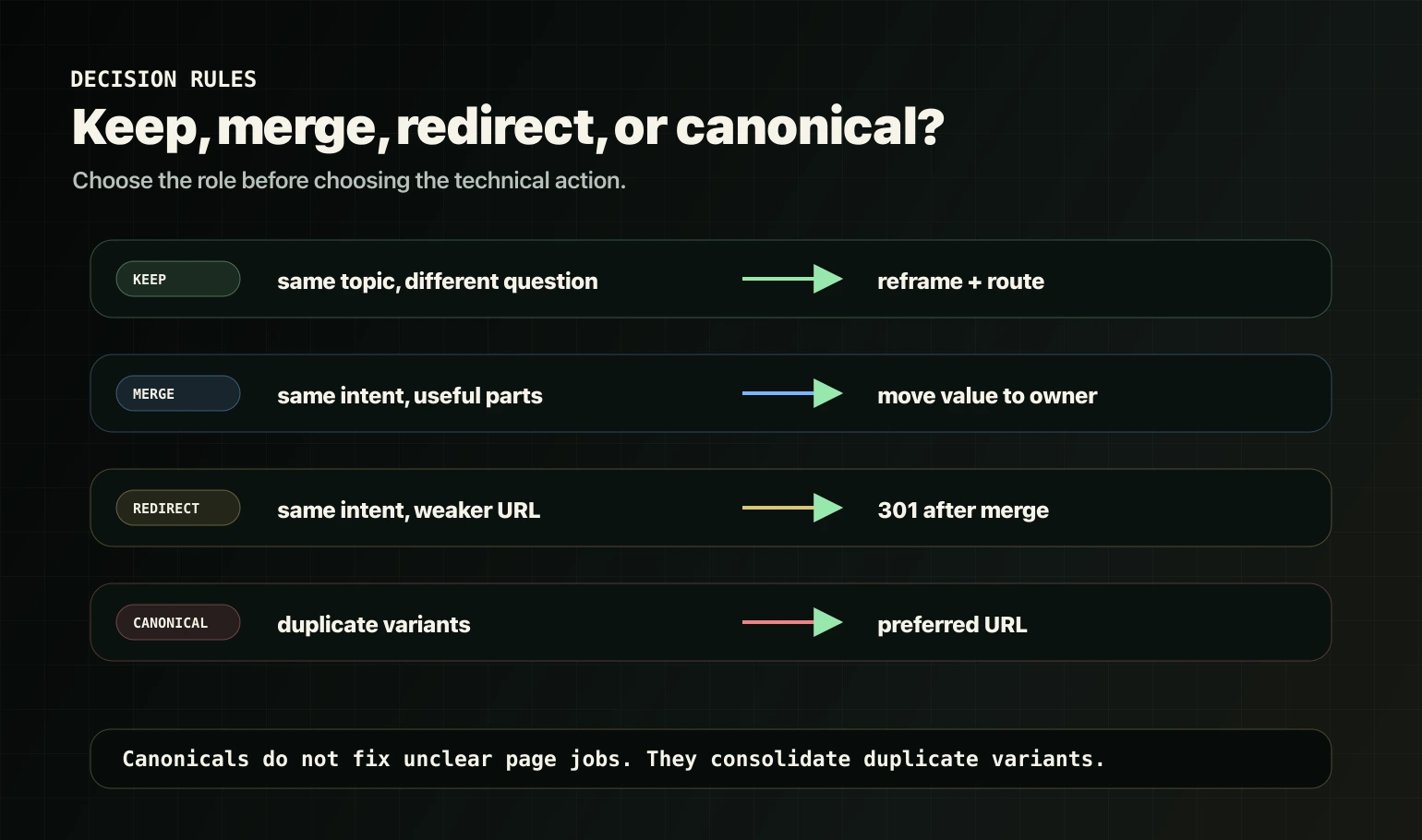
Use these rules before you touch URLs:
- Same intent, one page should win: redirect the weaker URL to the owner after useful content is moved.
- Same intent, both pages have useful sections: merge into the owner, then redirect the old URL.
- Same topic, different stage or question: keep both, reframe the support page, and route it to the owner.
- Duplicate variants: canonicalize duplicate or near-duplicate versions to the preferred URL.
Technical references:
- Google redirects documentation
- Google duplicate URL consolidation guidance
- Google crawlable links guidance
How To Validate Cleanup Worked
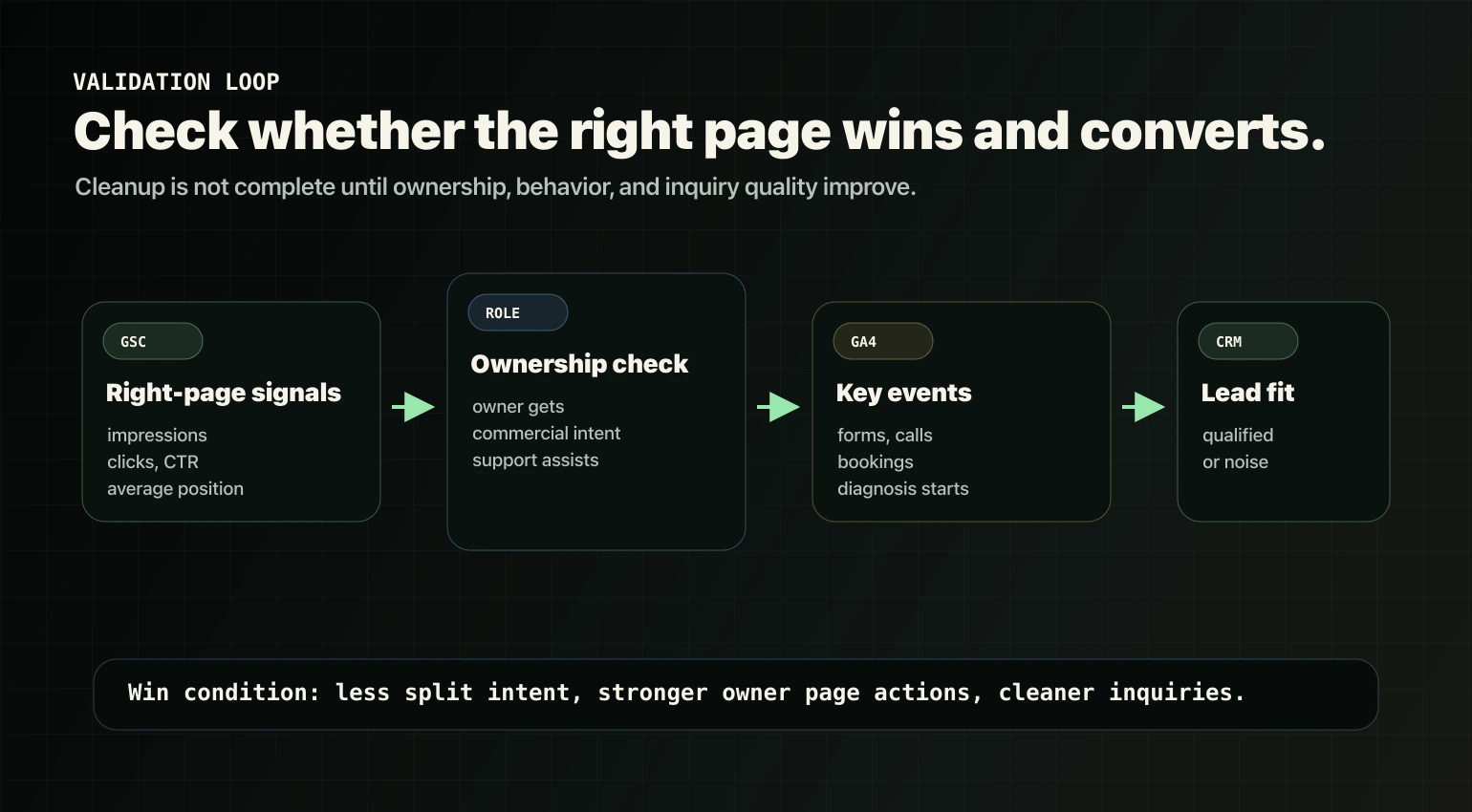
1. Use Search Console To Confirm the Right Page Is Winning
In Google Search Console's Performance report, check clicks, impressions, CTR, and average position for the cluster.
What you want:
- the owner page becomes the clearer recipient of commercial impressions and clicks,
- the split between competing URLs decreases over time,
- support pages keep earning adjacent questions but route better.
Reference: Google Search Console Performance report
2. Use GA4 To Check Whether Better Ownership Improved Actions
Mark key business actions as key events: forms, calls, bookings, or diagnosis starts.
What you want:
- owner page key event rate improves,
- assisted conversion paths become clearer,
- fewer sessions stall on support pages with no next step.
Reference: GA4 key events
Common Mistakes That Keep Overlap Alive
- Publishing support pages with the same commercial promise as the service page.
- Using canonical tags instead of clarifying intent in the content.
- Redirecting pages before deciding whether the second page still has a useful job.
- Leaving internal links vague so the wrong URL stays reinforced.
- Adding more content before ownership and routing are clean.
Related Reads
- Fix overlap between a service page and blog post
- Decide where a keyword belongs: blog vs service
- Service page checklist
- How to structure service pages for better leads
- Service business content funnel map
- Build location pages without doorway SEO
- AI visibility fundamentals for service businesses
- Technical SEO
FAQs
Is Page-Role Cleanup Just Deleting Pages?
No. Page-role cleanup assigns each URL a clear job: owner, support, proof, or router. Sometimes you keep both pages and clarify intent plus routing. Deleting is only one possible move.
Should I 301 Redirect Every Overlapping Page?
Only when you are sure the page no longer deserves its own destination and the intent is the same. Otherwise, keep the page and reframe it into a support role that routes to the owner.
Will Canonical Tags Fix Cannibalization?
Canonicals help consolidate duplicate or near-duplicate URLs. They do not resolve two different pages competing for the same intent. That requires role clarity and content boundaries.
What Is the Fastest Win in Page-Role Cleanup?
Upgrade the owner page first with above-the-fold clarity, proof, and a clear CTA, then route your top support pages to it with descriptive internal links.
Want This Mapped on Your Site?
Start with a Free Clarity Call and we will identify whether the next move is page-role cleanup, a rebuild, technical fixes, or funnel expansion.