

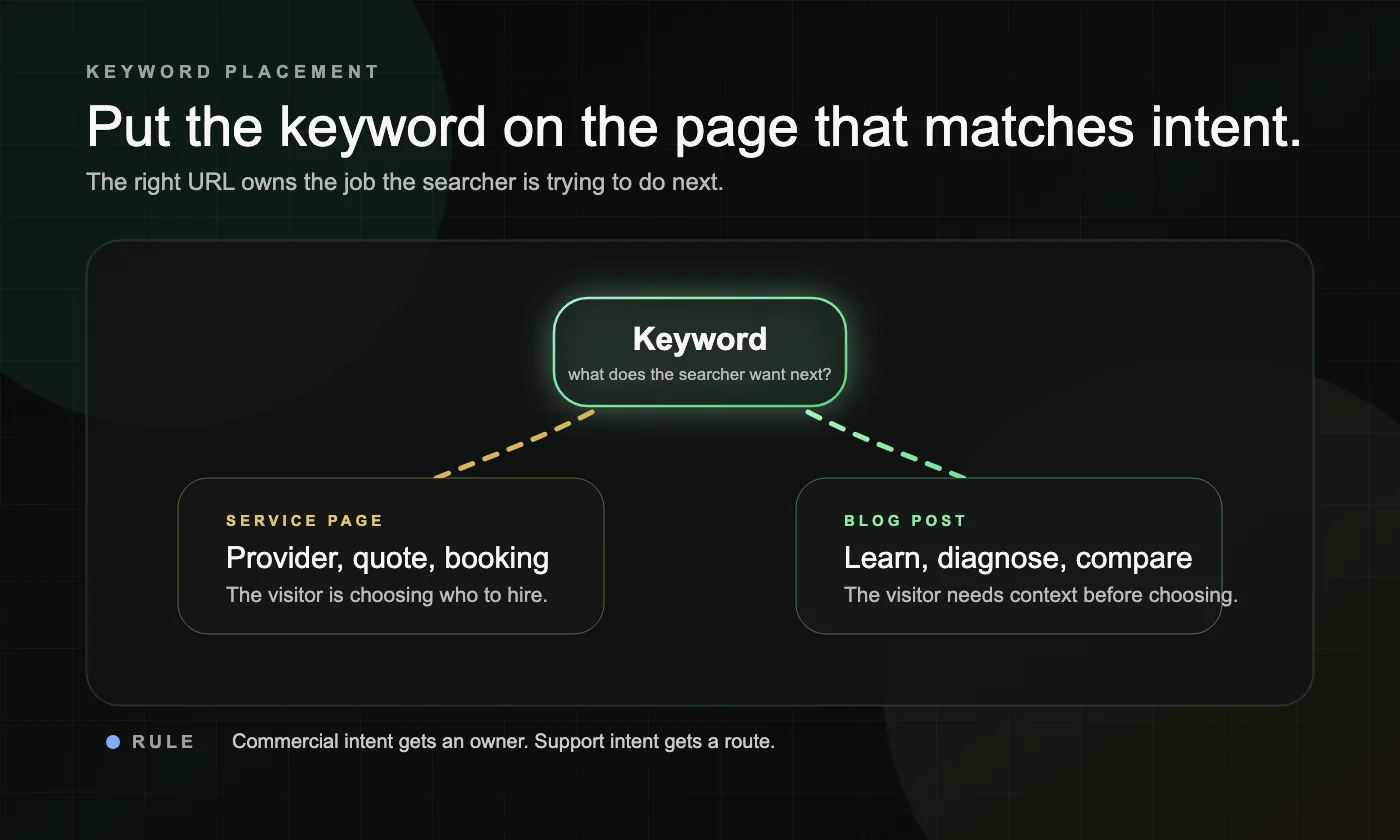
A keyword should go on the page that best matches what the searcher wants to do next. If the query shows provider or hire intent, it belongs on a service page. If it shows learning, diagnosis, comparison, or preparation intent, it usually belongs in a blog post.
Our Support Content page explains how we map support content around one commercial page so blogs strengthen service pages instead of competing with them.
Why does keyword placement matter for lead generation?
Because keyword placement is really page-role placement. When the wrong page targets the wrong intent, the wrong URL starts ranking, the right page stays weak, and visitors land on a page that is not built for their next decision.
Before changing titles, URLs, or publishing more content, review which queries are already sending traffic to which pages in Search Console. That is the fastest way to spot a blog ranking for a service query or a service page trying to own a research question.
Which keywords should go on a service page?
Service-page keywords belong on the page built to help someone choose a provider, understand the offer, and take the next step. These are the queries closest to hire intent.
Use this quick comparison to sort the most common query types:
| Query pattern | Searcher likely wants | Best page type | Why |
|---|---|---|---|
| [service] services or [service] company | A provider | Service page | The visitor is evaluating who to hire |
| [service] near me or [service] in [city] | A local provider | Service page | The intent is commercial and location-aware |
| what is [service] or how does [service] work | An explanation | Blog post | The visitor is still learning |
| [problem] causes or [problem] signs | A diagnosis | Blog post | The visitor is problem-aware, not provider-ready |
| [service] cost or [service] vs [alternative] | Comparison | Usually blog post or guide | The intent is often mixed and needs more context |
| book [service] or best [service] provider | Action | Service page | The visitor is close to choosing |
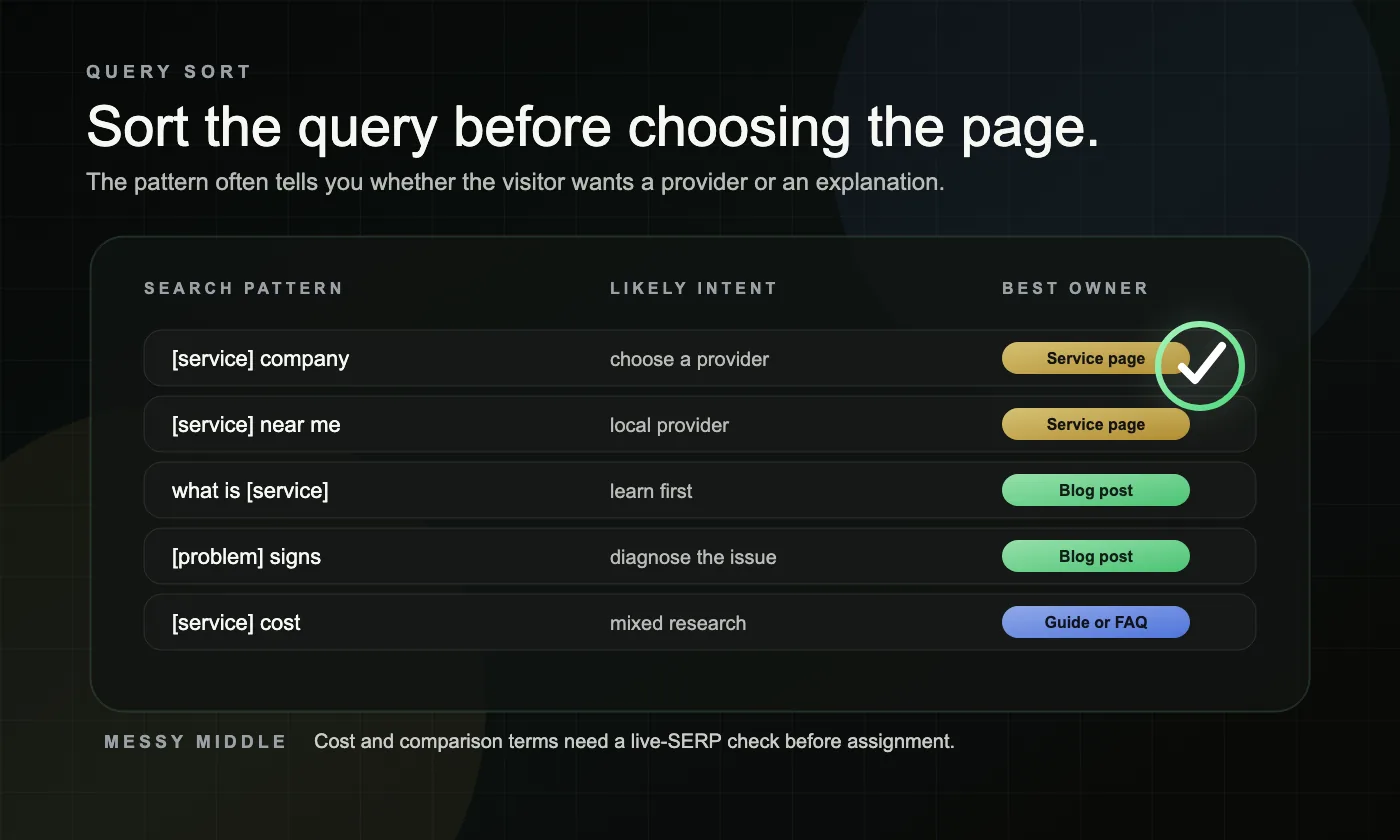
The messy middle is usually cost, process, comparison, and best queries. Those can live on a blog post or a service page depending on what Google is rewarding in the live SERP, so the safer move is to make one page own the commercial version and let the support content own the question-led version.
Which keywords should go in a blog post?
Blog-post keywords belong on pages meant to explain, compare, prepare, or diagnose. A good blog answers the question directly, then routes the reader toward the relevant service page without pretending to be the service page itself.
Use this checklist before assigning a keyword to a blog post:
- Is the query phrased like a question, symptom, checklist, comparison, or mistake?
- Would the reader expect explanation before choosing a provider?
- Does the topic need nuance, examples, or steps that would clutter a service page?
- Can the post link naturally to a relevant service page at the right moment?
- Can the post stay useful even if the reader is not ready to buy today?
Google’s people-first content guidance is a good filter before publishing a blog just because the keyword exists.
How do you decide where a keyword should go when intent is mixed?
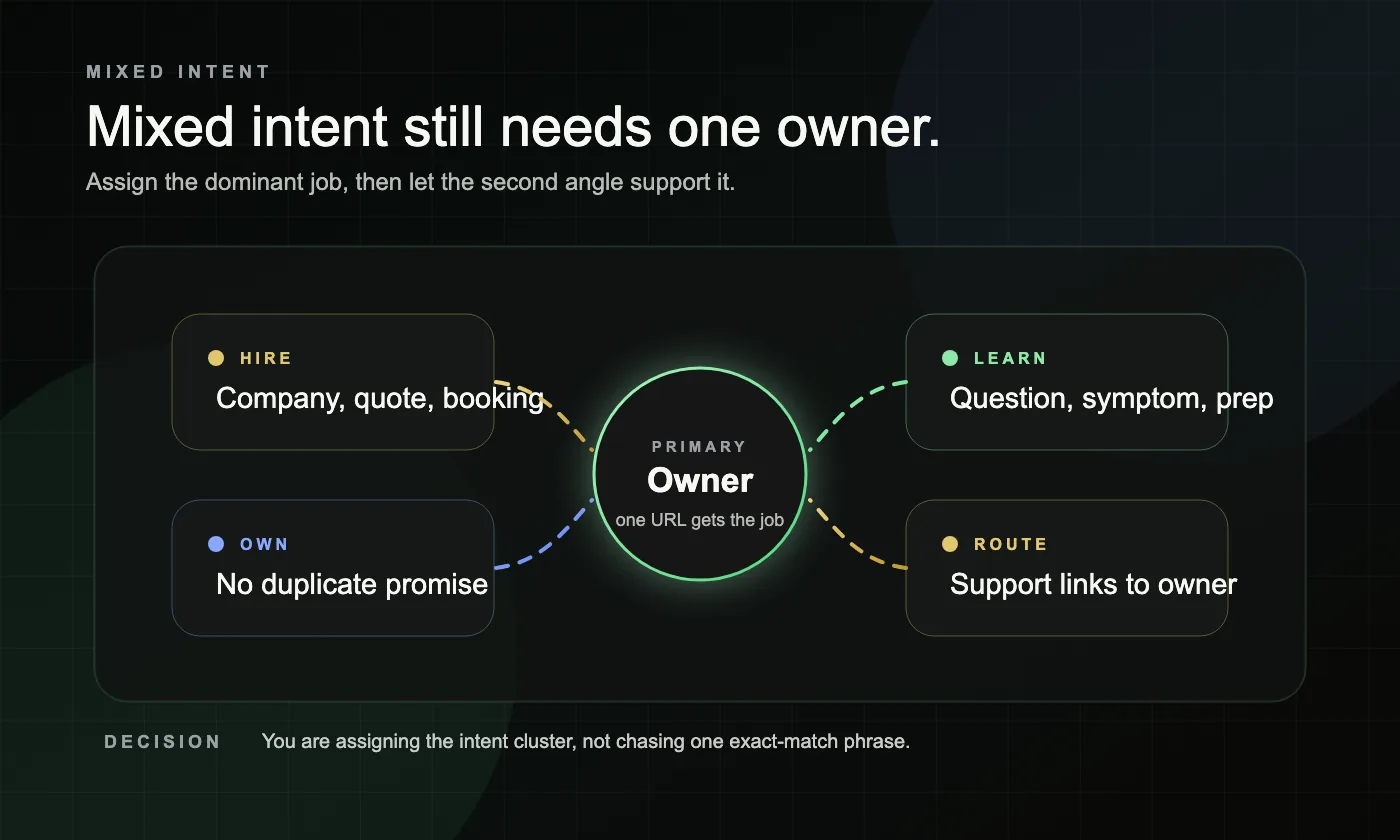
When intent is mixed, choose one primary owner and suppress adjacent intent on that page. Then create a support page only if the second angle deserves its own destination.
In practice, you are not assigning one exact-match phrase. You are assigning the dominant intent of a small cluster of related searches.
Hire. If the searcher wants a company, service, quote, or booking, the service page should own it.
Learn. If the searcher wants explanation, symptoms, prep, or comparison, the blog should own it.
Own. If another URL already should own the commercial version, do not publish a second page with the same promise and a slightly different headline.
Route. If the page cannot move the reader toward a clear next step, it is probably the wrong page type or the wrong angle.
Google’s link guidance is still the best reference for descriptive internal links once you know which page should own the intent.
What does this look like in real service business examples?
In real projects, the problem usually shows up as a blog post ranking for a buying query or a service page trying to answer too many early-stage questions. Two composite examples make the split clearer.
Composite example 1: A home service company had an emergency repair page, but its blog post on how to choose an emergency repair company started ranking for the city-level hire query because the title, H1, and internal links leaned too hard into the commercial phrase. The blog got traffic, but the service page got fewer high-intent visits. The fix was to reframe the blog around what to do before help arrives, strengthen the service page, and route the blog back to the service page with clearer internal links.
Composite example 2: A B2B service firm had a service page for its core offer and a blog post using almost the same promise with slightly softer wording. Search visibility split between the two URLs, and neither page felt authoritative. The fix was to let the service page own the buyer-intent term, rewrite the blog around a comparison question, and make the blog answer the question without trying to close the sale on its own.
What should you fix first if the wrong page is ranking?
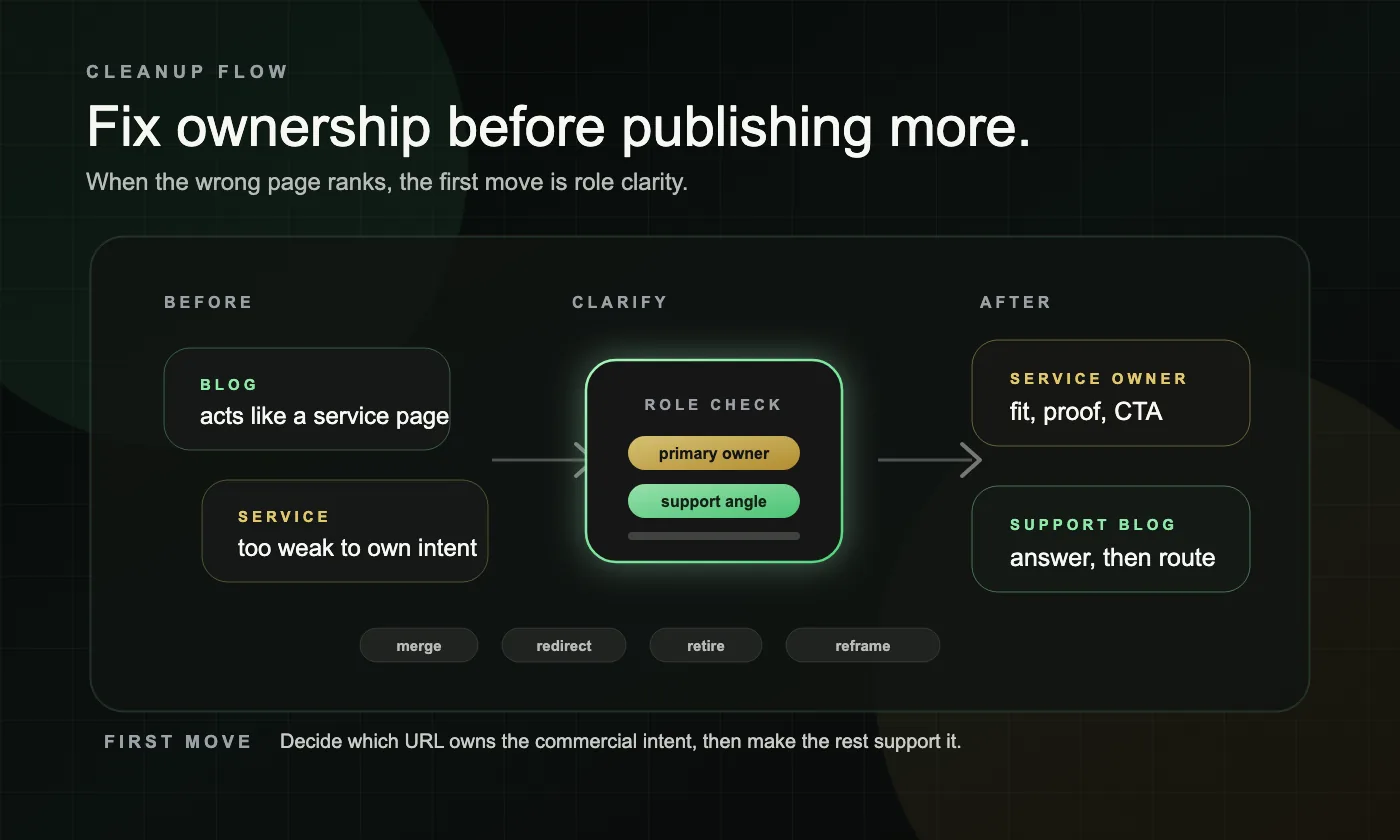
Fix ownership before you publish more content. The first move is usually not another article. It is deciding which URL should own the intent and making every other page support that decision.
Use this order:
- Pick the primary page for the query cluster.
- Rewrite the competing page around a clearly different stage or question.
- Tighten the service page so it can win the decision with clearer fit, process, proof, and CTA.
- Update internal links so the support page points naturally to the owning page.
- Merge, redirect, or retire pages only when they truly do the same job.
- Monitor query/page splits again after the changes.
If the service page is still too weak to own the query even after cleanup, the problem is usually structural rather than editorial. Our Website Rebuild page is the better next read in that case.
What mistakes cause blogs and service pages to compete?
They compete when the blog starts acting like a service page or the service page tries to absorb every research question. Most of the time, the conflict is caused by unclear page roles, not by the fact that both pages mention the same topic.
Common mistakes and red flags include:
- using the same commercial phrase in both the service page and the blog title
- writing a blog post that sounds like why our service instead of answering a real question
- publishing several posts around slight wording variations of the same service intent
- sending strong internal links to the blog for a term the service page should own
- publishing more content before the core service page is clear enough to convert
- keeping old overlapping pages live because they still bring some traffic
Mentioning a service naturally inside a blog is not the problem. Making the blog the primary owner of the same commercial intent is the problem.
If you need a cleaner system across several services, our Support Content page shows how we map page ownership, support topics, and routing before more content goes live.