

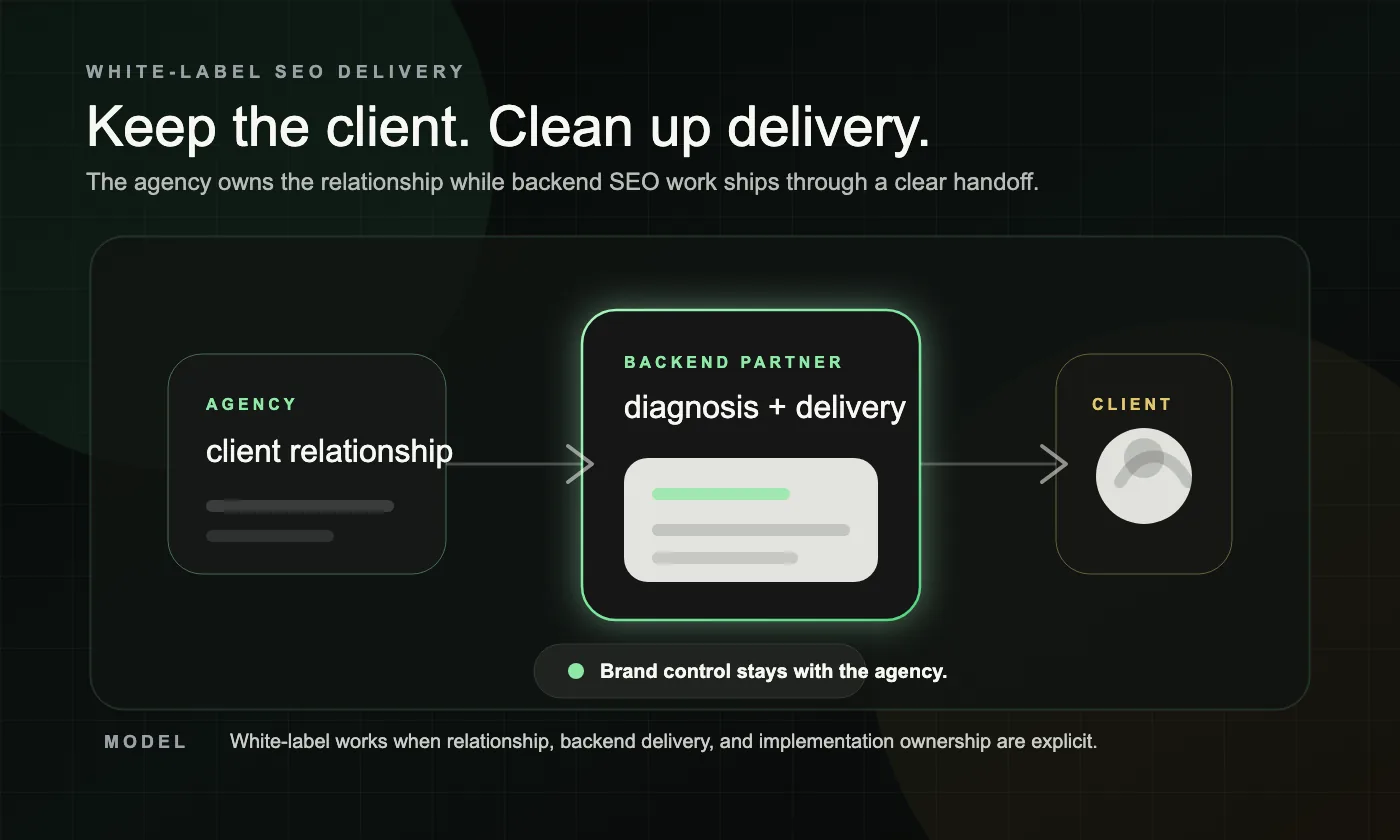
White-label SEO delivery lets an agency keep the client relationship while a specialist partner handles the backend work. Done well, it is not a shortcut around quality. It is a cleaner fulfillment model for agencies that can sell SEO but do not want to build, hire, and manage a full internal SEO department first.
You can sell our work as your own through Agency Partners, or refer a business and do nothing more through Referral Partners; the terms live on those pages.
Why do agencies hit a fulfillment ceiling before they hit a sales ceiling?
Because delivery strain usually shows up before demand disappears. Agencies often keep winning work while strategy, QA, handoffs, and timelines get harder to protect.
That is the moment when SEO stops feeling like a service line and starts feeling like operational drag. Account managers coordinate freelancers, strategists fill specialist gaps at night, and the agency stays “busy” without becoming more reliable.
What is white-label SEO delivery, really?
White-label SEO delivery is a behind-the-scenes partnership where the agency owns the client, the pricing, and the communication, while the partner handles agreed backend SEO work under the agency’s brand.
The important part is not the label. It is the operating model. A good white-label setup reduces fulfillment risk because ownership stays clear.
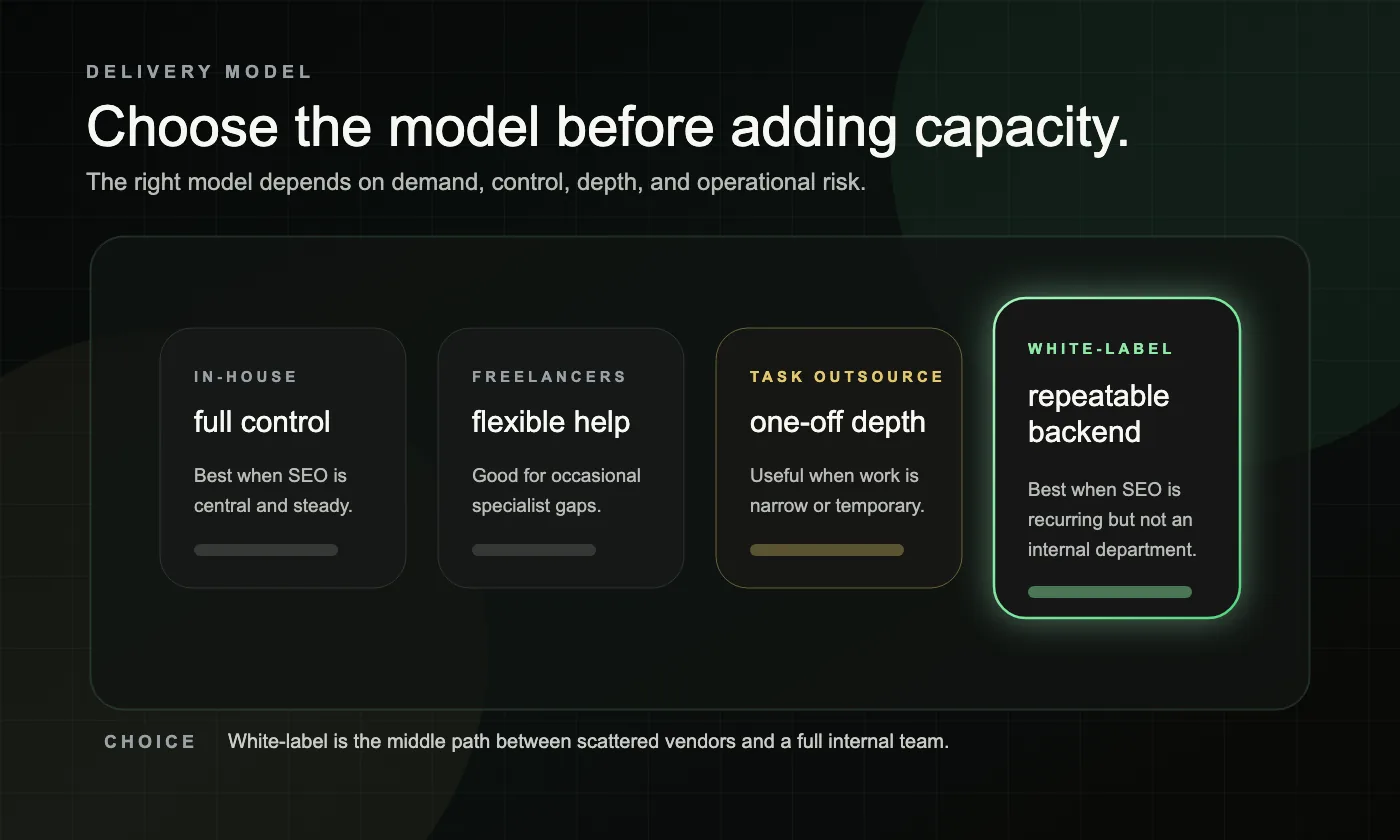
| Delivery model | Best when | Main upside | Main risk |
|---|---|---|---|
| In-house hiring | SEO demand is steady, strategic, and central to the agency | Full internal control | Slow hiring, fixed overhead, and talent risk |
| Freelancers | You need occasional specialist help | Flexibility | Fragmented QA and vendor chasing |
| Task outsourcing | You need one-off audits, migrations, or content bursts | Specialist support without a long-term commitment | The agency becomes the coordinator of disconnected work |
| White-label delivery | SEO is recurring and you need predictable fulfillment under your brand | Consistency, clearer systems, and brand control | Role confusion if scope and ownership are not explicit |
White-label works best when the agency wants leverage, not chaos.
How should an agency decide whether it needs a white-label partner?
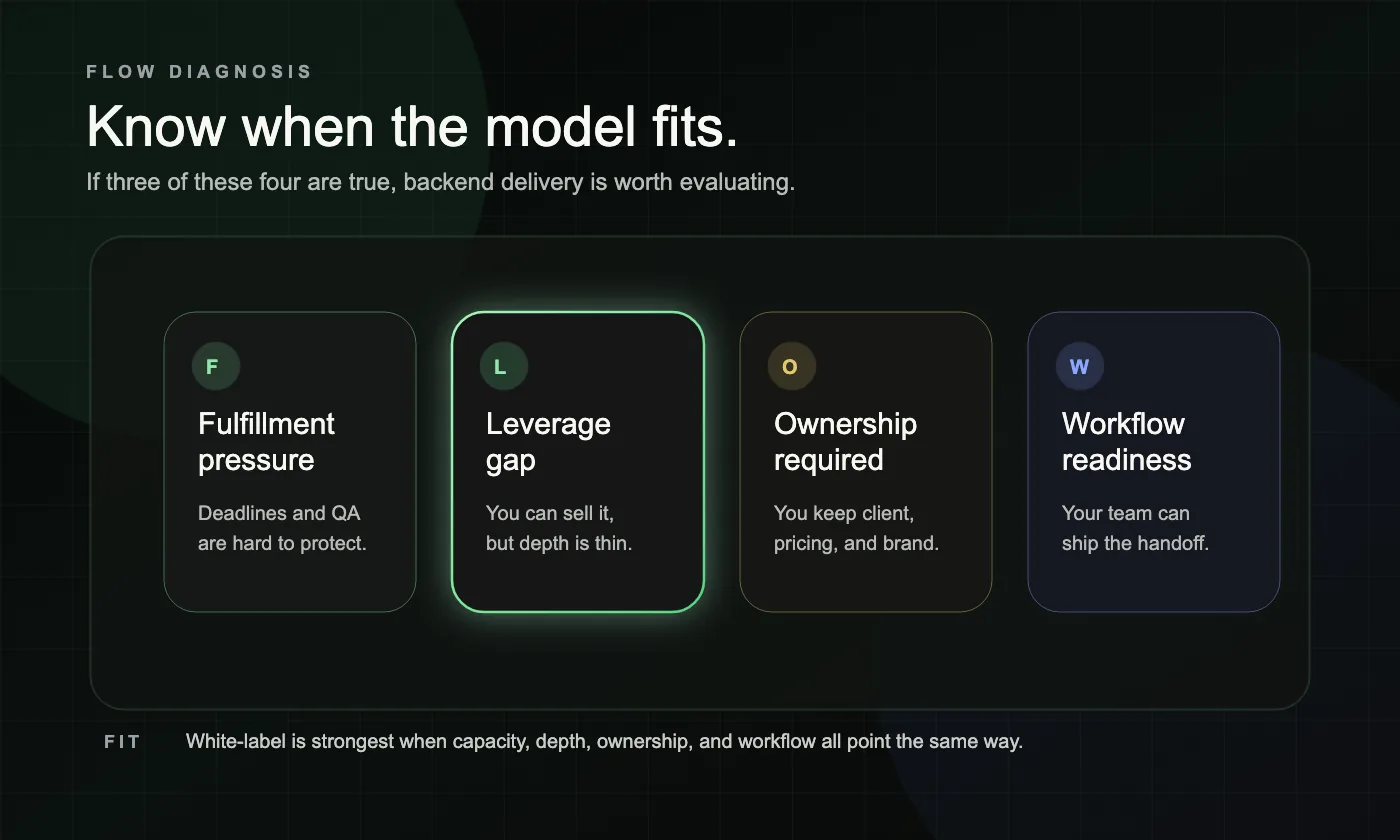
Use the FLOW checklist: Fulfillment pressure, Leverage gap, Ownership requirement, and Workflow readiness. If three of those four are already showing up, a white-label model is usually worth serious consideration.
Fulfillment pressure
If deadlines slip, reporting takes too long, or SEO work keeps piling up on a few people, the issue is no longer demand. It is delivery capacity.
Leverage gap
If the agency can sell SEO but does not have deep in-house coverage for technical work, service-page rebuilds, local structure, or content systems, there is a leverage gap.
Ownership requirement
If you want to keep the client relationship, pricing, approvals, and brand fully on your side, white-label is a stronger fit than handing clients to another provider.
Workflow readiness
If your team already has an implementer, developer, strategist, or content workflow that can ship backend deliverables cleanly, you are much closer to white-label readiness.
Use this checklist before you decide:
- SEO is recurring, not just occasional
- Account managers are spending too much time coordinating execution
- Delivery depends on one or two internal people
- You want to keep client ownership and agency branding
- You need specialist depth without adding permanent headcount
- Your team can implement or manage a clean handoff once work is delivered
When is white-label a better fit than hiring, freelancers, or ad hoc outsourcing?
White-label is the better fit when SEO has become a real delivery line, but not yet a stable enough department to justify building a full in-house team around it.
Hiring makes sense when SEO is central to the agency, demand is consistent, and you want deeply embedded internal capability. Freelancers and ad hoc outsourcing make sense when the work is narrow, occasional, or experimental.
White-label becomes the better answer in the middle. It gives the agency a repeatable backend without forcing the agency to become a recruiter, trainer, and process owner for every specialist role at once.
What should be included in a healthy white-label delivery model?
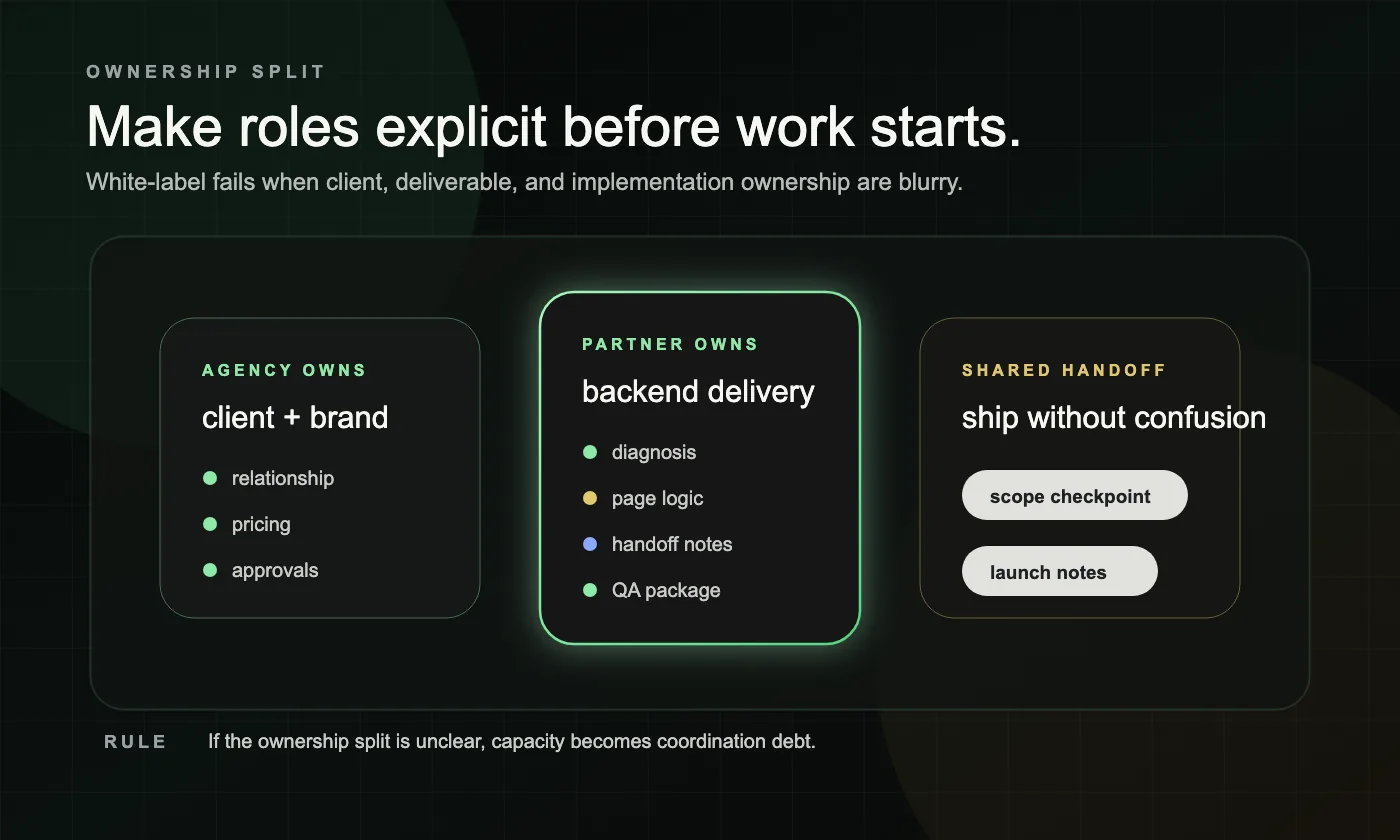
A healthy model should include an initial review, scoped deliverables, QA, reporting, confidentiality, and a clean ownership split. If those pieces are missing, the partner is not really reducing operational risk. They are just moving it around.
For service-business clients, the highest-leverage backend work is rarely just link building or generic blog production. It is usually structural work: page-role mapping, service-page clarity, scoped rebuild copy, pruning direction, internal linking logic, and support content direction.
A strong delivery model usually includes:
- a client brief with goals, constraints, and service context
- baseline review before random execution begins
- clear page or campaign ownership
- defined deliverables with approval checkpoints
- branded reporting or implementation notes
- NDA and confidentiality expectations
- a written ownership split for client communication and implementation
Google’s SEO Starter Guide is still a useful baseline for judging whether the work being sold is rooted in crawlability, content quality, and site understanding rather than mystery tactics.
If your agency keeps inheriting service-business sites where weak service pages, overlap, and unclear structure are the real delivery problem, our Website Rebuild page explains the build, with the scope quoted on the call.
What does this look like in a real agency example?
In real agency work, the value usually comes from removing operational drag, not from making the offer sound bigger.
Composite example 1: A web design agency kept adding “SEO” after new site launches, but each project became a different mix of freelancer tasks. Technical fixes lived in one place, content lived in another, and no one owned the page system. The agency did not need five more vendors. It needed one backend partner to diagnose the structural gaps, map the priority pages, and hand back a cleaner package the internal team could ship.
Composite example 2: A growth agency with strong sales and account management started landing more local service-business clients. The bottleneck was not client acquisition. It was backend depth. Service pages were weak, local coverage was messy, and support content kept overlapping with money pages. White-label delivery worked because the agency kept communication and implementation while the backend partner handled the initial review, page logic, scoped rebuild direction, and cleaner support content.
In both cases, the win was not “outsourcing SEO.” The win was replacing fragmented execution with a more reliable delivery path.
What should you fix first before bringing in a partner?
Fix the operating model first. A white-label partner works best when the agency already knows what it wants to protect and what it wants help delivering.
Use this order:
- Decide what kind of SEO work you actually want to sell
- Define who owns strategy, client communication, approvals, and implementation
- Standardize one intake brief so every project starts with the right context
- Choose one repeatable client type or package before you try to scale everything
- Set QA and reporting expectations before work starts
- Bring in a partner only after the ownership split is clear
Most agencies do this backward. They add capacity first and discover the workflow problems later.
If you want a cleaner backend model for that handoff, our Agency Partners page is the best next read.
What red flags should you watch for?
The biggest red flags are secrecy, vague methods, role confusion, and promises that sound too easy. A weak partner creates more agency risk, not less.
Watch for these signs:
- guaranteed rankings or “special” relationships with Google
- no clear explanation of what will actually be done
- no NDA, confidentiality language, or non-solicitation expectations
- reporting that shows activity but not decisions or priorities
- broad promises with no scoped workflow behind them
- the provider wanting client ownership or direct relationship by default
- long rigid contracts before the quality has been tested
Google is explicit here: no one can guarantee a #1 ranking, and you should be careful with any SEO that will not clearly explain its methods or pushes deceptive tactics.
A useful rule is simple: if you cannot explain who owns the client, who owns the deliverable, and who owns implementation in one sentence, the model is still too blurry.