

This is not a full AI visibility guide. For the evergreen foundation, start with AI Visibility for Service Businesses.
Download the quarterly notes template
Use the DOCX or printable PDF to fill in your own quarter: external changes, stable principles, actions, measurement notes, and watchlist.
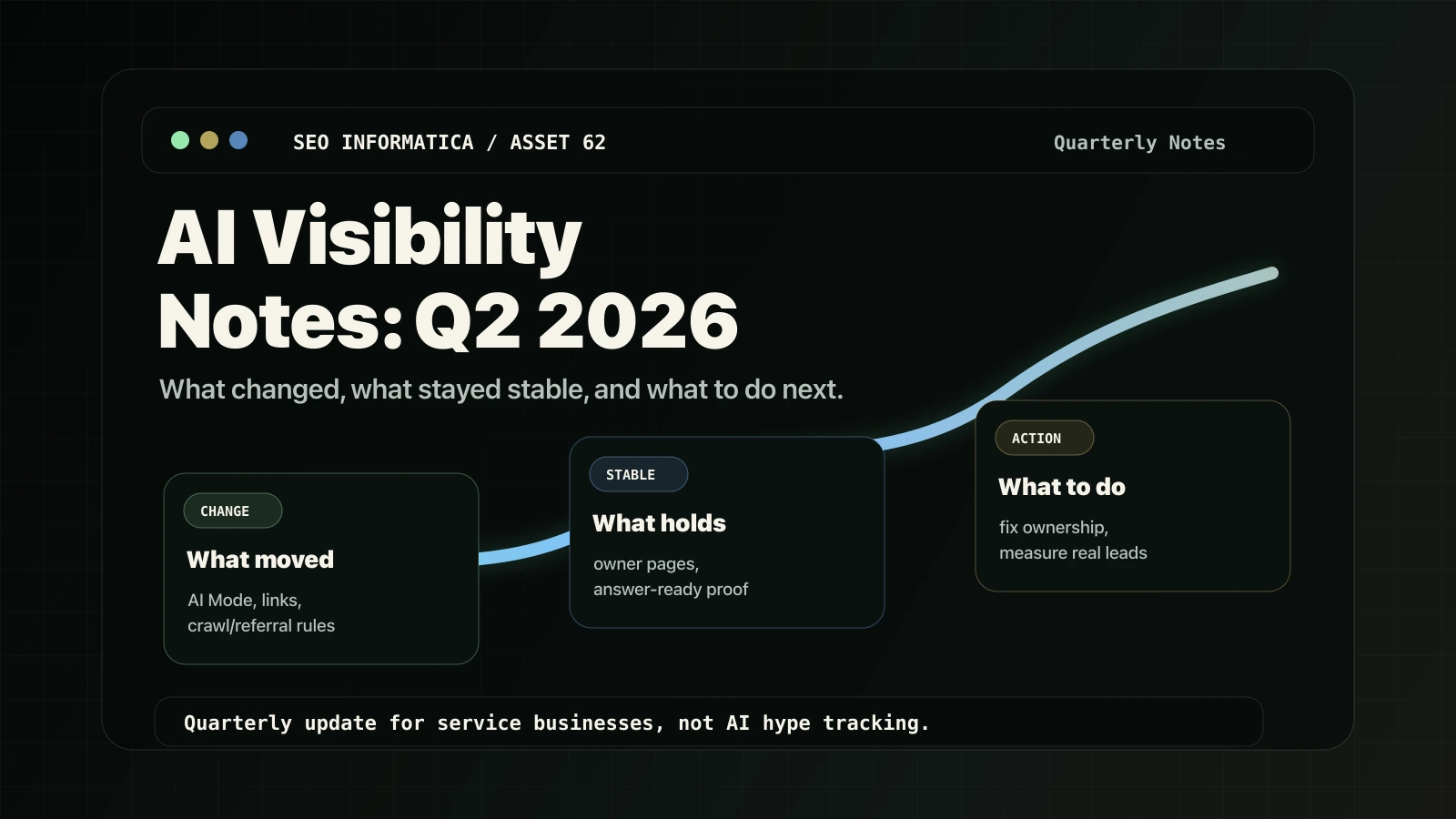
At a glance
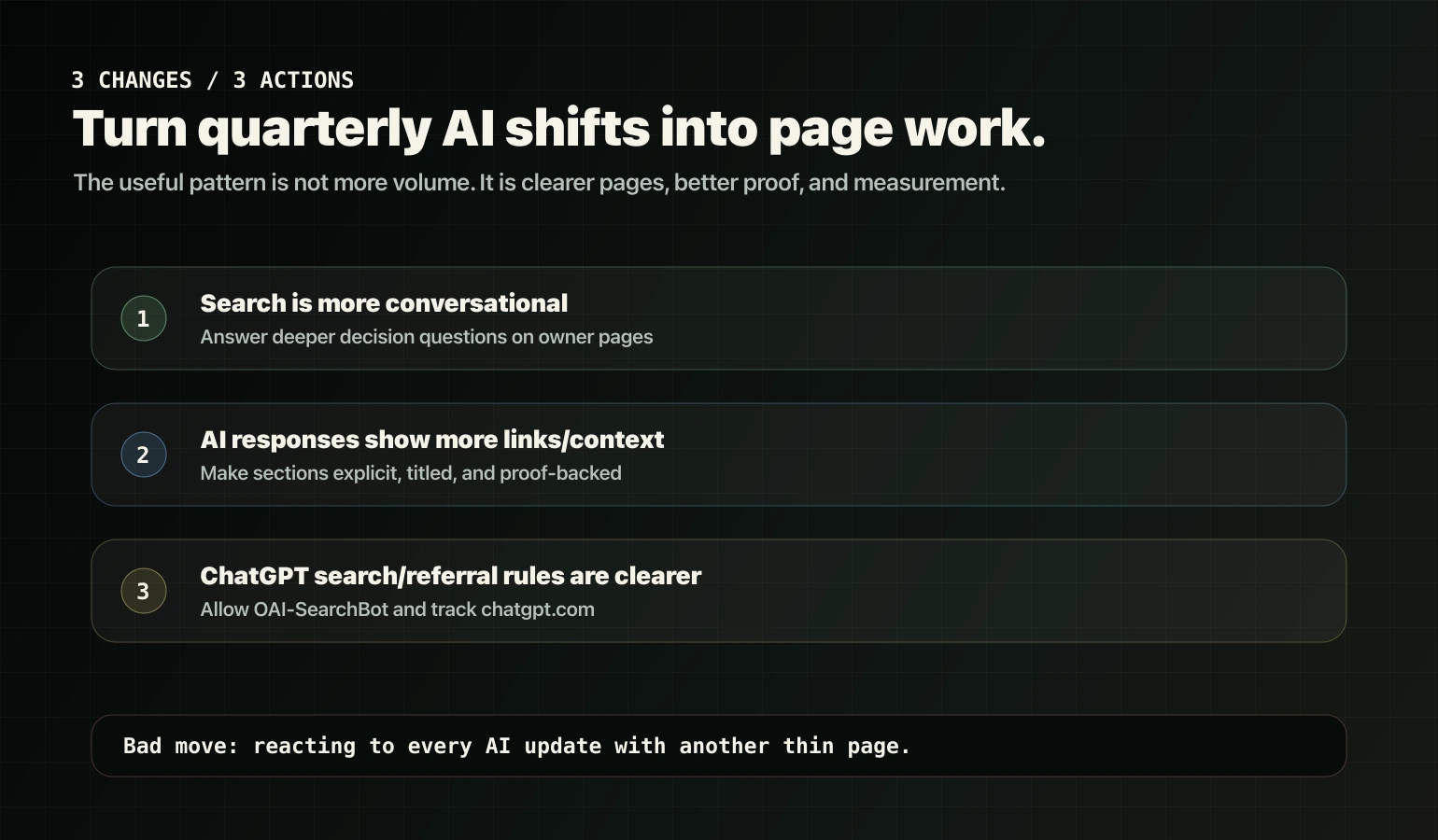
The 3 changes
- Google AI Search moved further toward conversational, multimodal, and task-oriented behavior.
- Google put more emphasis on links, source context, and exploration inside AI search experiences.
- ChatGPT Search visibility and tracking rules became clearer: crawl access, citations, and referral measurement matter.
The 3 actions
- Upgrade owner service pages so they answer deeper decision questions without spawning thin support pages.
- Make proof, fit, process, pricing factors, and timelines explicit enough to be understood and cited.
- Track AI visibility as a routing and lead-quality system: GSC signals, GA4 events, CRM quality, and
utm_source=chatgpt.comwhere it appears.
If you want this applied to your site with fix order, review Search + AI Visibility or start with a Free Clarity Call.
What changed this quarter
Change 1. AI Search is becoming more conversational and task-oriented
Google's Q2 Search updates pushed AI Mode further into deeper reasoning, agents, local/service tasks, personal context, and custom generated experiences. Google also reported that AI Mode queries are longer, more multimodal, and more decision-oriented than traditional searches.
Why it matters for service businesses:
- Searchers are less likely to use neat keyword phrases and more likely to ask messy decision questions.
- Local and service tasks create pressure on your pages to state service scope, fit, next steps, and constraints clearly.
- A page that only says "we help with X" is too thin for comparison, planning, and booking-style behavior.
What to do now:
- Pick the owner service page for each priority service.
- Add decision-support sections: process, fit/non-fit, pricing factors, timelines, and required inputs.
- Keep booking/contact routes obvious on mobile.
- Do not create a new page for every AI Mode query variation.
Sources:
Change 2. AI responses are showing more links and source context
Google said it is improving how links appear in AI Mode and AI Overviews, including inline links near relevant text and previews that help users understand where a link leads. Google also continues to describe query fan-out as part of how AI Search explores subtopics and sources.
Why it matters:
- AI visibility is not just "get mentioned." It is getting the right page surfaced for the right sub-question.
- Pages need clearly titled sections that can support a specific answer.
- Thin posts, generic FAQs, and recycled summaries are weak candidates for this environment.
What to do now:
- Write answer blocks inside the owner page, not only in separate blog posts.
- Put proof near the claim it supports.
- Use headings that describe the actual decision question.
- Add images or diagrams only when they make the page easier to understand.
Sources:
- Google: 5 new ways to explore the web with generative AI in Search
- Google guide to optimizing for generative AI features
Change 3. ChatGPT Search crawl and referral signals are clearer
OpenAI's publisher documentation separates OAI-SearchBot from GPTBot. OAI-SearchBot is the crawler used for surfacing sites in ChatGPT Search, while GPTBot relates to training. OpenAI also says ChatGPT referral URLs can include utm_source=chatgpt.com, which gives marketers a cleaner way to identify inbound ChatGPT Search traffic.
Why it matters:
- Blocking the wrong crawler can remove you from a discovery surface you actually want.
- ChatGPT traffic should not be lumped into vague "direct" or "referral" buckets without checking source data.
- Visibility still needs routing. A ChatGPT click to a weak page is not a win.
What to do now:
- Check
robots.txtfor OAI-SearchBot and GPTBot rules separately. - Confirm important service pages are publicly accessible, indexable, and not hidden behind scripts, login, or broken rendering.
- Add
utm_source=chatgpt.commonitoring to GA4/CRM reporting where it appears. - Do not promise ChatGPT citations. Track what happens when referrals occur.
Sources:
What stayed stable
1. SEO still matters in AI Search
Google's guidance is blunt: generative AI features are still rooted in Search ranking and quality systems. Crawlability, indexability, snippet eligibility, useful content, and clear structure are still the foundation.
Stable action: fix the page system before chasing labels like AEO, GEO, or "AI SEO."
2. Owner pages still need borders
If five URLs try to answer the same commercial intent, you do not have an AI visibility strategy. You have a meaning problem.
Stable action: one page owns hire intent. Support content answers adjacent questions and routes back to the owner page.
3. Answer-ready content beats FAQ spam
The useful work is not dumping more FAQs at the bottom of the page. The useful work is answering buyer decisions where they happen: process, fit, timelines, price factors, scope, tradeoffs, and proof.
Stable action: build the service page around decisions, not keyword variants.
4. Measurement still needs business truth
Search Console can show demand and right-page ownership. GA4 can show behavior and conversion events. CRM or lead review tells you whether the inquiries were worth having.
Stable action: report signals, outcomes, and compounding indicators separately.
Measurement notes for this quarter
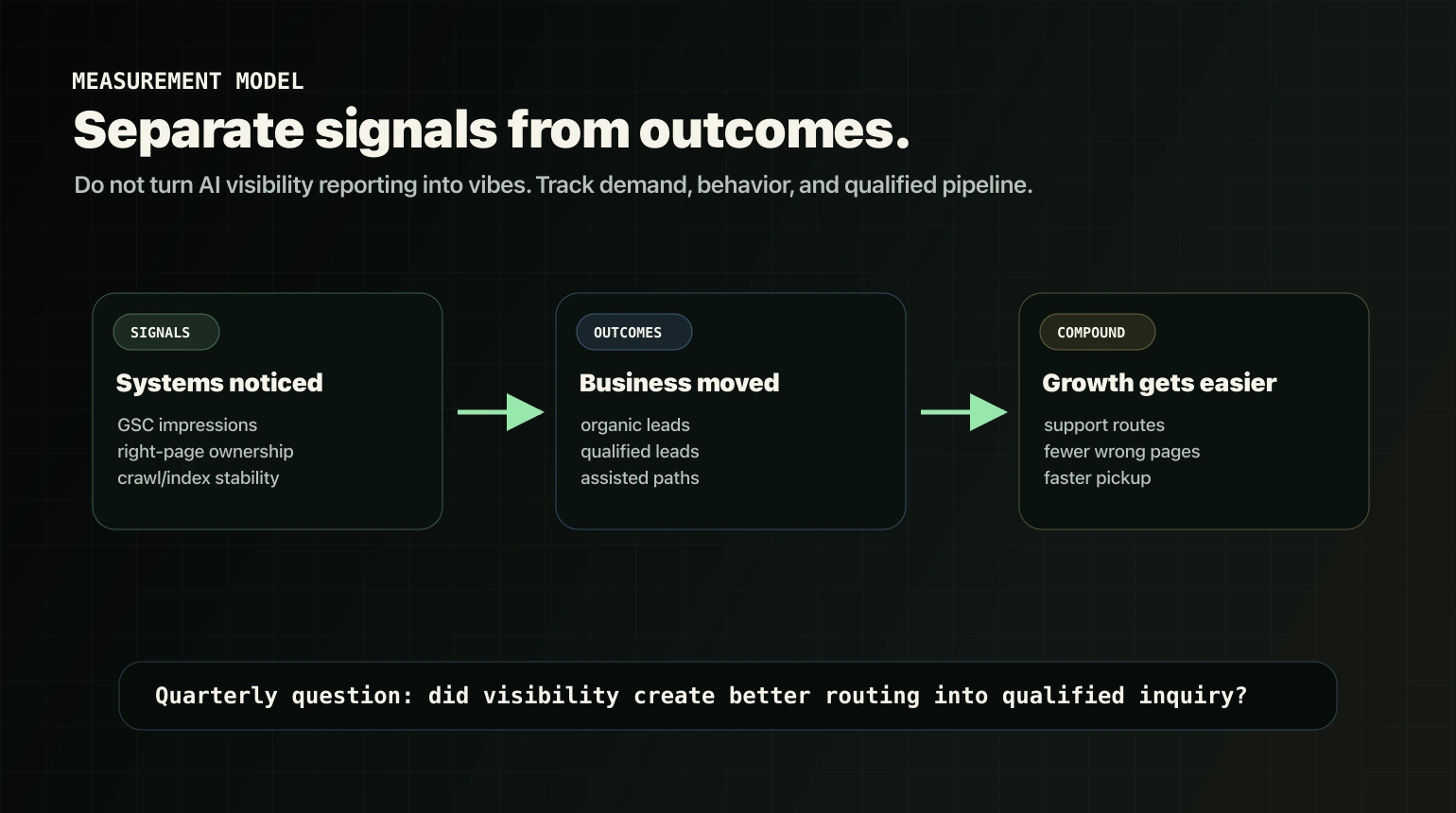
Do not report AI visibility as vibes. Use this structure:
Signals: systems noticed
- Owner page impressions and clicks in Google Search Console.
- Whether the right owner page appears for commercial intent.
- Crawl/index stability for priority service pages.
- ChatGPT referral appearances, including
utm_source=chatgpt.comwhere present.
Outcomes: business moved
- Organic lead events in GA4.
- Qualified leads in CRM.
- Disqualification reasons.
- Conversion rate from owner service pages.
Compounding indicators: growth gets easier
- Fewer wrong-page ranking incidents.
- Support content routes into the owner service page.
- Updated pages pick up impressions without creating overlap.
- Proof assets reduce sales friction.
No fake benchmark is useful here. Fill the template with your own numbers.
What we changed in the playbook
Treat AI updates as page-system pressure, not content-calendar pressure.
Why: conversational and fan-out behavior rewards clear page roles and specific answers more than scattered volume.Add source-worthy sections to owner pages before writing more support posts.
Why: inline links and source previews make weak, vague pages easier to ignore.Separate ChatGPT crawler control from training control.
Why: OAI-SearchBot and GPTBot do different jobs. Blocking both by default may be the wrong business decision.
Action checklist for service businesses
Do this in order:
- Confirm the owner service page for your highest-priority service.
- Add or upgrade answer-ready sections: process, fit, pricing factors, timeline factors, and required inputs.
- Add proof blocks with context: what changed, timeframe, scope, and constraint.
- Add routing bridges from top traffic posts to the owner service page.
- Prevent overlap before publishing new AI visibility content.
- Validate tracking across Search Console, GA4 key events, CRM lead quality, and ChatGPT referrals where they occur.
- Check OAI-SearchBot access separately from GPTBot.
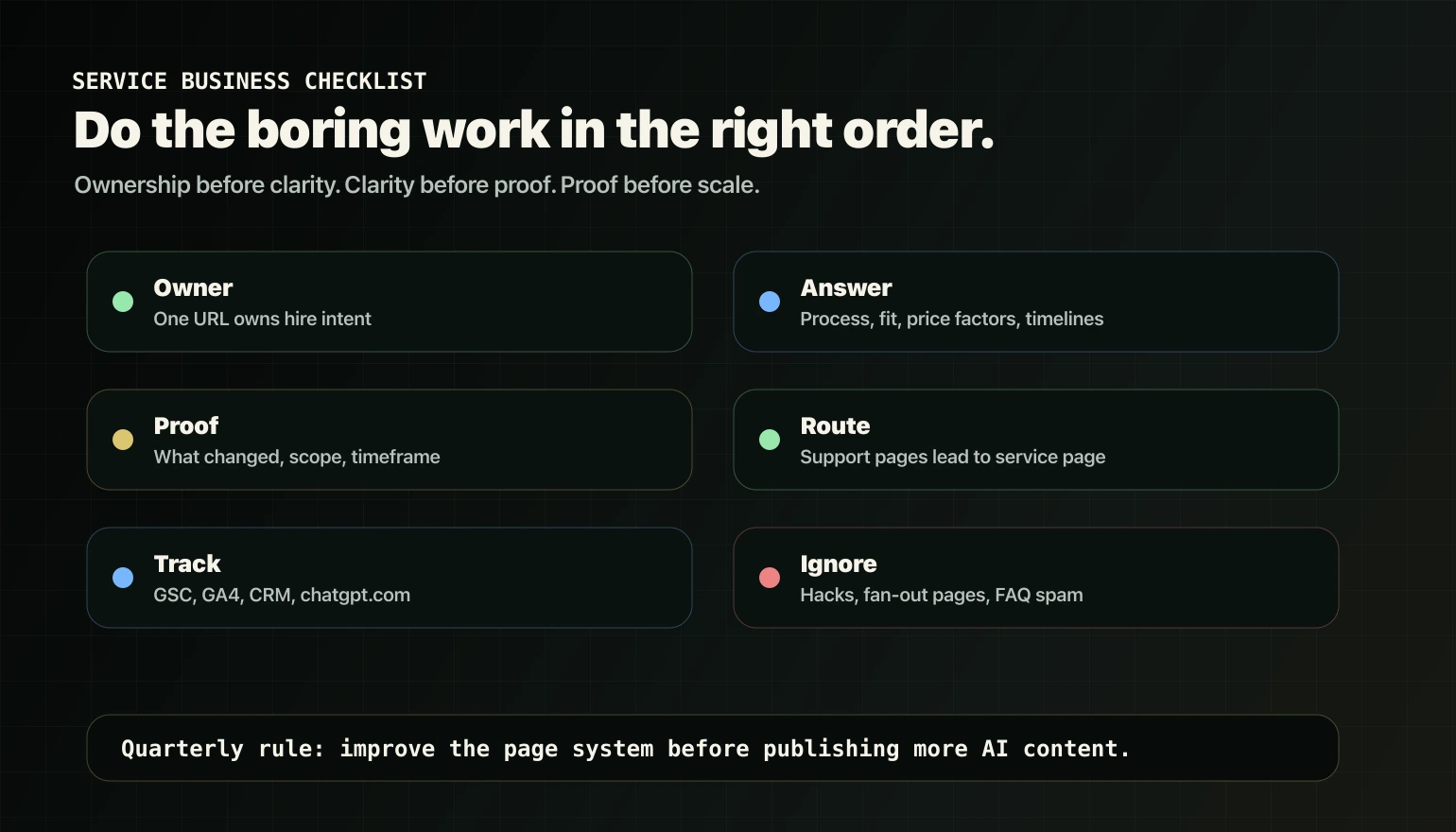
What we are ignoring
- AI hacks that do not improve the visible page.
- Publishing fan-out pages for every query variation.
- FAQ spam as a substitute for decision support.
- Guaranteed AI mentions or citations.
- Reporting impressions without asking whether inquiries improved.
Watchlist for next quarter
1. Agentic local/service actions
Signal to watch: more booking, calling, reservation, or service-selection behavior inside AI search surfaces.
Action if it happens: tighten service scope, availability, proof, and conversion paths on owner pages.
2. ChatGPT referral visibility
Signal to watch: utm_source=chatgpt.com or ChatGPT referral traffic appearing in GA4, CRM, or server logs.
Action if it happens: segment by landing page and lead quality. Do not celebrate traffic until the route produces qualified inquiries.
Source log
Official sources used for this quarter:
- Google Search I/O 2026 updates
- Google: 5 new ways to explore the web with generative AI in Search
- Google AI Mode usage insights
- Google guide to optimizing for generative AI features
- Google AI features and your website
- Google guidance on generative AI content
- Search Console clicks, impressions, and position definitions
- OpenAI crawler overview
- OpenAI Publishers and Developers FAQ
- OpenAI ChatGPT Search help
Need help applying this to your site?
Review Search + AI Visibility or start with a Free Clarity Call. The useful next step is not another AI tactic list. It is knowing which page, route, or measurement layer is actually blocking qualified inquiries.