If you have been told "SEO is a long game," you have probably also been trained to accept slow, vague progress.
A Lead Gen Rebuild is not a "publish more blogs and wait" project. It is a foundation rebuild: page ownership, structure, core pages, overlap cleanup, and the conversion route that turns visibility into qualified inquiry.
This guide explains what a 14-day ready-to-implement timeline actually means, what happens in each window, what you receive at the end, and how implementation works after handoff.
For the full service overview, start with Lead Gen Rebuild: https://seoinformatica.com/lead-gen-rebuild/
Diagnosis summary
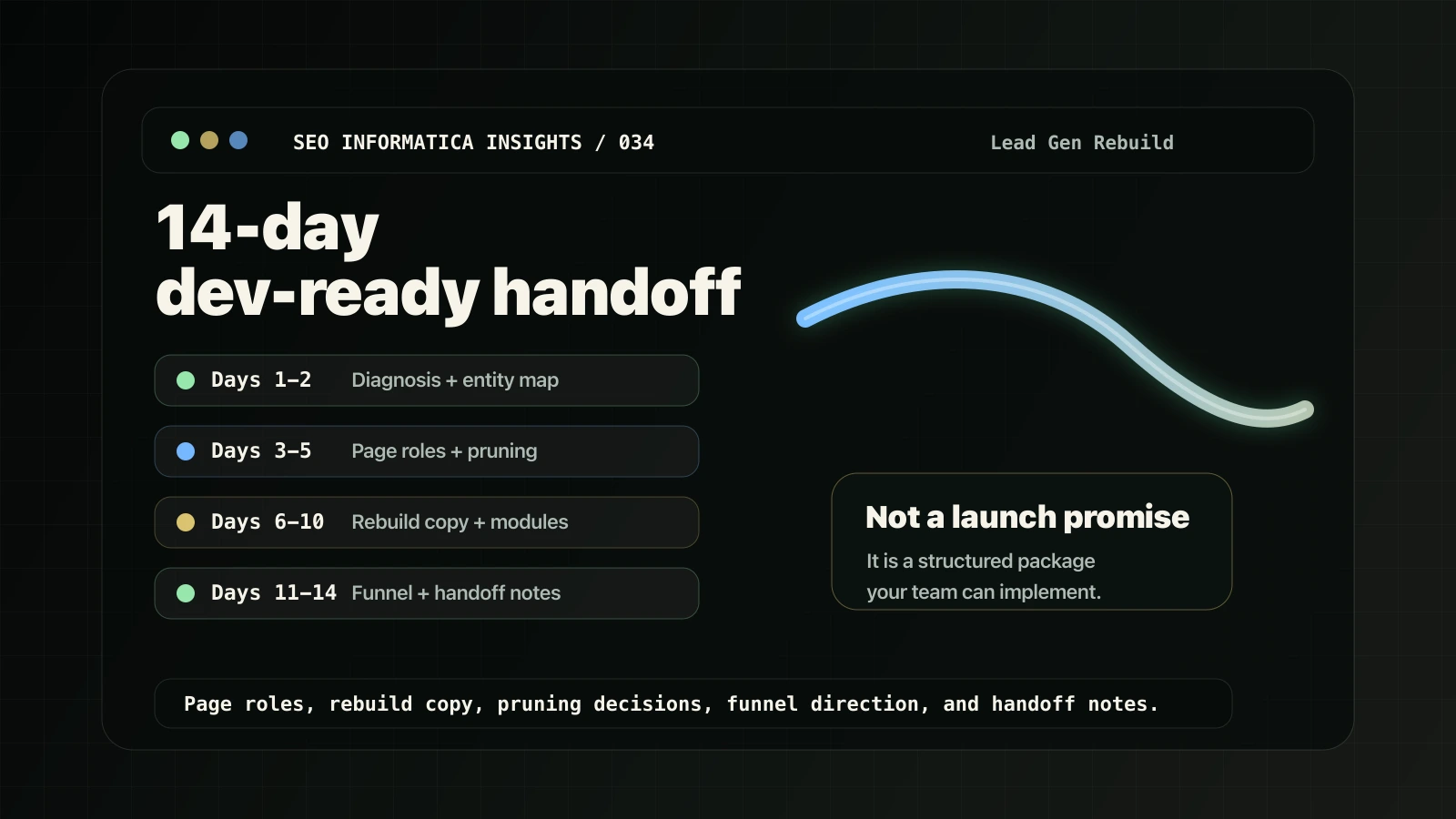
- 14 days is the standard turnaround for eligible starter scopes to deliver a ready-to-implement rebuild package. It is not a full redesign and it is not a launch guarantee.
- The rebuild is built to fix page roles, service page clarity, overlap, cannibalization, and decision support before more SEO activity compounds on a weak base.
- You leave with a dev-ready handoff your team, developer, or agency can ship cleanly, plus guidance to protect the structure during rollout.
What 14 days actually means
"14 days ready-to-implement" means the rebuild is delivered as an implementation package for standard starter scopes. The direction, page roles, rebuild copy, module guidance, consolidation logic, and handoff notes are complete and organized so your team can execute cleanly.
It does not mean:
- a full visual redesign has been completed,
- development has already been done on your server,
- the website is live by day 14.
Think of it like this:
- 14 days = the rebuild package is prepared, scoped, and ready to ship.
- Go-live timing = depends on your implementation path, approvals, developer availability, and build complexity.
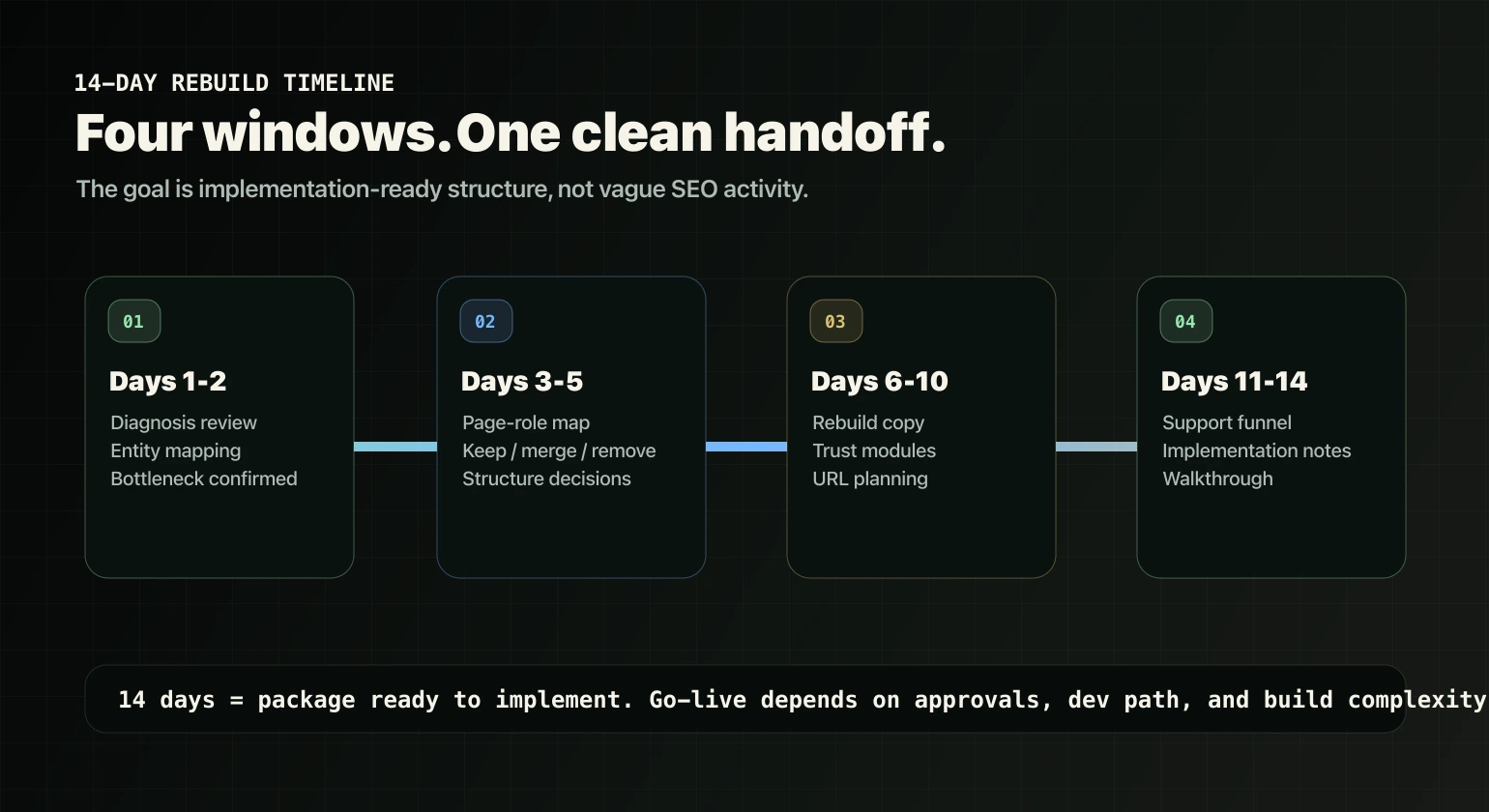
The 14-day timeline at a glance
| Window | What happens | What you get | What we need from you |
|---|---|---|---|
| Days 1-2 | Diagnosis review and entity mapping | Offer/service meaning clarified, ownership assumptions, bottleneck confirmed | Website URL and basic business context |
| Days 3-5 | Structure, page-role, and pruning decisions | Page-role map, keep/merge/remove/create direction, structure refinements | Priority services and priority pages if any |
| Days 6-10 | Rebuild copy and new page planning | Dev-ready copy, trust modules, CTA logic, decision support, URL planning | Existing proof assets if available |
| Days 11-14 | Funnel direction, handoff notes, walkthrough | First support funnel direction, internal linking guidance, schema guidance, implementation notes | Implementation contact or rollout owner |
Larger, messier, multi-location, or legacy-heavy websites may require a longer custom scope.
Days 1-2: diagnosis review and entity mapping
We start by confirming the real bottleneck: what is actually stopping the site from turning demand into qualified inquiry.
That usually includes one or more of these problems:
- the wrong page ranking for the wrong intent,
- the homepage or blog stealing service intent,
- service pages that feel broad, duplicated, or unclear,
- proof that exists but does not appear where buyers decide,
- navigation and page structure that make ownership confusing,
- overlap or cannibalization that dilutes rankings and buyer clarity.
Entity mapping is the simple version of a hard problem: what does this business actually mean on the website?
We clarify your services and offers so they can be expressed consistently across pages, headings, navigation, and supporting content.
Output by end of Day 2: a confirmed bottleneck plus the foundation assumptions the rebuild is built on.
Days 3-5: structure, page-role, and pruning decisions
This is where most SEO projects get messy if you skip the hard choices. Before we rebuild copy or plan new pages, we decide ownership:
- Which page owns each important commercial intent?
- Which pages are redundant or overlapping?
- What should be merged, removed, rebuilt, or newly created?
The goal is a site system where buyers can tell the difference between services quickly, search systems see clear intent ownership, and internal routes support the pages closest to revenue.
Output by end of Day 5:
- a clear page-role map for core URLs,
- keep, merge, remove, and create decisions to reduce overlap,
- navigation and structure refinement direction.
For the page-level quality standard, use the Service Page SEO checklist: https://seoinformatica.com/service-page-seo-checklist/
Days 6-10: rebuild copy and new page planning
Now we rebuild the pages that matter most: usually the pages closest to revenue.
"Dev-ready" means the copy and modules are structured to ship, not just to sound good in a document.
Depending on scope, this includes:
- rebuild copy for scoped pages with clearer service meaning, fit, and next step,
- trust modules such as proof placement, testimonials, case snippets, and credibility signals,
- CTA logic with one primary action repeated at the right decision points,
- decision support including process, FAQs, objections, fit guidance, pricing factors, and timeline factors,
- new URL planning where needed so ownership is reinforced instead of duplicated.
Output by end of Day 10: rebuild copy, module guidance, and URL planning that align with page ownership and conversion flow.
Days 11-14: funnel direction, handoff notes, and walkthrough
Rebuild is not the finish line. It is the base that makes growth useful.
In this window, we connect the rebuilt foundation to the first support layer: one service-support funnel that answers real buyer questions and strengthens the right commercial page.
We also close the loop with:
- internal linking guidance,
- schema guidance for key page types where it genuinely helps,
- implementation notes for what to build, merge, redirect, or remove,
- a walkthrough so your team can ship cleanly.
Output by end of Day 14: a complete, organized rebuild package plus a handoff walkthrough.
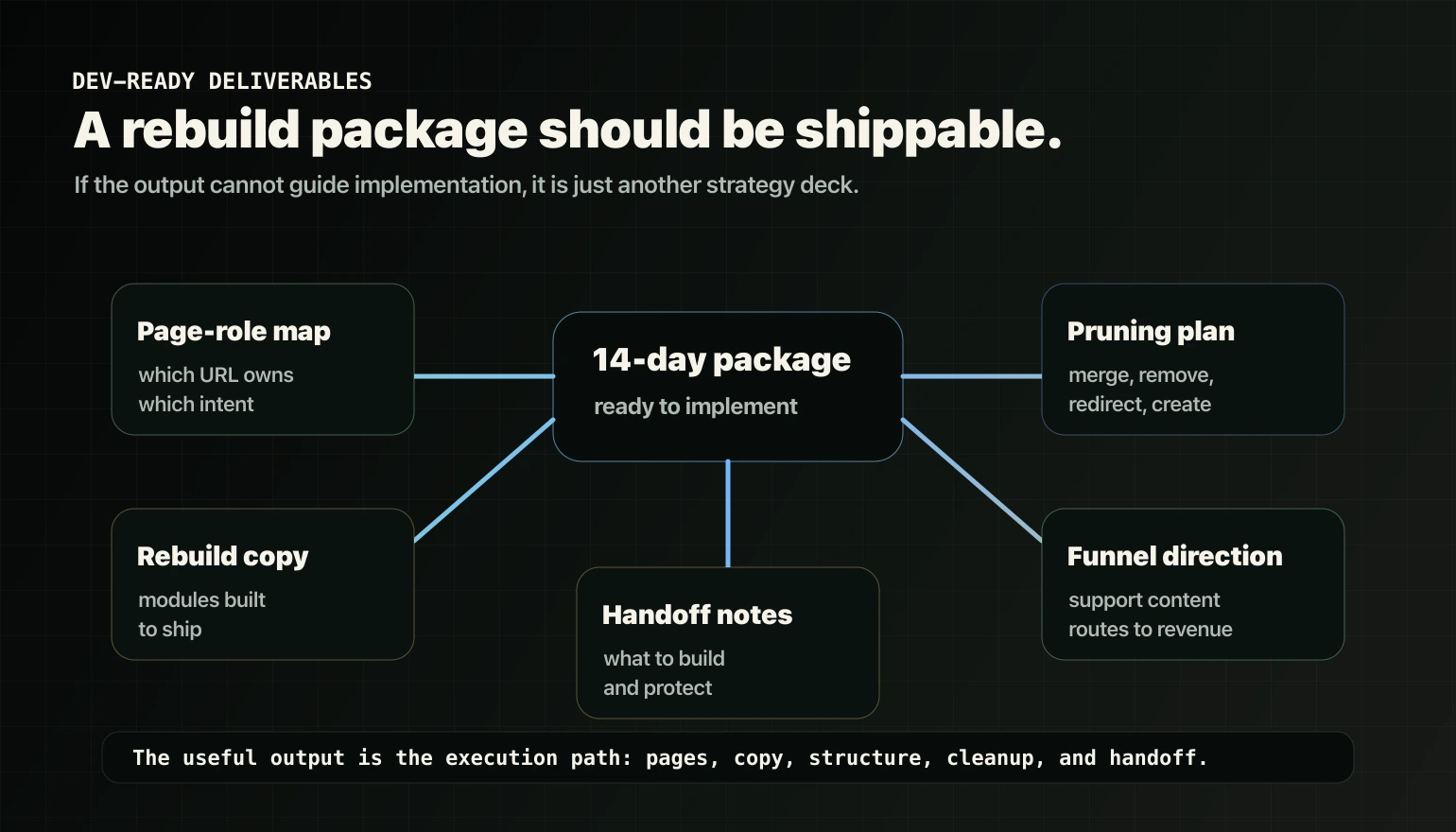
What you receive at the end
If you have been burned by "strategy decks" that do not ship, this is the difference: the rebuild is delivered as a ready-to-implement package.
The package can include:
- business and service entity definition,
- page-role map for core URLs,
- dev-ready copy and modules,
- trust sections, CTA logic, and decision-support sections,
- keep, merge, remove, and create recommendations,
- navigation and structure refinements,
- new URL planning where needed,
- pruning plan for overlapping content,
- one service-support content funnel,
- internal linking guidance,
- schema guidance for key page types,
- implementation handoff and walkthrough.
Design is not the core offer. The output is built so your developer, designer, internal team, or agency can implement it cleanly.
What we need from you to keep the timeline clean
Keep this simple. We do not need a long brief. We need enough context to make decisions quickly and correctly.
Required:
- website URL,
- business name,
- main service or offer,
- main market, city, or region,
- what feels broken right now,
- what a good outcome would look like in the next 90 days.
Optional:
- Google Business Profile link,
- recent redesign or relaunch notes,
- developer or content team context,
- pages you want reviewed first,
- proof assets you already have.
What can extend the timeline
The 14-day turnaround is a strong fit for eligible starter scopes. The timeline can extend when the footprint is larger or the cleanup is heavier.
Common reasons include:
- more than roughly 25 core URLs, excluding blogs,
- multi-location structures that need tighter ownership control,
- legacy-heavy overlap from years of duplicated service or location pages,
- regulated or complex offers that require higher precision,
- slow approvals or unclear priority services.
If the project needs a larger scope, the worst move is pretending the same 14-day promise still applies. That is how rebuilds become rushed, vague, and expensive to fix later.
Implementation after the handoff
The rebuild supports two implementation styles.
Option 1: handoff-first
We deliver the rebuild package and your team implements.
This fits when you already have a developer or agency ready to build immediately and you need a clean package with clear structure and easy execution.
Option 2: guided rollout
We support implementation, review what gets built, and help protect the structure during launch.
This fits when the build needs QA, structural guardrails, migration support, or cleanup discipline during rollout.
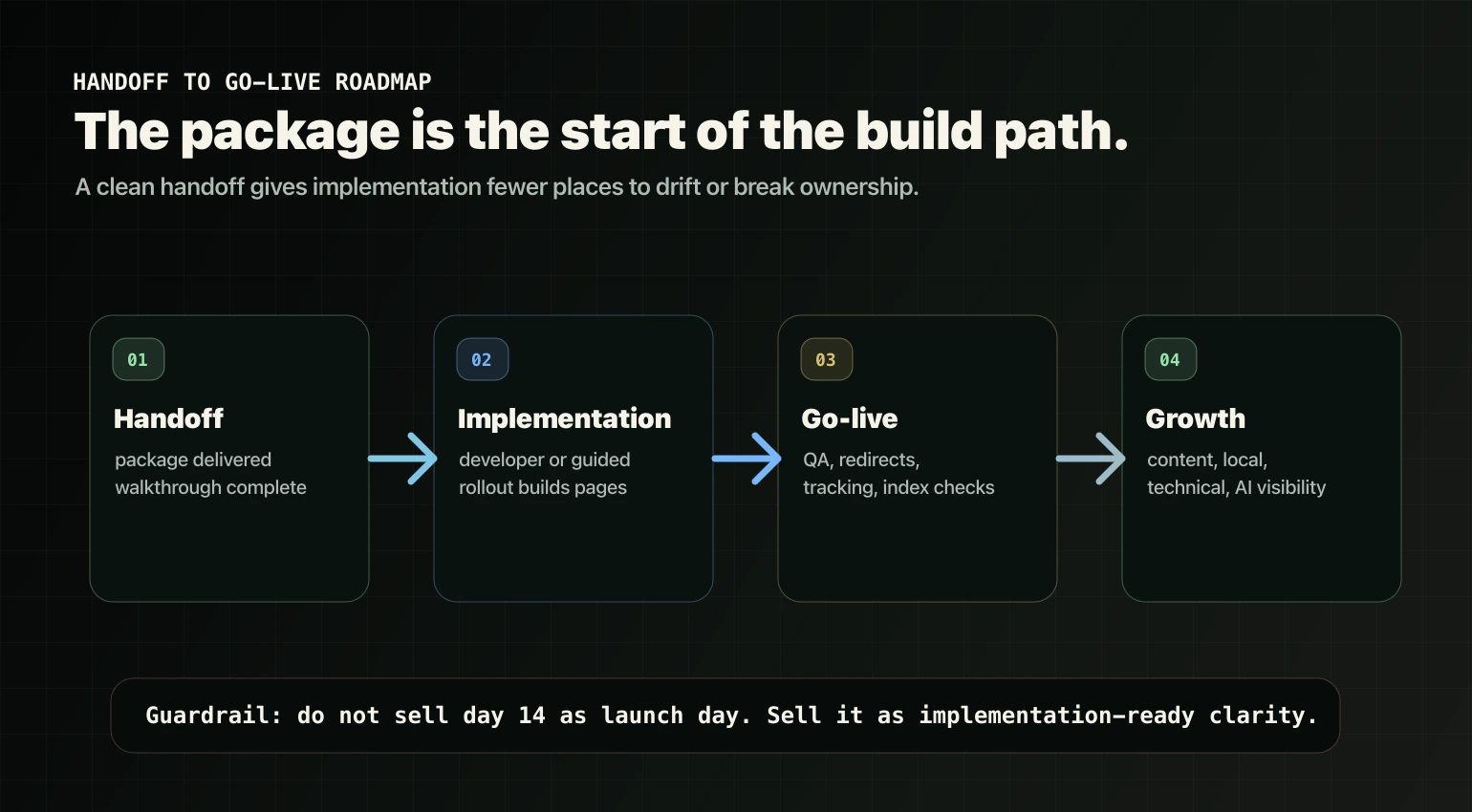
What to expect after go-live
A rebuild fixes the foundation: page meaning, ownership, routing, and decision support. Once that foundation is live, search demand has somewhere useful to land.
Timing depends on crawl behavior, indexation, competition, implementation quality, and how quickly the changes ship. But the bigger point is this:
- before rebuild, activity often compounds on weak structure;
- after rebuild, content, local, technical, and AI visibility work have a stronger base to compound on.
For a real example of foundation-first work, read the HR advisory rebuild case study: https://seoinformatica.com/case-studies/confidential-hr-advisory-rebuild/
Important: we do not guarantee rankings, lead volume, or AI citations. We improve structure, pages, and execution quality so outcomes have a stronger base.
Frequently Asked Questions
Is the 14-day timeline the launch date?
No. It is the standard turnaround for delivering a ready-to-implement rebuild package for eligible starter scopes. Go-live timing depends on your implementation path and approvals.
Is this just an SEO audit?
No. The Free Website Lead Leak Diagnosis is the entry point for clarity. A Lead Gen Rebuild is a structured paid engagement with implementation-ready deliverables: page roles, rebuild copy and modules, structure direction, pruning, and handoff.
Do you rewrite existing pages?
Yes. Existing pages may be rebuilt, merged, removed, or supported by new pages depending on what the site needs to reduce overlap and improve ownership.
Do you also implement the work?
Implementation support is available. Some clients prefer handoff-first; others prefer a guided rollout with review and structural guardrails.
What if our site is still new?
That is often the best time to do this. A strong foundation early can prevent years of patchwork corrections later.
Do you guarantee rankings or leads?
No. We improve the structure, pages, and execution quality that support stronger outcomes. We do not guarantee rankings, lead volume, or AI citations.
Start with diagnosis
If you want the shortest path to clarity, start with the Free Website Lead Leak Diagnosis: https://seoinformatica.com/start/