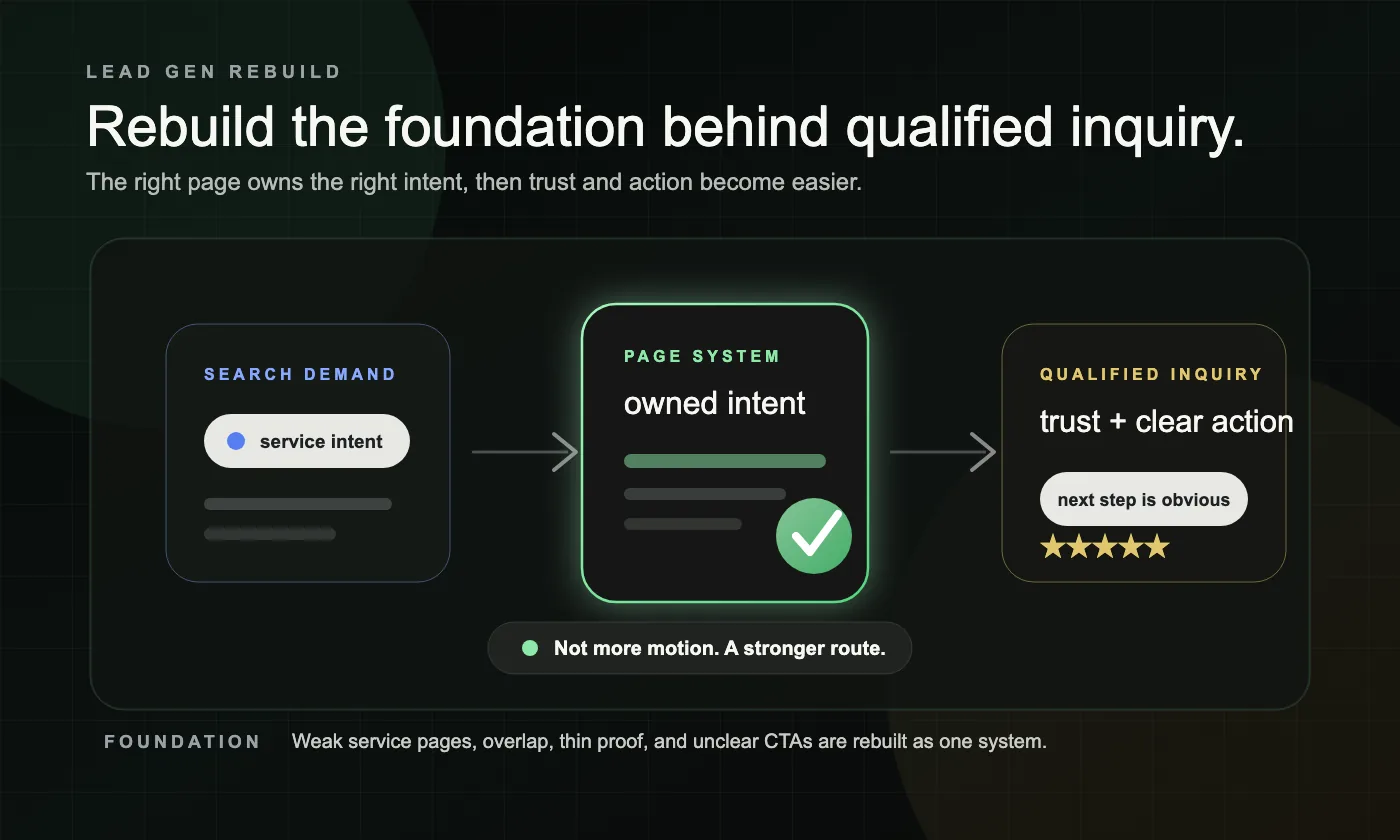
A Lead Gen Rebuild is a search-led website foundation rebuild for service businesses. It fixes the parts of a website that make search visibility hard to convert: weak service pages, unclear page roles, messy structure, overlapping URLs, thin proof, and unclear next steps.
This is not a visual facelift first. It is the work of making the right page own the right intent so traffic has a stronger path to qualified inquiry. If the site already feels active but still hard to trust, hard to explain, or hard to grow cleanly, our Lead Gen Rebuild page shows what that work looks like.
Why would a business need a Lead Gen Rebuild?
A business usually needs a Lead Gen Rebuild when the real bottleneck is not traffic volume. The bottleneck is that the website is not set up to help the right visitor understand the offer, trust the page, and take the next step.
That is why some sites keep publishing, redesigning, or tweaking forms without really fixing the lead problem. The activity changes, but the route stays weak.
Use this quick diagnosis checklist:
- Traffic exists, but qualified inquiries stay inconsistent
- The homepage or blog keeps ranking for service terms that should belong to a service page
- Service pages feel broad, duplicated, or hard to tell apart
- Visitors reach important pages, but the offer still feels vague
- The site has proof somewhere, but not where people decide
- More content keeps getting added without a clearer page system underneath it
Search Console’s Performance report is still the fastest place to see whether the wrong queries are landing on the wrong pages.
How is a Lead Gen Rebuild different from a redesign, a diagnosis, or ongoing growth?
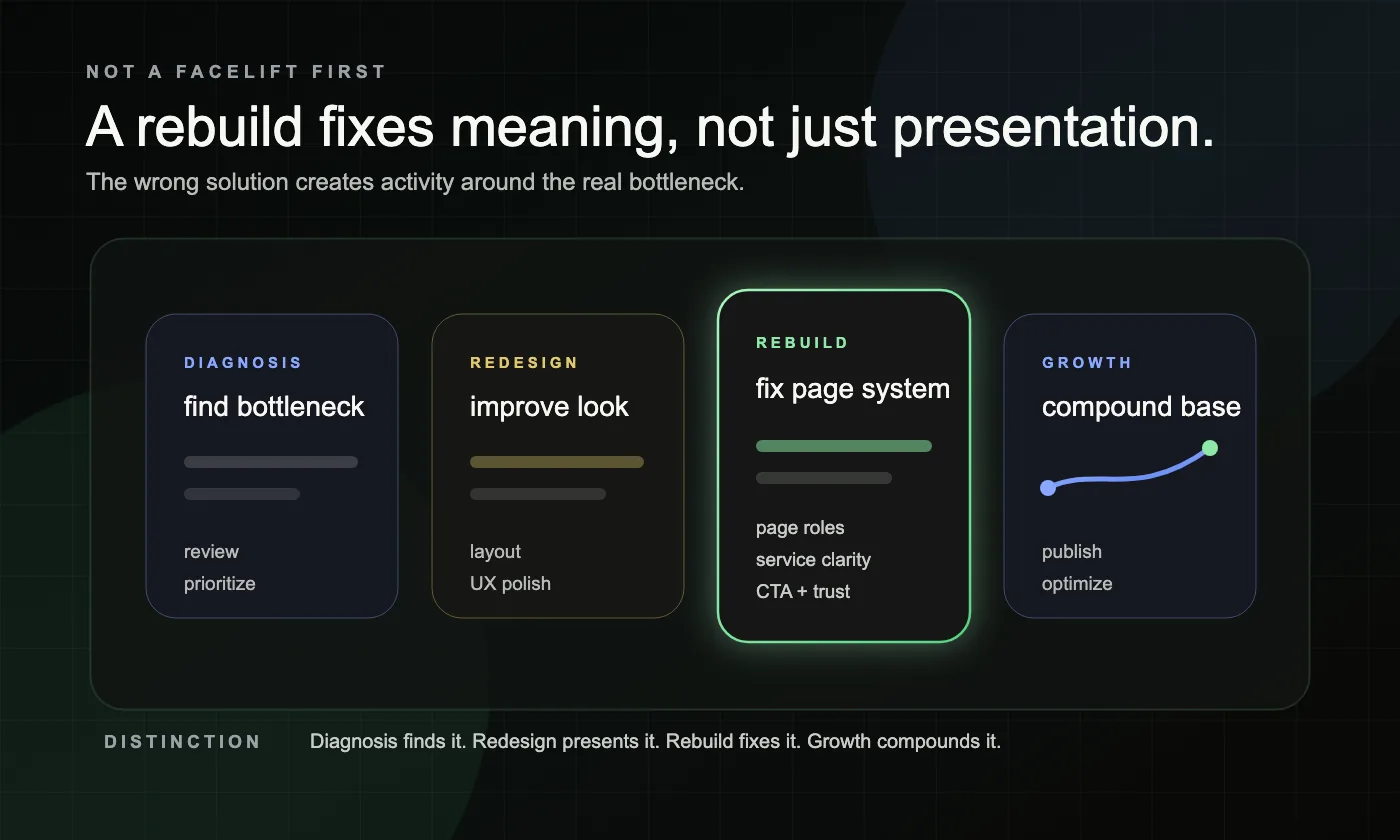
A Lead Gen Rebuild is not the same thing as a visual redesign, and it is not the same thing as a diagnosis. A diagnosis finds the bottleneck. A redesign improves how the site looks and feels. A Lead Gen Rebuild changes the foundation that affects page meaning, routing, and lead quality.
| Option | Main job | Best fit | What changes most |
|---|---|---|---|
| Diagnosis | Find the real bottleneck | The next move is still unclear | Review, prioritization, and recommendation |
| Redesign | Improve presentation and usability | The site still works structurally but feels dated, off-brand, or hard to use | Layout, visuals, UX, and interface polish |
| Lead Gen Rebuild | Fix the page system that supports lead flow | The site has weak page ownership, overlap, weak service pages, or poor decision support | Page roles, service-page direction, pruning, trust, CTA flow, and content direction |
| Ongoing Growth | Compound from a stronger base | The foundation is already clear enough to improve iteratively | Publishing, page improvements, local/technical support, and expansion |
This distinction matters because the wrong solution wastes time. A redesign can improve appearance while leaving the real lead bottleneck untouched, and ongoing growth can add motion around a foundation that still needs structural correction.
If the base is already fairly clear and the next need is compounding visibility, our Ongoing Growth page explains that path.
What does a Lead Gen Rebuild actually fix?
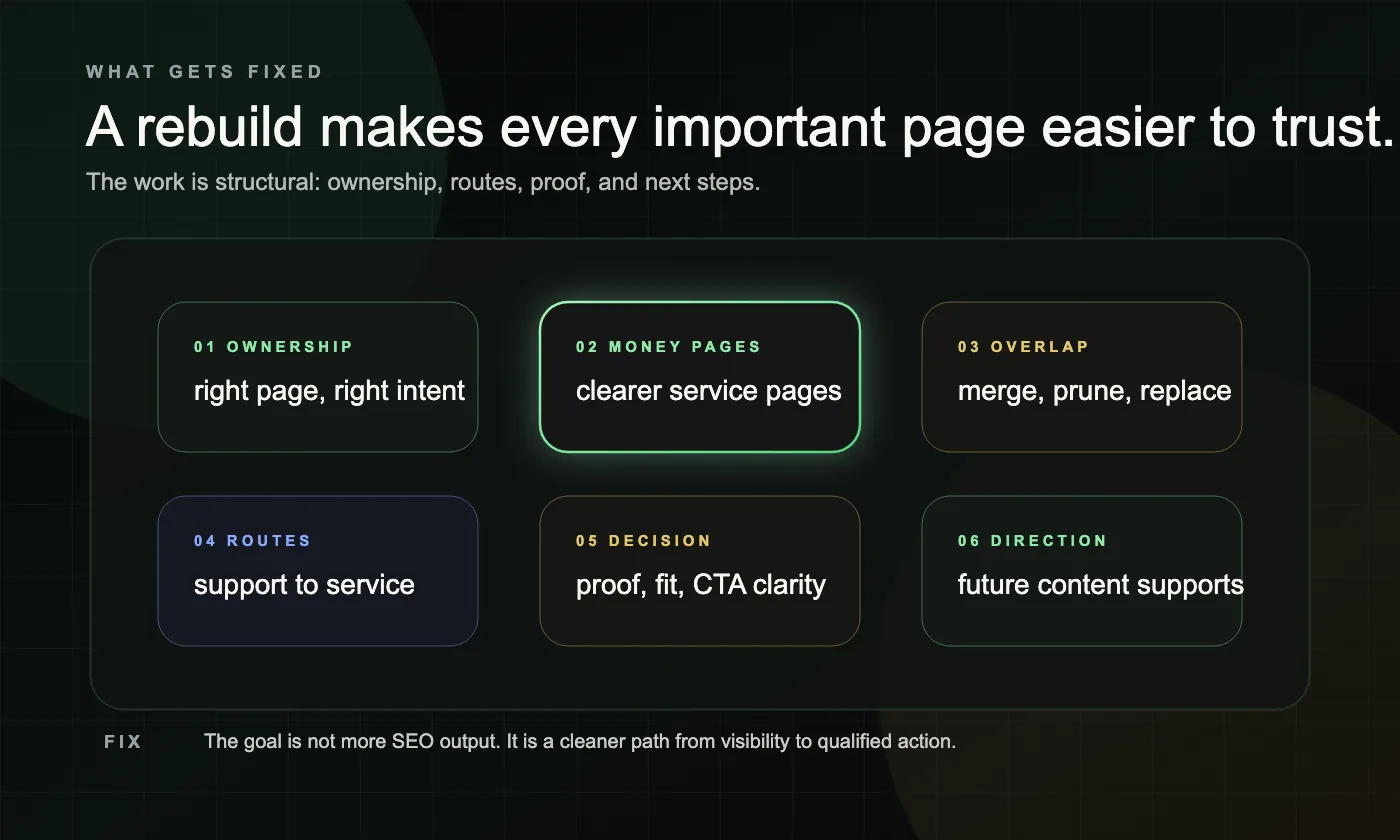
A Lead Gen Rebuild fixes the parts of the site that determine whether demand can turn into action. That usually means service clarity, page ownership, structure, core pages, trust blocks, CTA logic, overlap, and the first support-content route around a priority service.
If you need the operating sequence, read the Lead Gen Rebuild timeline; once the rebuild is live, use what to expect after a rebuild to keep the first 30, 60, and 90 days focused.
In practice, that often includes:
- deciding which page should own each important commercial intent
- rebuilding the pages closest to revenue
- merging, pruning, or replacing overlapping URLs
- tightening internal routes between support content and money pages
- adding decision support such as process, fit guidance, proof, FAQs, and next-step clarity
- resetting content direction so new publishing strengthens the right page instead of competing with it
This is also why a Lead Gen Rebuild is different from “more SEO.” It is not mainly about adding more content. It is about making the existing and future content land in the right places.
Google’s link best practices are still the simplest reference when internal routes and page relationships need to become easier for people and search systems to follow.
What does this look like in a real service business example?
A Lead Gen Rebuild usually changes the site’s roles and sequence more than its visual style. Two composite examples make the pattern easier to see.
Composite example 1: A home service business had good local visibility and steady clicks, but most non-branded traffic landed on the homepage and a few broad blog posts. The service pages were thin, too similar to each other, and weak on proof. The fix was to give each core service a clearer page, rebuild the first screen and trust sections, prune overlap, and route support content back to the right service page.
Composite example 2: A founder-led B2B service firm had a polished site with decent traffic, but the structure made every service sound similar. Buyers could tell the business was credible, but not which page fit which problem or what happened after contact. The rebuild focused on service clarity, page-role separation, stronger decision support, and a cleaner path from article to service page to inquiry.
In both cases, the real win was not “more traffic.” The real win was making the site easier to understand, easier to trust, and easier to act on.
What should you fix first before rebuilding?
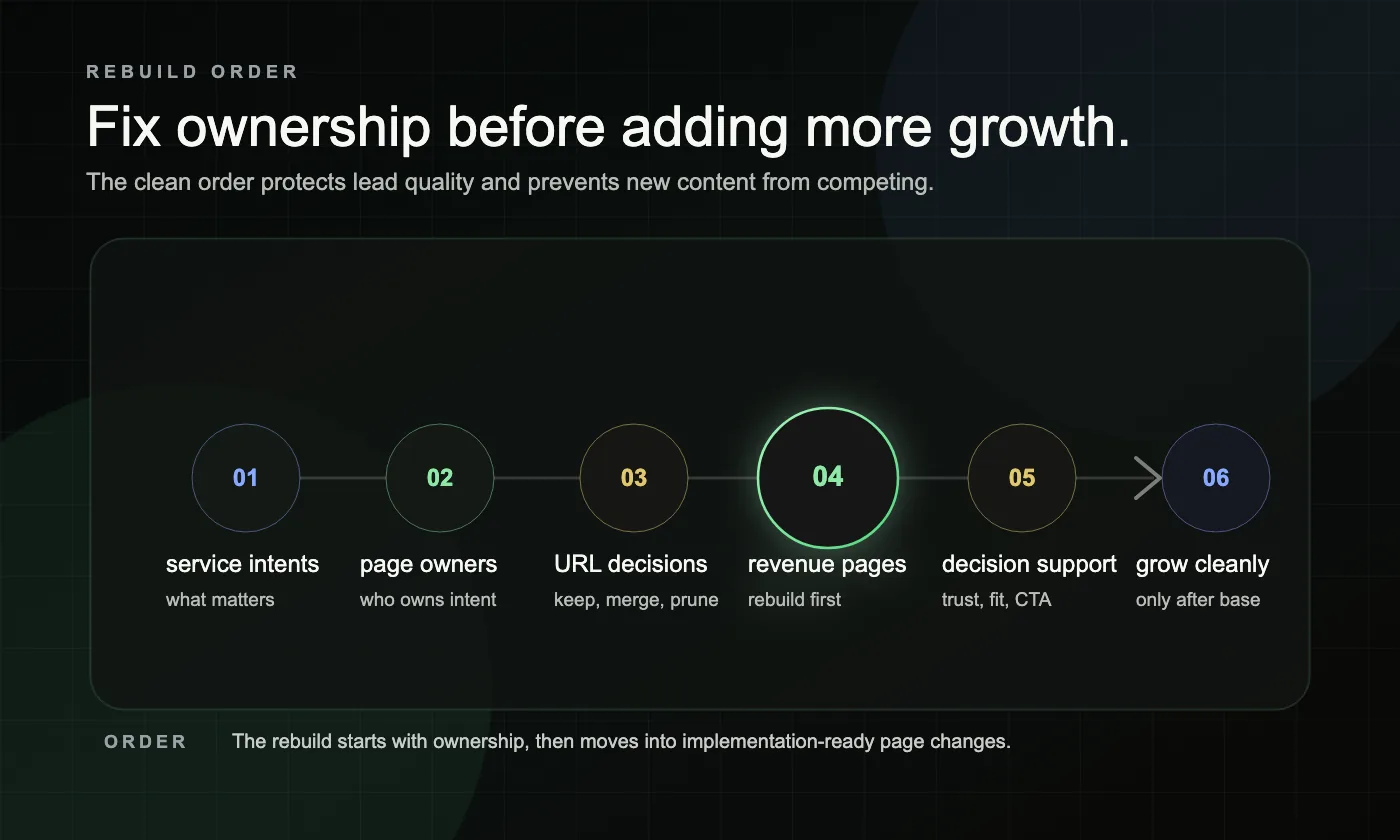
Fix ownership and diagnosis first. A rebuild works best when it starts with clarity about which page should own which intent and which parts of the site are only creating noise.
Use this order:
- Identify the main service intents that matter to lead quality
- Decide which pages should own those intents
- Mark existing URLs as keep, merge, rewrite, replace, or remove
- Rebuild the pages closest to revenue before expanding blog volume
- Tighten trust, process, fit, and CTA clarity on those pages
- Only then expand content, local support, or broader growth work
Google’s people-first content guidance is a useful filter when deciding which pages deserve to stay, which should be merged, and which should stop existing only for search coverage.
If this process shows that the problem is bigger than one page and smaller fixes keep getting buried, our Lead Gen Rebuild page is the best next read.
What mistakes make businesses rebuild the wrong thing?
Most rebuild mistakes happen when the business treats the symptom instead of the system. That usually means changing how the site looks while keeping the same weak page roles underneath it.
Common mistakes and red flags include:
- assuming a redesign will solve a structural clarity problem
- publishing more blog content while service pages still feel vague
- keeping several overlapping URLs because each one gets a little traffic
- rebuilding copy without deciding which page should own the query
- treating forms as the main issue when the page still does not build enough confidence
- asking for monthly SEO growth before the base is clear enough to support it
A useful test is simple: if someone lands on a core page and still cannot tell what the service is, who it is for, why it is different, and what to do next, the site probably needs more than visual polish.
Frequently asked questions
Is a Lead Gen Rebuild just a website redesign?
No. A redesign mainly improves presentation and user experience. A Lead Gen Rebuild goes deeper into page roles, service meaning, overlap, decision support, and the path from visibility to inquiry.
Is a Lead Gen Rebuild just an audit?
No. A diagnosis finds the bottleneck. A Lead Gen Rebuild turns that diagnosis into implementation-ready structural and page-level changes.
Can existing pages stay, or does everything get rebuilt from scratch?
Existing pages can absolutely stay when they still deserve their job. The point is not to replace everything. The point is to keep what works, strengthen what matters, and remove what dilutes the system.
How do I know if I need a rebuild or ongoing growth?
If the main pages are already clear and the next need is expansion, ongoing growth is usually the right move. If the site still has weak service pages, confusing structure, overlapping URLs, or unclear lead paths, rebuild should come first.
Get a free clarity diagnosis.
If the site is getting attention but the route to inquiry still feels weak, get a free clarity diagnosis.