

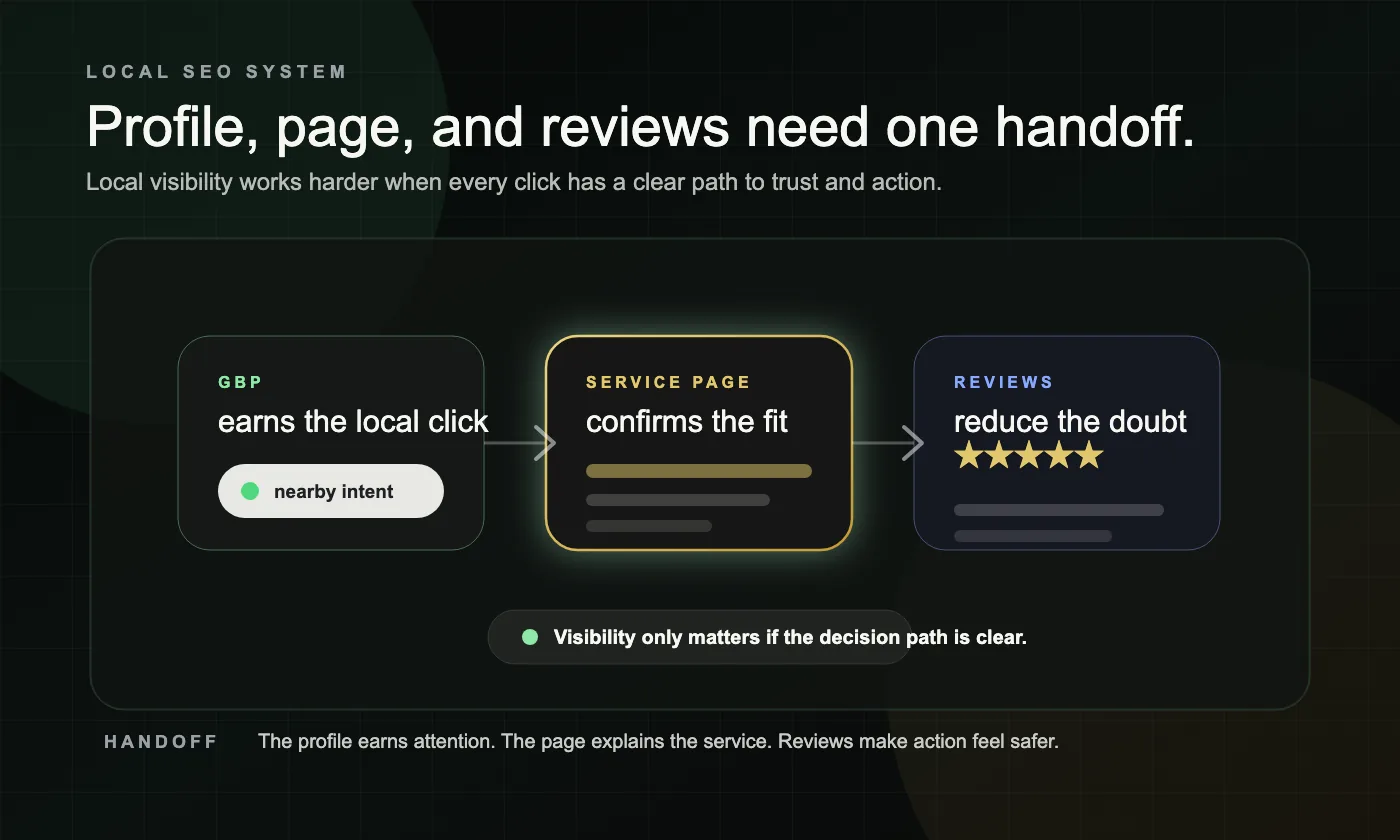
Local SEO for service businesses works best when three things align: your Google Business Profile earns the local impression, your service page confirms the fit, and your reviews reduce doubt. If one of those layers is weak, you can still get visibility without getting the right leads.
Our Local SEO page explains how we connect profile work, local pages, and lead routing so local visibility has a better path to inquiry.
Why do GBP, service pages, and reviews need to work together?
Because local SEO is not one asset. It is a handoff between visibility and decision-making.
Google Business Profile helps you appear for nearby intent. The service page helps a visitor understand the service, the fit, and the next step. Reviews help reduce the risk of choosing you. When those three pieces do not support each other, the business may still show up but the lead path stays weak.
Use this quick diagnosis table to spot where the breakdown is happening:
| Layer | Main job | Common failure pattern | What to fix first |
|---|---|---|---|
| Google Business Profile | Match local searches quickly | Wrong category, incomplete info, old hours, weak service setup | Fix core profile accuracy |
| Service page | Explain the service and move the visit forward | GBP sends clicks to the homepage or a vague page | Fix the landing page first |
| Reviews | Add third-party trust | Very few reviews, weak review mix, or no replies | Build an honest review process |
| Routing | Connect local clicks to the right page | Profile, page, and local intent are not aligned | Tighten page ownership and links |
What diagnosis framework should you use before changing local SEO?
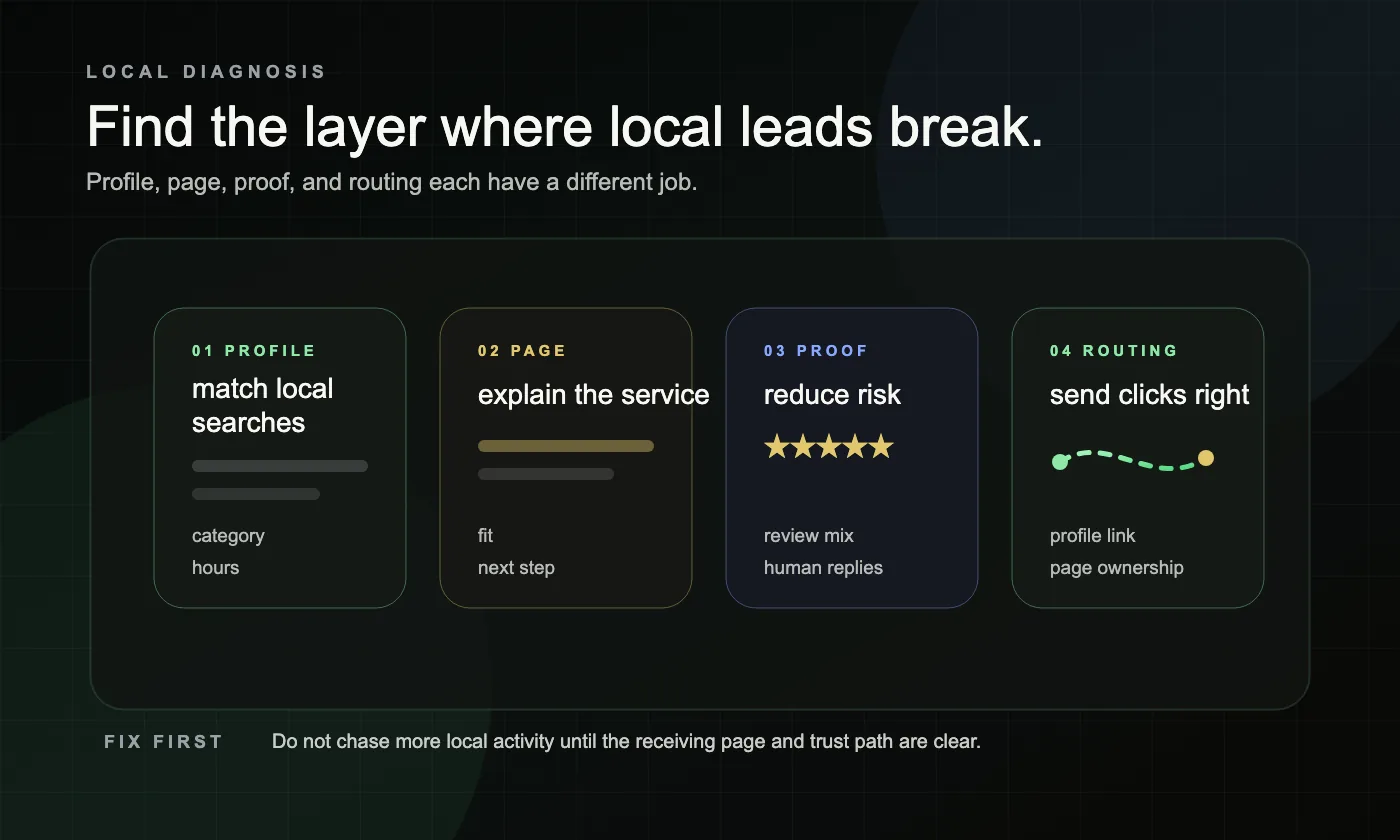
Use a simple four-part diagnosis: profile, page, proof, and routing. That keeps the work focused on what actually affects local lead flow instead of turning local SEO into a pile of disconnected tasks.
Profile
Start with the Business Profile itself. The category, service setup, hours, phone number, service area, and website link should all support the real business and the real offer.
Google says complete and detailed profile information helps it match a business to relevant searches, and that local visibility is shaped by relevance, distance, and how well-known the business is. Google’s local ranking guidance is the clean reference for that baseline.
Page
Then look at the page receiving the click. For most service businesses, that should be the page most likely to help someone decide, not just the broadest page on the site.
Proof
Next, review the trust layer. Reviews, review replies, and on-page proof need to work together so the visitor does not have to guess whether the service is credible.
Routing
Finally, check whether the system routes people correctly. If the profile points to the wrong page, the right page has no local clarity, or nearby support pages compete with each other, local traffic gets wasted.
Use this checklist before making new pages or chasing more visibility:
- Is the profile verified and accurate?
- Does the primary category reflect the core service?
- Is the profile linking to the page that best matches the main local intent?
- Does that page explain the service, the area, the fit, and the next step clearly?
- Do reviews and review replies reduce doubt, or just sit there passively?
- Can a visitor move from search result to service page to inquiry without getting lost?
How should you optimize Google Business Profile for local service intent?
Start with accuracy before activity. A service business usually needs the right category, complete core details, a correct service setup, and a profile that looks real and current before any optimization starts to matter.
If customers do not visit your business address, set the profile up as a service-area business and show the service area instead of a public address. Google’s service-area business guidance explains that setup.
A practical profile checklist looks like this:
- Verify the profile
- Choose the most accurate primary category for the core business
- Keep phone number, hours, and website link current
- Add services in plain language
- Use real photos that reflect the actual business
- Make sure the service area matches where the business truly operates
- Review the website link and confirm it sends people to the right page
A useful rule here is simple: if the profile gives one picture of the business and the website gives another, local SEO gets weaker.
What should local service pages do that Google Business Profile cannot?
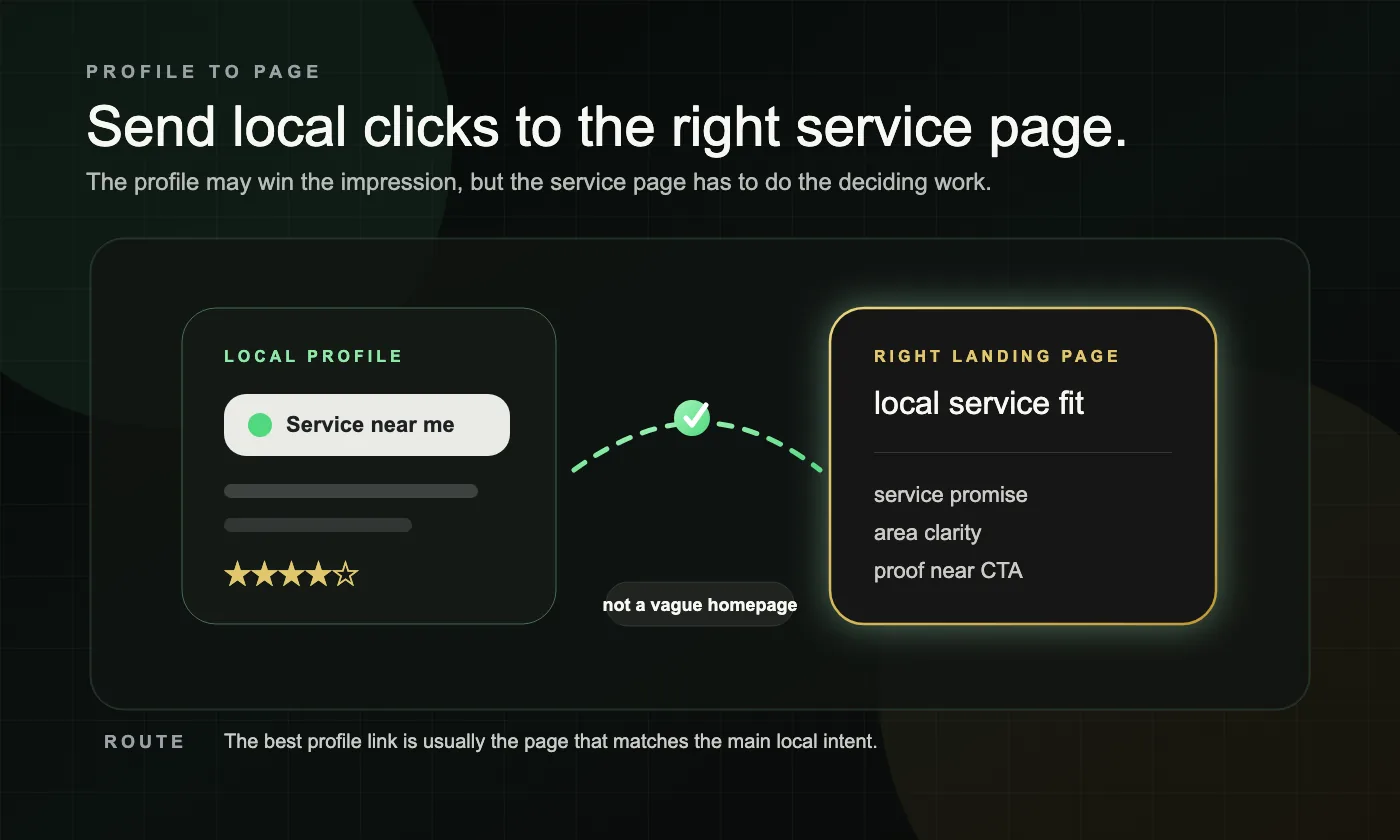
A profile can surface you, but it cannot explain the service in enough depth to close the decision. The local service page has to do that work.
For a service business, the page should answer the local version of the buyer’s real questions: what do you do, who is it for, where do you do it, what does the process look like, and what should I do next?
That usually means the page needs:
- a clear local service promise
- a short explanation of the problem the service solves
- service-area clarity where it matters
- process or expectation-setting
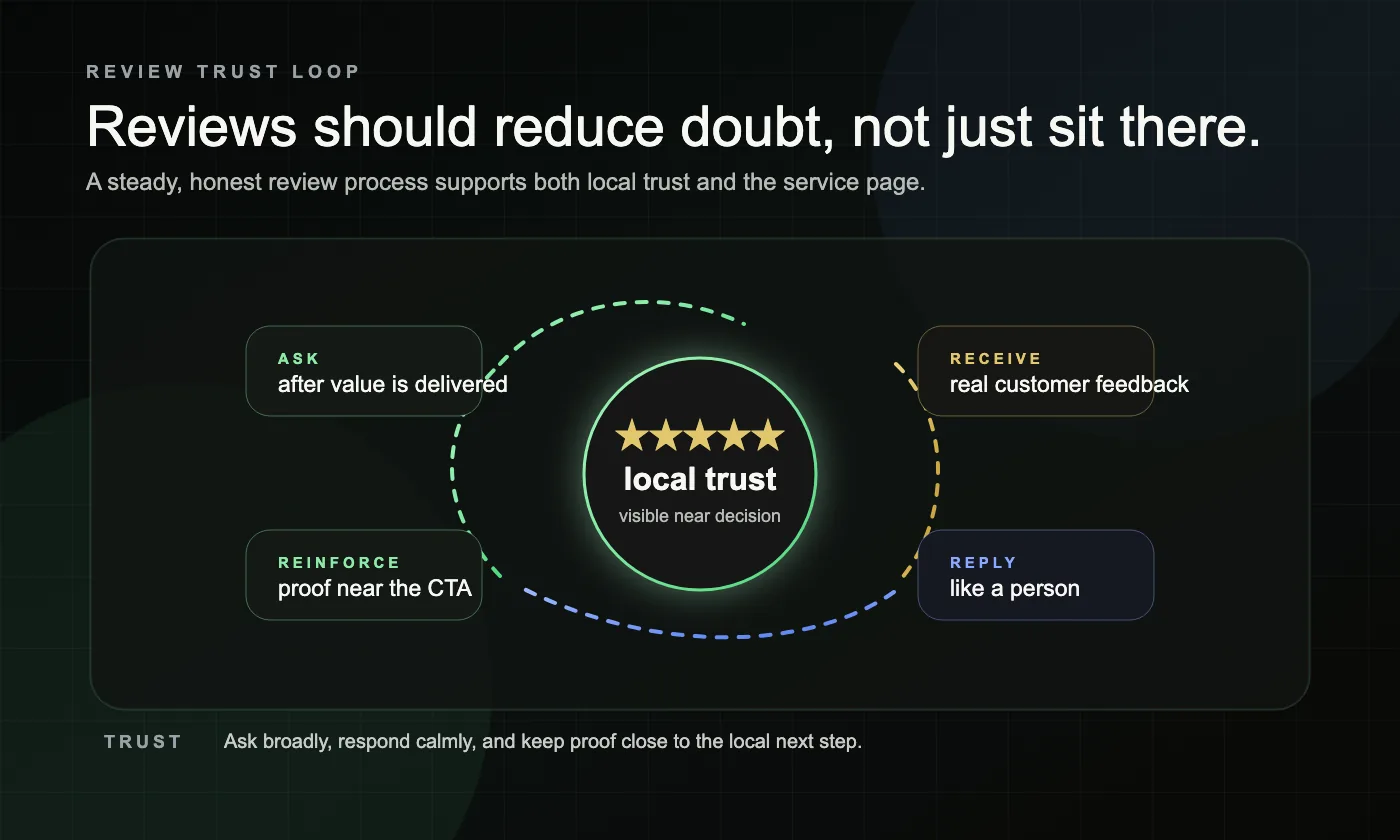
- proof near the CTA
- one obvious next step
This article is about the core local service page, not a copy-paste city-page expansion plan. If local clicks are already coming in but the service pages still feel vague, weak, or overlapping, our Website Rebuild page is the better next read.
How do reviews influence local trust and local rankings?
Reviews help in two ways. They influence how trustworthy the business looks to a human, and Google also says more reviews and positive ratings can help local ranking.
Google also says honest and balanced reviews help potential customers decide, and that a mix of positive and negative feedback often feels more trustworthy. Google’s review guidance is useful context here.
That makes the real goal simple: build a repeatable, policy-safe process for collecting genuine feedback after real customer experiences.
Use this review checklist:
- Ask every real customer, not just the happiest ones
- Ask after value has been delivered, not at a random moment
- Use a simple review link or request method
- Reply like a person, not a script
- Thank people briefly when useful
- Respond calmly and clearly to negative reviews
- Flag reviews that violate policy instead of arguing with them publicly
Google does not allow incentivized, biased, or selectively solicited reviews. Its review policy guidance is worth keeping close if reviews become part of your operating process.
What does this look like in a real service business example?
In real projects, the local issue is often not “we need more maps visibility.” It is that the profile, the page, and the trust layer are not handing off cleanly.
Composite example 1: A restoration company had a solid Business Profile and enough reviews to look credible, but the website link went to a generic homepage. The profile won the click, but the site did not immediately explain the local service, emergency fit, or next step. The fix was not more local SEO activity. The fix was sending that traffic to the right service page and tightening the page’s opening, FAQ, proof, and CTA flow.
Composite example 2: A service-area electrician had a decent website and a clear service page, but review growth was thin and old reviews sat unanswered. The business looked technically present but socially quiet. The fix was a consistent post-job review request process, human replies, and clearer proof near the inquiry point on the page.
In both examples, local SEO improved when the system got tighter, not when the task list got longer.
What should you fix first if local visibility exists but leads are weak?
Fix the landing page and profile-to-page alignment first. More profile activity does not solve a page that does not help someone decide.
Use this order:
- Decide which page should receive your main local commercial clicks
- Fix the profile basics so the category, service setup, hours, and website link support that page
- Strengthen the page so it explains the service, the fit, the area, the proof, and the next step
- Build a simple review request and reply process
- Only then expand local support pages or broader local content
If you need help tightening that local system without guessing, you can see how our Local SEO work is scoped.
What mistakes keep local SEO from turning into leads?
Most local SEO problems stay alive because the business treats visibility and conversion as separate jobs. In local search, they are connected.
Common mistakes and red flags include:
- treating GBP like a one-time setup
- linking the profile to the homepage when a local service page should own the click
- using a vague or mismatched primary category
- showing an address publicly when customers do not actually visit there
- creating local pages with no clear job
- collecting reviews in bursts instead of through a normal operating process
- offering incentives or only asking certain customers for reviews
- leaving review replies blank or robotic
- assuming profile views automatically mean the page is ready to convert
A simple test helps here: if someone sees the profile, clicks through, and still cannot tell what service is for them and what to do next, the local system is still too weak.
Frequently asked questions
Is Google Business Profile enough for local SEO?
No. It is the entry point, not the full system. A strong local setup still needs the right service page and enough trust to help someone choose you.
Can a service-area business rank without a storefront?
Yes. But the profile setup, service-area clarity, page quality, and review trust need to be stronger because the business cannot rely on a walk-in location to do that work.
Do reviews help local SEO or just conversions?
They help both. Reviews can strengthen local trust for users, and Google also says review volume and positive ratings can help local visibility.
Should the profile link to the homepage or a service page?
Usually the page that best matches the main local intent is the better destination. That is often a strong service page, not automatically the homepage.
Get a free clarity call.
If your Google Business Profile is active but local leads still feel inconsistent, get a free clarity call.