

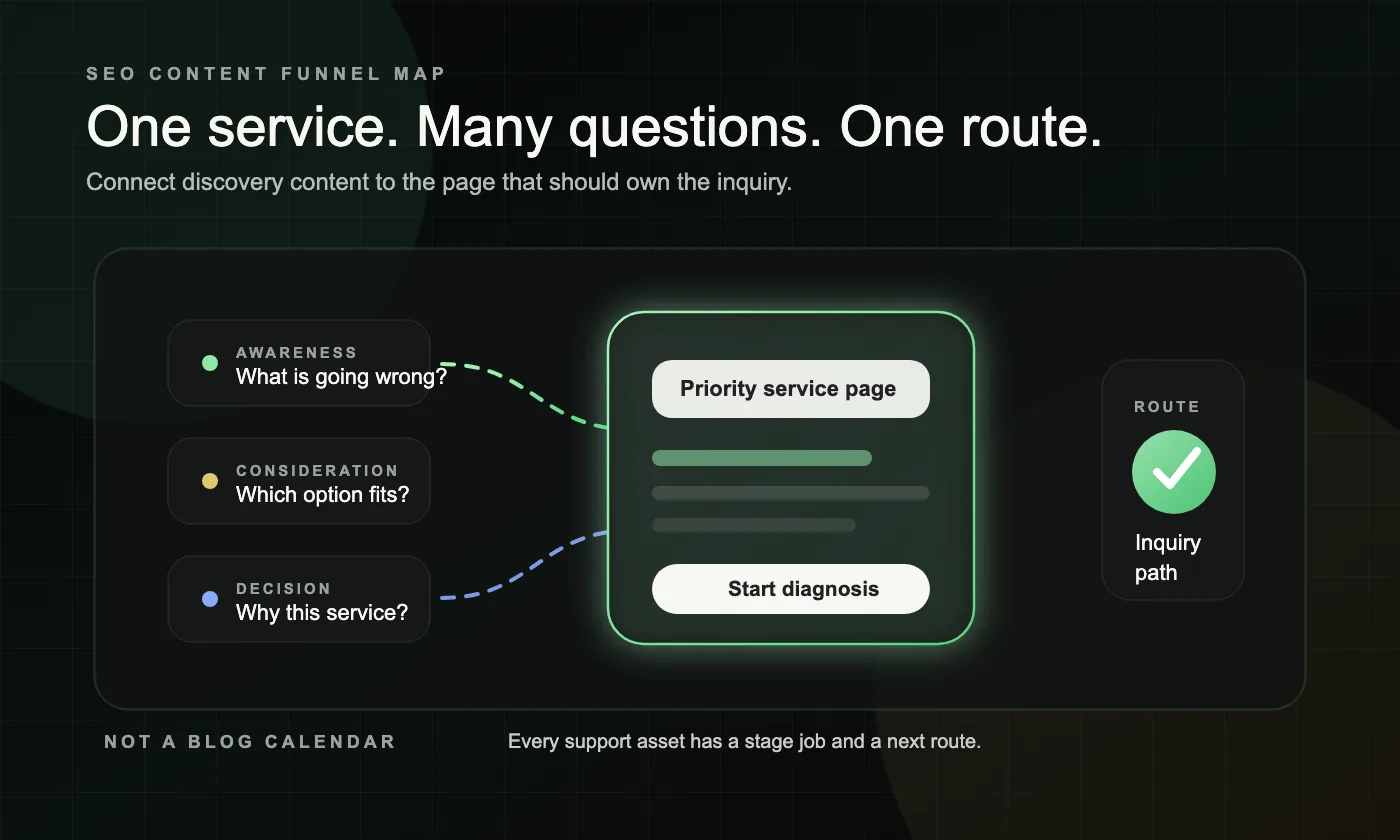
An SEO content funnel map for a service business is a simple plan that connects one priority service page to the questions buyers ask before they contact you. It is not a blog calendar. It is a route from discovery to decision.
Our Content Funnels page shows how we build support content around one priority service without creating overlap.
Why do content funnels matter for service businesses?
Because most service businesses do not have a content volume problem. They have a route problem. Posts get published, a few pages rank, and nothing consistently moves the right visitor toward the page that should own the inquiry.
A funnel solves that by giving every asset a job. One page owns the main commercial intent. The surrounding assets answer the comparison, cost, process, fit, and objection questions that show up before someone is ready to contact you.
Google’s SEO Starter Guide is still the clearest reminder that SEO has to help search engines understand your content and help users decide whether to visit.
What makes a funnel map different from a blog calendar or topic cluster?
A funnel map adds buyer stage, page ownership, and next-step routing to your content planning. It is not just a list of topics, and it is not just a topical cluster.
| Approach | What it organizes | What it usually misses | Best use |
|---|---|---|---|
| Random blog calendar | Publishing cadence | Page ownership, stage gaps, and routing | Keeping a team consistent |
| Topic cluster | Topical breadth around a subject | Decision path and conversion flow | Building authority around a topic |
| Canonical service page | Main commercial intent | Pre-sale support content around buyer questions | Converting ready buyers |
| SEO content funnel map | One service, the questions around it, and the route between them | Nothing important when the service page is already clear and strong | Turning search visibility into inquiries |
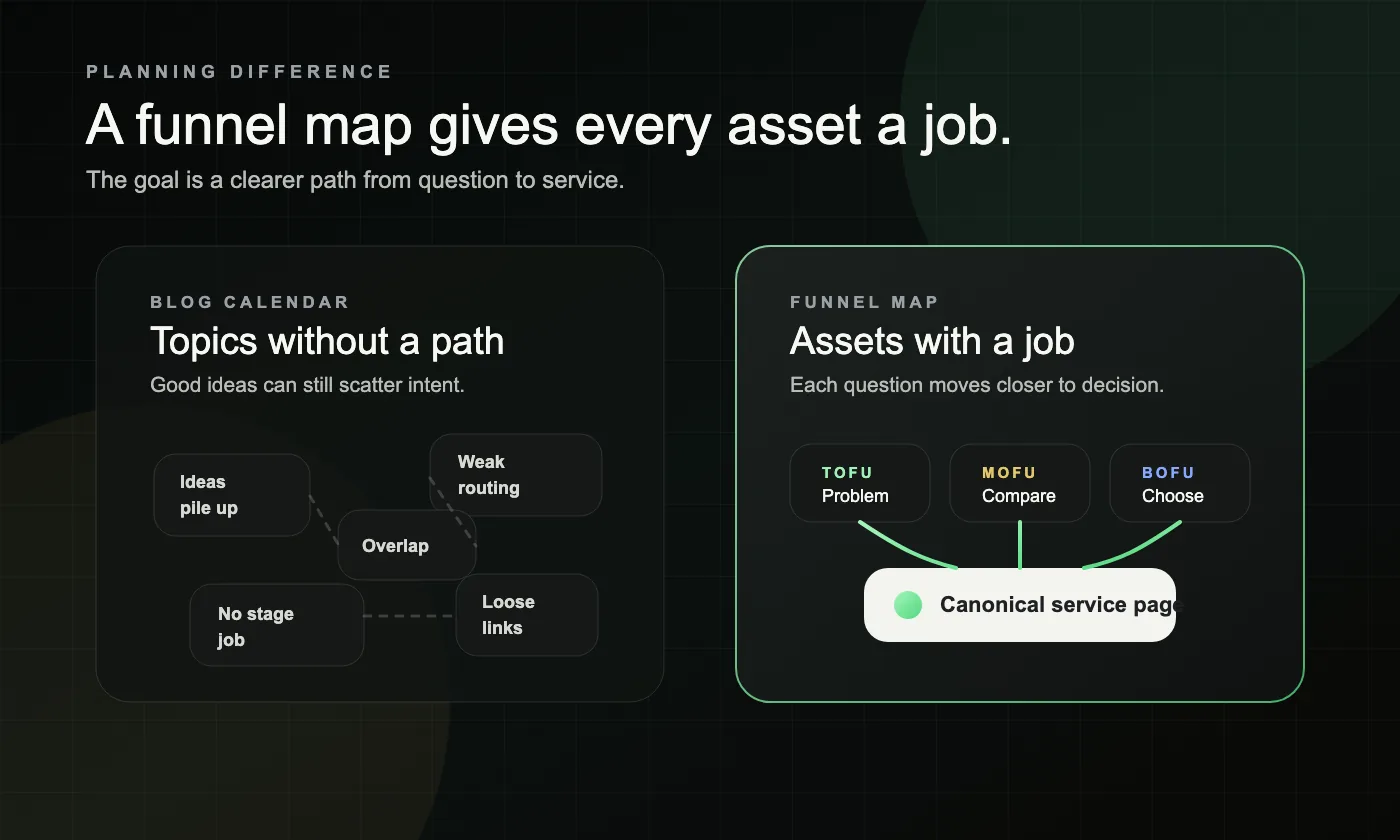
The key difference is control. A topic cluster can help you cover a subject. A funnel map makes sure that coverage moves people toward the right page instead of scattering them across disconnected posts.
How do you diagnose whether you need a funnel map or a rebuild first?
Start by deciding whether the main service page is already strong enough to anchor the funnel. If the page is weak, unclear, or overlapping with other URLs, build the foundation first. If the page is already credible and clear but lacks support content, map the funnel next.
Use this diagnosis checklist before you plan anything new:
- Can one page clearly own the main service intent?
- Does that page explain the service, the fit, the process, the proof, and the next step?
- Do existing blogs already answer real buyer questions, or are they mostly traffic-first topics?
- Do support posts link naturally back to the service page?
- Can you label your existing content as keep, update, merge, or retire?
Use Search Console’s Performance report to see which queries and pages already bring people in before you map anything new.
If the service page itself is still weak, start with a Website Rebuild before you try to scale support content.
How do you map one service into TOFU, MOFU, and BOFU?
Start with one priority service, not the whole website. Then map the buyer questions around that service into awareness, consideration, and decision stages.
For most service businesses, the map looks like this:
| Funnel stage | Buyer mindset | Best asset types | Typical questions | Next route |
|---|---|---|---|---|
| TOFU / Awareness | Problem-aware | Symptom posts, explainers, checklists, basic guides | What is going wrong? Why is this happening? | Move to a clearer process or comparison page |
| MOFU / Consideration | Solution-aware | Comparisons, process pages, cost guides, fit articles, mistake posts | Which option is right? What does it cost? What should I expect? | Move to the canonical service page |
| BOFU / Decision | Provider-aware | Service page, consultation page, case-style proof, decision FAQ | Why choose this service? What happens next? | Move to inquiry or diagnosis |
| Support / Post-inquiry | Confidence-building | FAQs, implementation guides, care content, follow-up proof | What happens after contact? What should I prepare? | Reinforce trust and reduce drop-off |
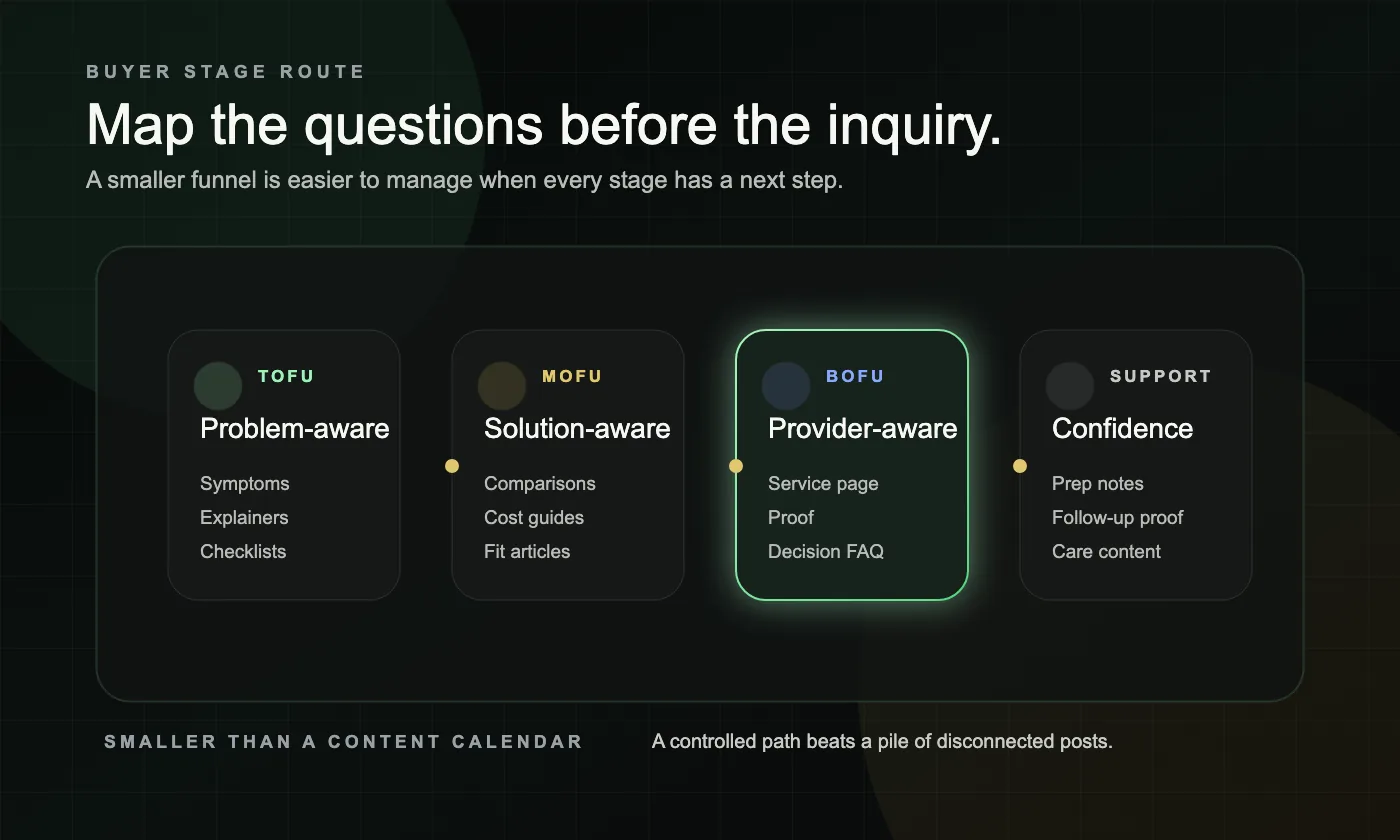
That is why the best funnel maps usually feel smaller than people expect. They are not giant editorial wish lists. They are controlled paths built around one service page that matters.
Keep internal links crawlable and descriptive so support assets actually strengthen the right page. Google’s link best practices are a useful baseline for that work.
What does a real service-business funnel map look like?
A real map is easier to understand when you see it anchored to one service instead of a broad category.
Composite example 1: A roofing company wanted more emergency repair inquiries. The anchor page was the emergency roof repair service page. The support map around it included a TOFU article on why roofs leak after heavy rain, a MOFU comparison on roof repair vs. replacement after storm damage, a second MOFU guide on what affects emergency repair cost, and a BOFU service page that made next steps obvious. The win was not “more roofing content.” The win was giving urgent, high-intent visitors a clear route.
Composite example 2: A managed IT provider had useful blog traffic but weak lead flow. The anchor page was managed IT support for small businesses. The support map around it included a TOFU post on signs a company has outgrown break-fix support, a MOFU comparison on break-fix vs. managed IT, a MOFU article on onboarding expectations, and a BOFU page that handled fit, process, and next step. The site did not need more disconnected thought leadership first. It needed one clear decision path.
In both cases, the funnel only started working once one page owned the buying intent and the surrounding articles stopped competing with it.
What should you fix first before publishing more funnel content?
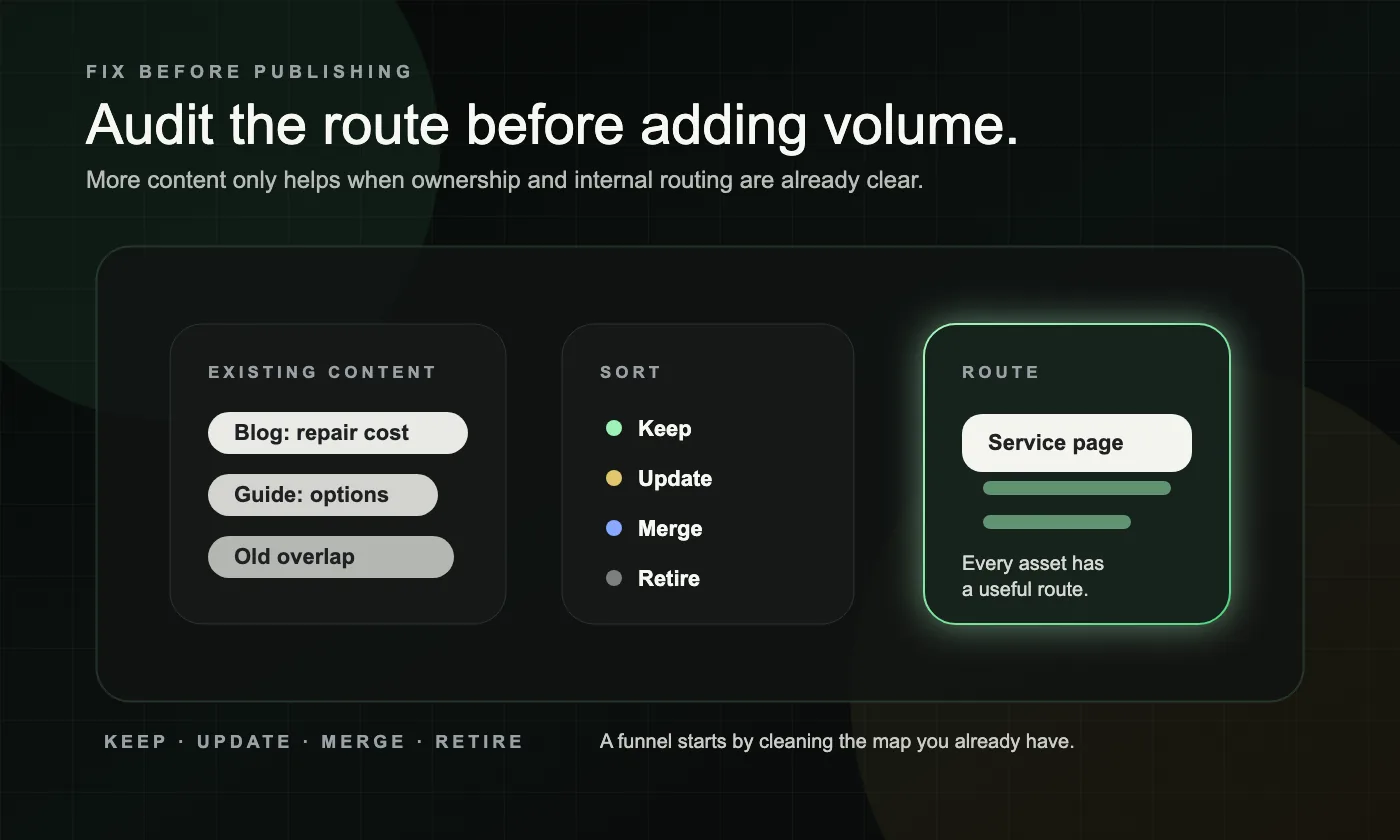
Fix ownership and routing before you expand volume. More publishing into a weak structure usually creates more noise, not more leads.
Use this order:
- Choose one priority service.
- Decide which page should own the main commercial intent.
- Audit existing content and mark each asset as keep, update, merge, retire, or repurpose.
- Fill the highest-leverage MOFU gaps before adding more broad awareness content.
- Add natural internal routes from support content to the service page and then to the next step.
- Set a refresh cycle so the funnel does not drift into overlap six months later.
Google’s people-first content guidance is a useful filter when a planned asset sounds like filler instead of a real answer to a buyer question.
You can see how this looks when mapped around one priority service on our Content Funnels page.
What mistakes break SEO content funnels for service businesses?
Most broken funnels fail for predictable reasons. They either start with random content, protect nothing, or never give readers a useful next step.
Common mistakes and red flags include:
- Building content around keyword volume before choosing the service page that should own the inquiry
- Letting support posts target the same commercial phrase as the service page
- Publishing only awareness content while comparison and decision content stay thin
- Skipping the content audit, so old overlapping pages stay live and keep diluting the funnel
- Using weak internal links that never clearly point back to the service page
- Trying to map every service at once instead of proving one priority funnel first
- Treating AI-written output like a funnel strategy when no real buyer path has been defined
A useful test is simple: if your most-read article does not lead naturally to a more commercial next step, you do not have a funnel yet. You have a destination page.
Frequently asked questions
Should every service have its own funnel?
Eventually, your priority services should each have their own funnel. But do not start there. Start with the service that matters most for revenue or lead quality, then expand once the model is working.
Do blog posts sit at the top and service pages at the bottom?
Often, yes, but not always. Some blog posts are middle-of-funnel assets because they answer comparison, cost, process, or fit questions. The service page still needs to own the final buying intent.
Is a content funnel the same as a topic cluster?
No. A topic cluster organizes content around a subject. A funnel organizes content around buyer stage and next-step routing. The strongest systems use both.
How many assets do you need before a funnel starts working?
Usually fewer than people think. One strong service page, two to four high-leverage support assets, and clear internal routing can outperform a large pile of disconnected posts.
Get a free clarity call.
If you are publishing content but still cannot see a clear path from search to inquiry, get a free clarity call.