

If your site has multiple services, multiple cities, and multiple industries, it is easy to build a website that competes with itself.
The usual symptom looks like this:
- several pages rank or rotate for the same queries,
- your best page will not stick in position,
- buyers land on the wrong page and bounce,
- you publish more pages and the problem gets worse.
This happens when you do not decide ownership: which page is supposed to win for which intent.
If you already have overlap and messy structure, that is usually a foundation fix: Website Rebuild. If the main complexity is local intent and service-area structure, see Local SEO. For clarity on what to fix first, Get your free Outside View.
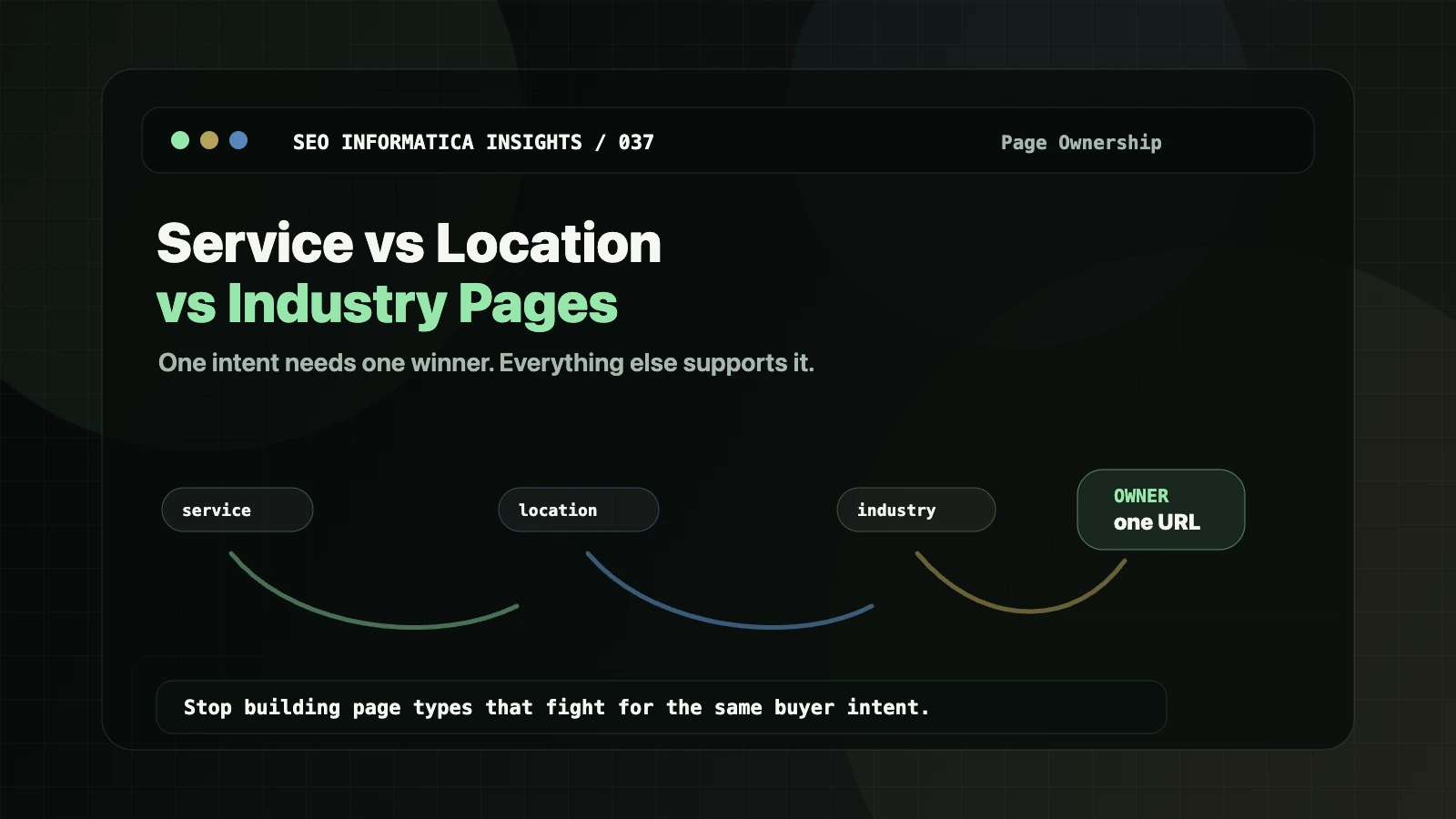
What to fix first
- Service pages should own commercial service intent: hire, buy, book, or evaluate.
- Location pages should own local intent: service plus place, but only when the page adds real location-specific value.
- Industry pages should own vertical-specific intent: service for a specific audience, but only when the message, proof, and delivery change.
- If you mix these roles without rules, you create duplication and cannibalization. Then SEO activity compounds on a weak base.
The core concept: page ownership
Ownership is a simple decision with big consequences:
- For each important intent, pick one best page.
- Every other page should either support that winner or be merged, redirected, or removed.
What breaks most service sites is creating three page types that all try to rank for the same combined intent.
Example of a collision:
- Service page: Commercial Cleaning
- Location page: Commercial Cleaning in Dubai
- Industry page: Commercial Cleaning for Hotels
- Combo page: Commercial Cleaning for Hotels in Dubai
Without ownership rules, these pages usually duplicate sections and compete for the same demand.
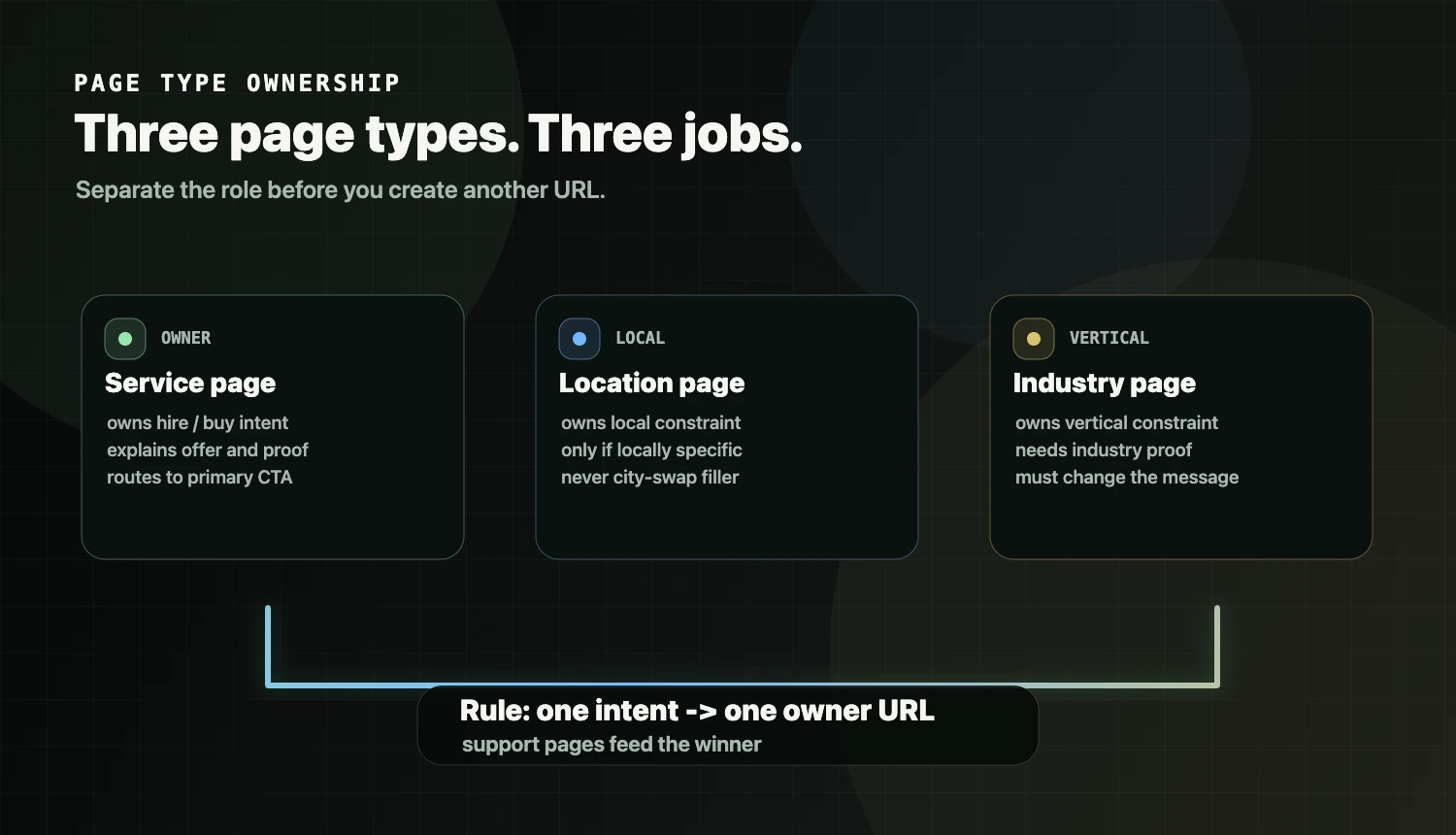
Service vs location vs industry: what each page is for
1. Service pages
Job: convert commercial intent for a specific service.
Best for queries like:
- hire [service]
- [service] company
- [service] agency
- [service] services
Ownership rule: one primary service page should own the main commercial intent for that service.
2. Location pages
Job: match service + place intent without duplicating the service page across many thin city pages.
Best for queries like:
- [service] in [city]
- [service] near me
- best [service] [city]
Ownership rule: only create location pages when the location intent is real and you can add location-specific value.
3. Industry pages
Job: address “service for my type of business” with specific proof, constraints, and delivery nuance.
Best for queries like:
- [service] for [industry]
- [industry] [service] provider
- [service] for [industry] companies
Ownership rule: only create industry pages when you can truly differentiate the page with proof, process, compliance, outcomes, or examples.
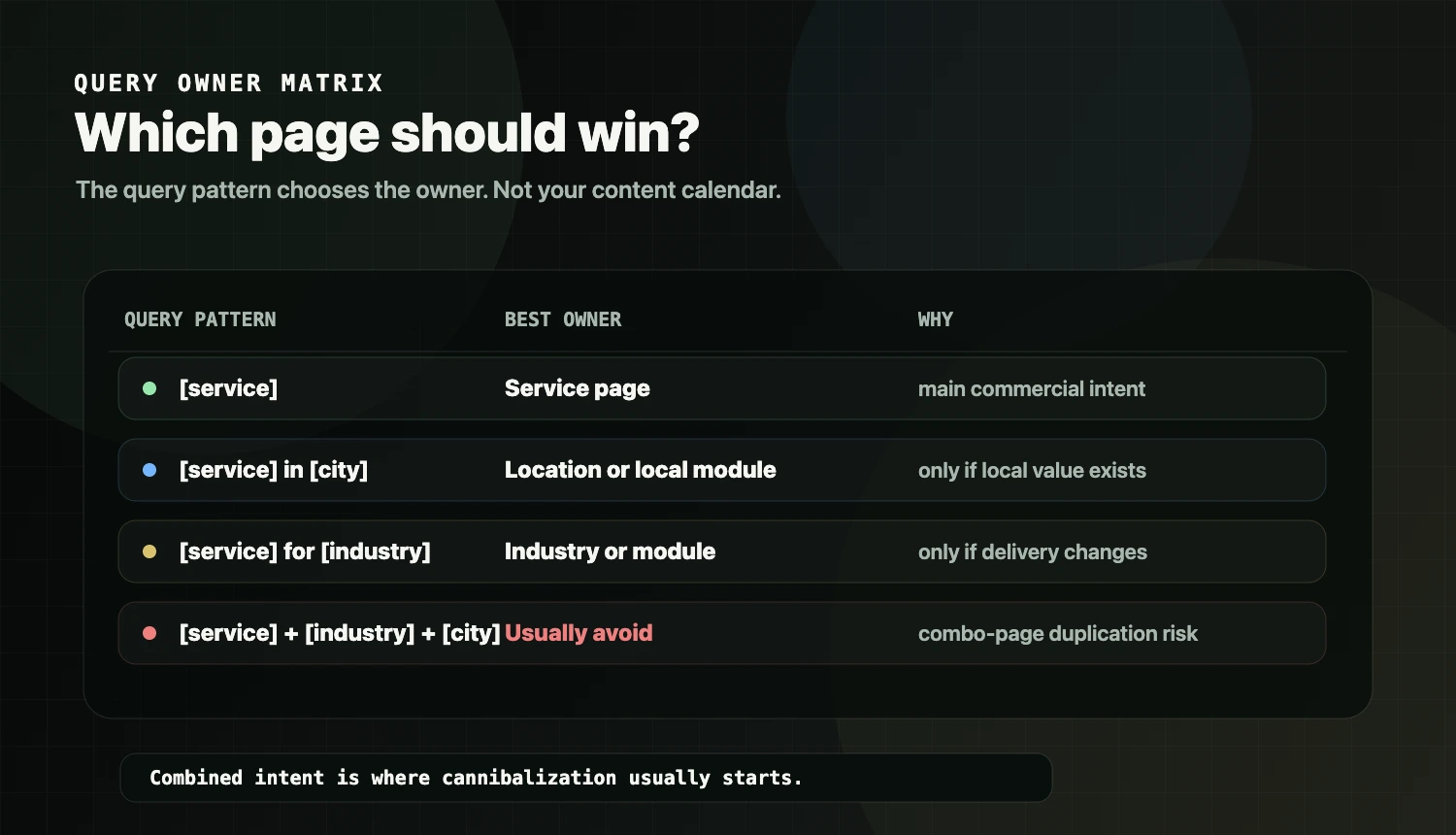
The ownership matrix: which page should win?
| Query pattern | Dominant intent | Best owner page type | Support pages that should feed it |
|---|---|---|---|
| [service], hire [service] | Buy or hire | Service page | Cost, timeline, how-it-works, case study |
| [service] in [city] | Buy with location constraint | Location page if justified, or service page with local module | Local proof, service-area notes, reviews, case study |
| [service] for [industry] | Buy with industry constraint | Industry page if justified, or service page with industry module | Industry case study, FAQ, process constraints |
| [service] for [industry] in [city] | Highly constrained | Usually avoid a separate page | Route to the best owner page and add modules where appropriate |
The more combined pages you create, the faster duplication and cannibalization grows.
The 7 ownership rules
OWNERSHIP RULES FOR SERVICE SITES

1. One intent -> one owner URL.
2. Service pages own the main commercial service intent.
3. Location pages exist only when location adds real value.
4. Industry pages exist only when industry changes message, proof, and delivery.
5. Avoid combo pages unless the business model truly requires them.
6. Support pages should route into the owner page.
7. If two URLs compete, consolidate: merge, redirect, and reinforce one winner.
When you should not create location pages
Location pages are one of the most common duplication traps. Do not create dozens of near-identical pages just because “local SEO.”
Avoid location pages when:
- you cannot add anything location-specific,
- you do not actually service that location meaningfully,
- you are remote-first and location is not a buyer constraint,
- the page would simply repeat the service page with the city swapped.
Google’s spam policies describe doorway abuse as creating pages for similar search queries that lead users to essentially the same destination, including pages targeted at regions or cities without enough distinct value: https://developers.google.com/search/docs/essentials/spam-policies
Instead, keep ownership on the service page and add a local module that supports service-area relevance: coverage, response times, local proof, or real service constraints.
When location pages do make sense
Create location pages when:
- you have real demand in specific areas,
- you can include local proof,
- your operating model changes by location,
- the page can answer location-specific buyer questions.
To avoid duplication, each location page should include at least two or three truly location-specific elements:
- local proof module,
- coverage map or service-area boundaries,
- location-specific FAQs,
- location-specific team or process notes if they are real.
Location pages should support the local variant of intent, not replace the service page as the only way buyers understand the service.
When you should not create industry pages
Industry pages often become thin niche pages that add no real value.
Avoid industry pages when:
- you have no industry-specific evidence, useful examples or delivery insight,
- the service is basically identical across industries,
- you would just swap the industry name in headings.
Instead, keep ownership on the service page and add an industry module for your top one to three industries: use cases, constraints, proof snippets, and buyer-specific objections.
When industry pages do make sense
Industry pages make sense when the industry changes at least two of these:
- risk profile: compliance, safety, legal, or operational requirements,
- buyer criteria: what matters to the buyer is genuinely different,
- delivery constraints: process, documentation, or timelines change,
- proof requirements: the buyer needs industry-matched examples.
Non-duplicative industry page structure:
- industry-specific “what success looks like”,
- industry constraints,
- industry proof,
- process notes specific to the industry,
- a clear route back to the owner service page or a justified service-for-industry owner page.
Worked industry examples
Our guides to SEO for HR consultants and SEO for IT companies and MSPs show how an actual service offer changes page choices. Each includes a labelled planning illustration; the HR guide also links to our published advisory rebuild.
For businesses with different audience boundaries, see SEO for recruitment and staffing agencies and SEO for accounting and bookkeeping firms. These are guides to planning SEO for those businesses, with their customers’ searches used inside the examples.
For project-based services, our guides to SEO for software development companies and SEO for engineering consultancies show how engagement scope and the team’s actual contribution shape the page plan.
For capability and location decisions, see SEO for contract manufacturers and SEO for virtual office providers. Their worked examples explain which details belong together and when a separate page adds useful information.
For specialist expertise, our guides to SEO for cybersecurity companies and SEO for management consultants show how service boundaries and a clear explanation of the evidence shape useful content.
For audience and offer decisions, see SEO for freight forwarders and SEO for corporate training companies. Their worked examples separate different search tasks and turn verified delivery details into an assessable description.
For installed commercial systems, our guides to SEO for commercial HVAC companies and SEO for security system integrators show how maintenance, project delivery and continuing support change the service explanation.
For industrial capabilities, see SEO for industrial testing laboratories and SEO for industrial maintenance companies. Their worked examples connect a specific testing or maintenance offer to the page that should explain it.
For project-based expertise, see SEO for cloud consulting companies and SEO for design agencies. Their completed examples show when a deliverable belongs on a service page and when a portfolio project needs its own explanation.
For distinct service requests, see SEO for business law firms and SEO for coworking spaces. These guides connect an available engagement or access plan to the information a prospective client needs before choosing it.
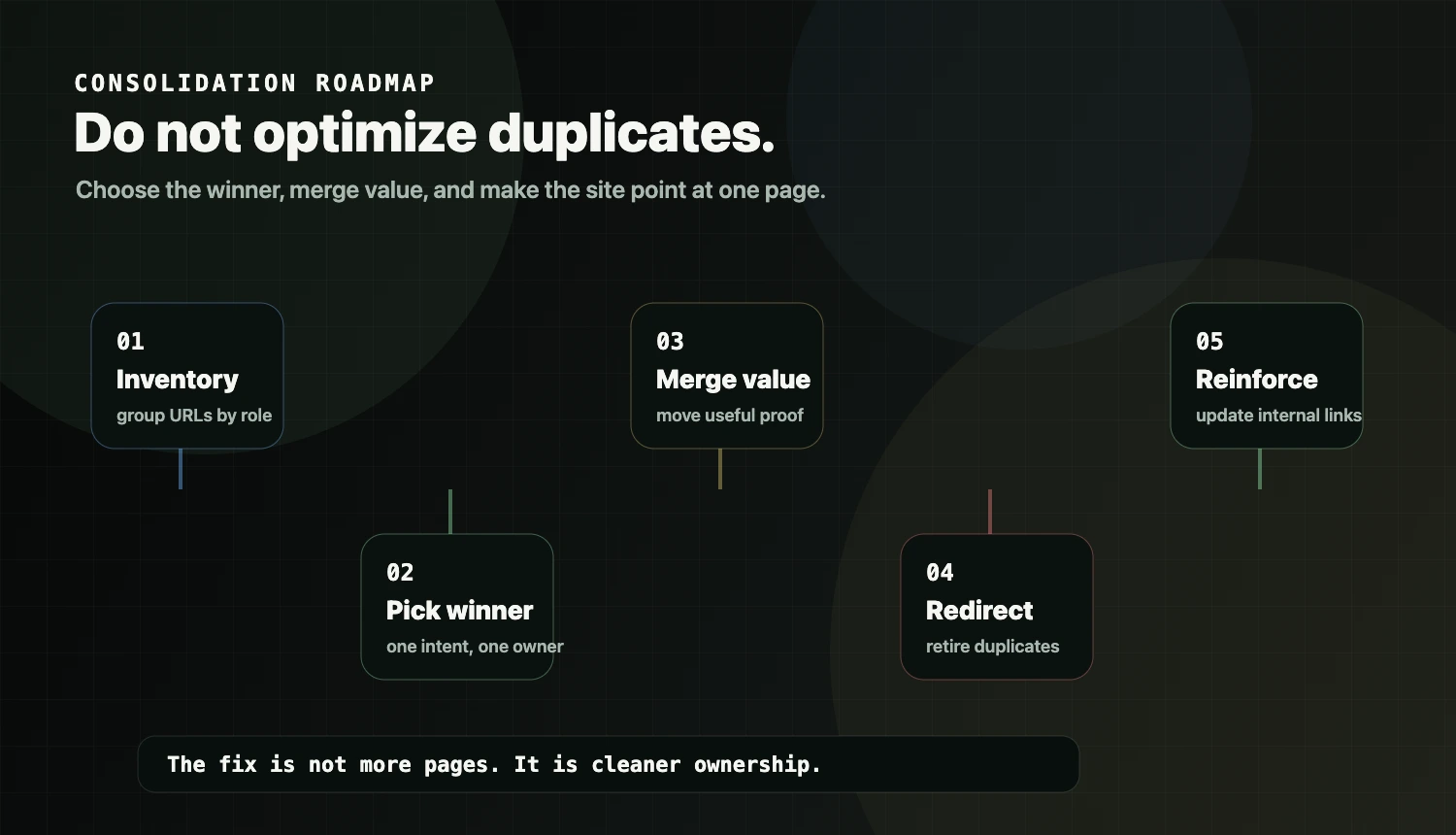
The consolidation playbook
If you already have 30 pages that overlap, do not try to optimize them all. Choose winners and consolidate.
Step 1: Inventory pages by role
- Service pages
- Location pages
- Industry pages
- Support pages: cost, timeline, FAQ, comparison, proof
Step 2: Choose one owner page for each primary service intent
Pick the URL you want to win. Everything else either supports it or gets merged.
Step 3: Merge and redirect duplicates
- Combine overlapping content into one stronger page.
- Redirect duplicates to the owner page.
- Update internal links so the owner page becomes the reinforced winner.
Google’s duplicate URL guidance recommends choosing a preferred canonical URL and using redirects when you want to get rid of existing duplicate pages: https://developers.google.com/search/docs/crawling-indexing/consolidate-duplicate-urls
Step 4: Re-scope pages into support roles
Some pages should not be deleted. They should be repositioned:
- turn weak industry pages into proof-rich case summaries,
- turn thin city pages into service-area explainers with unique value,
- turn duplicate service variants into buyer-question support pages.
If the cleanup is heavy, that is exactly what a Website Rebuild is designed to solve.
A simple decision tree
DECISION TREE

Q1. Is the intent "hire or buy the service"?
- Yes -> Service page should own.
- No -> It is support content.

Q2. Is location a real buying constraint?
- Yes -> Consider a location page or local module.
- No -> Do not create city pages just to have them.

Q3. Does industry change delivery, proof, or constraints?
- Yes -> Consider an industry page if you have specifics.
- No -> Use an industry module on the service page.

Q4. Are you about to create a combo page?
- Stop -> Usually duplication risk. Prefer modules and routing.
What to do next
- If your foundation is messy, overlapping services, duplicate location pages, unclear structure, a website rebuild addresses that foundation.
- If the main problem is local structure, service-area architecture, location-page value, or GBP landing pages, that is local SEO work.
- For clarity on what to fix first, Get your free Outside View.