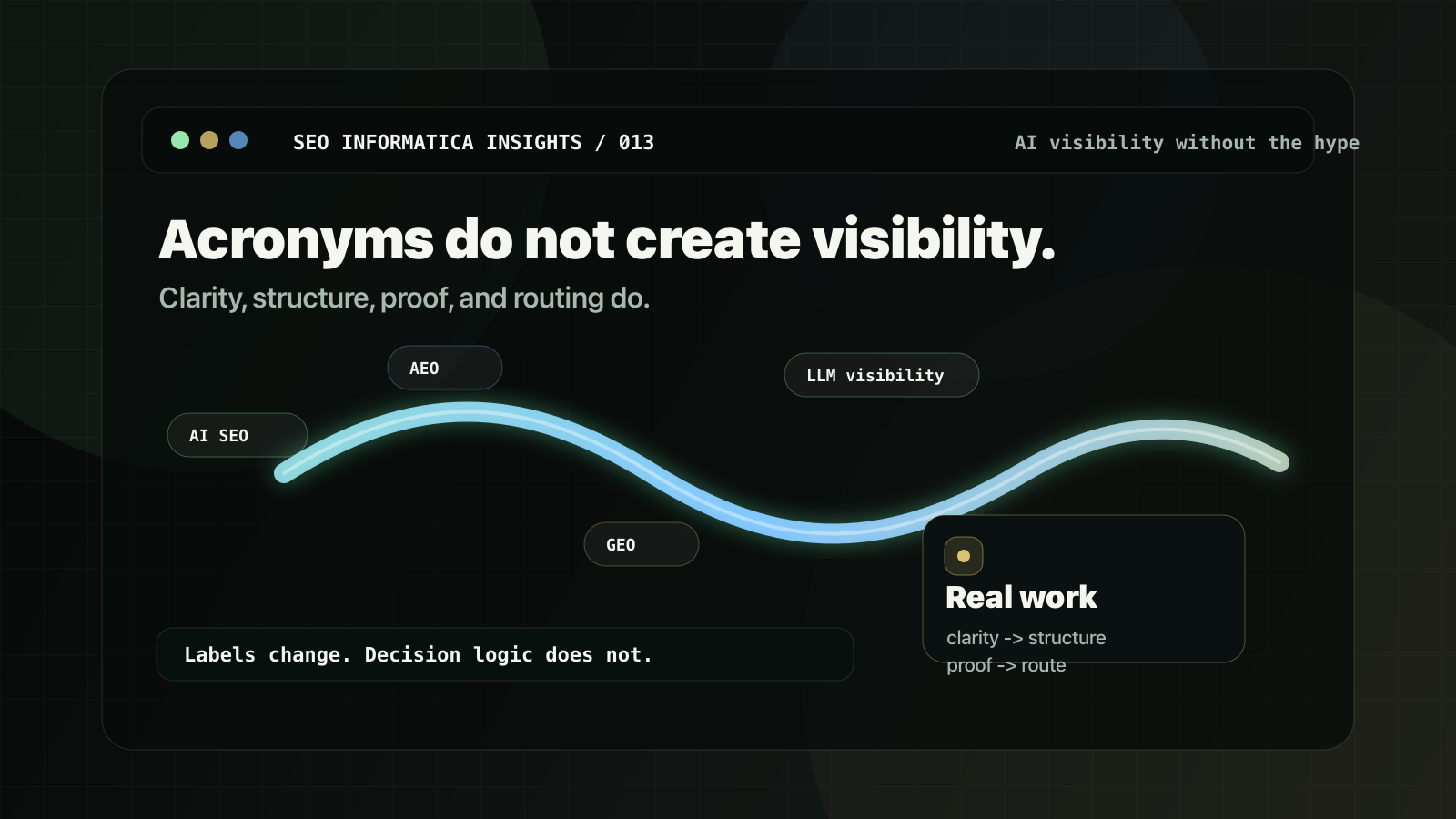
If you're a service business, the "new" visibility terms can feel like a moving target:
- AI SEO
- AEO (Answer Engine Optimization)
- GEO (Generative Engine Optimization)
- LLM visibility / LLM optimization
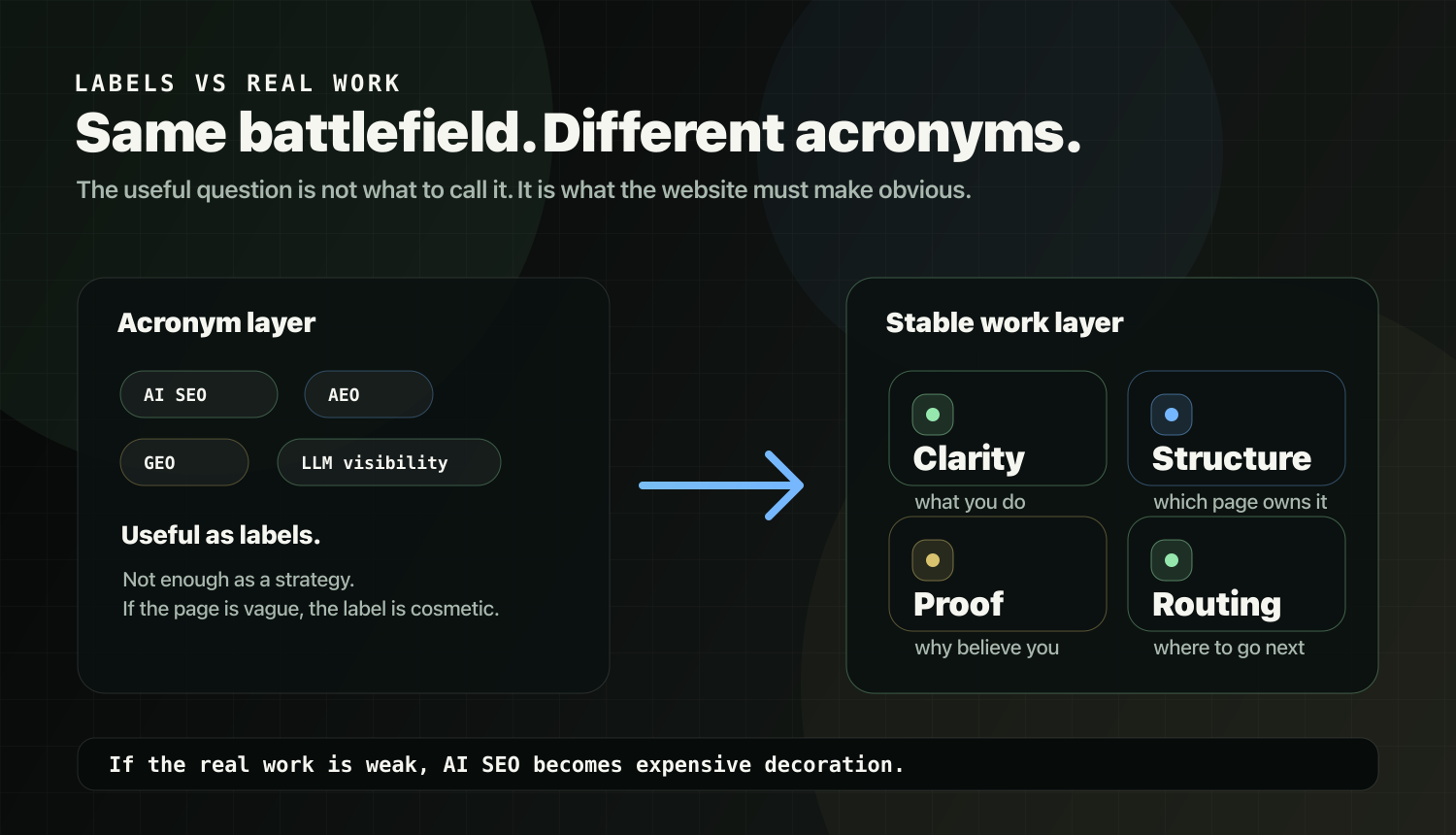
Here is the reality: these are mostly different labels for the same underlying work.
You do not win because you used the right acronym. You win when your website is:
- Clear about what you do: stable service language and entity clarity.
- Structured so the right page owns the intent: page roles and boundaries.
- Explicit enough to quote: answer-ready sections and proof.
- Routable to a next step: internal paths and conversion logic.
If you want help applying this to your site, start here:
Search + AI Visibility Or start with a Free Website Lead Leak Diagnosis
The short version if you do not want the theory
- SEO is about discoverability and relevance in search.
- AEO is about making key answers easy to extract.
- GEO is about being usable in generative summaries.
- LLM visibility is about assistants being able to access and interpret your service information.
- AI SEO is the umbrella term people use for the whole bundle.
For service businesses, these labels do not change the fundamentals: clarity, structure, evidence, and routing still decide outcomes.
Why there are so many labels now
Search and discovery have shifted in two ways.
1. More summary-first discovery
People increasingly get a summary first, either in search or inside an assistant, and only click once they have a shortlist.
2. Interpretation matters more than presence
If your site is vague, inconsistent, or scattered, systems cannot confidently interpret what you do, and users cannot confidently choose you.
That is why AI visibility is not a totally separate channel. It is a reflection of whether your site:
- explains the business consistently,
- supports real decision questions,
- and routes people to the right action.
Google's own guidance for AI features in Search is blunt: existing SEO best practices remain relevant, there are no additional technical requirements for AI Overviews or AI Mode, and there is no special schema or AI text file required to appear in those features. Google AI features guidance
Definitions in plain English, service-business focused
SEO (Search Engine Optimization)
Goal: show up for searches that match your service and location or industry intent.
Core idea: make pages discoverable, relevant, and useful, so they rank and earn clicks.
AEO (Answer Engine Optimization)
Goal: make your site easy to use for direct answers.
Core idea: state key answers explicitly in clear sections instead of hiding them in vague paragraphs.
Service-business example:
- How pricing works
- What changes the cost
- Typical ranges
- What's included
GEO (Generative Engine Optimization)
Goal: increase the likelihood your content helps shape generative summaries and still earns the click when it matters.
Core idea: create content that is specific, credible, and structured enough to be used without confusion.
Service-business example:
If "roof repair cost" is summarized, the site that has a better shot tends to show:
- clear scope boundaries such as repair vs replacement,
- constraints such as what affects price,
- proof such as examples, before/after evidence, and what changed.
LLM visibility (LLM optimization)
Goal: make assistants able to access, interpret, and trust your service information.
Core idea: it is not just ranking. It is being understandable and quotable.
Service-business example:
If your service names change across pages, such as "SEO growth," "SEO content system," and "lead-gen SEO," assistants and users have a harder time mapping what you actually offer.
AI SEO (umbrella term)
Goal: everything above in one phrase.
Core idea: most people use AI SEO as shorthand for SEO + AEO + GEO + LLM visibility.
There is no single universal definition for these terms. Different teams use them differently. That is why it is better to focus on what stays stable: the website must be clear and decision-supportive.
What does not change: the four rules that still decide outcomes
These are the rules that keep service businesses from wasting months "optimizing for AI" while leads stay flat.
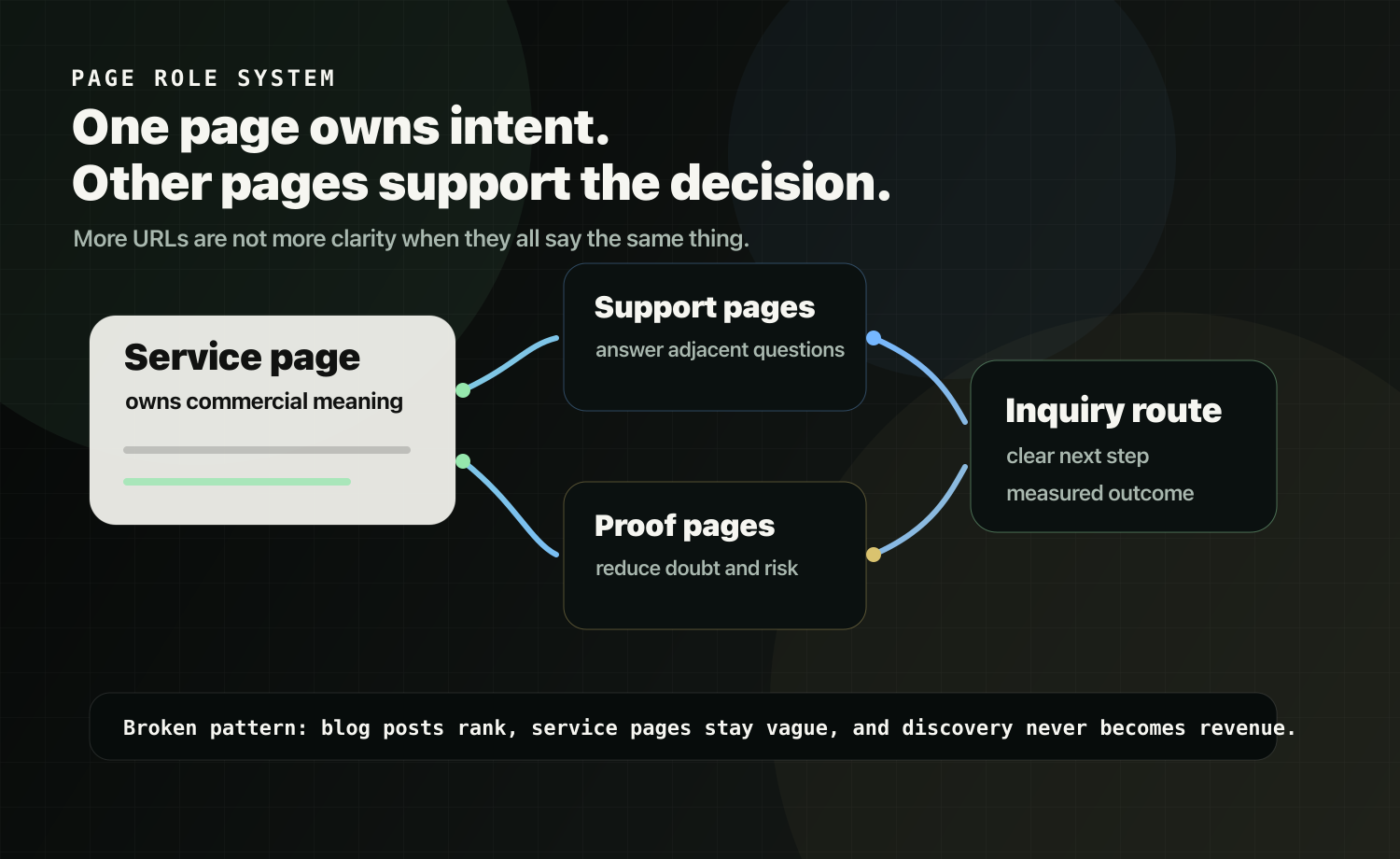
Rule 1: One page must own the commercial intent
If your service is split across five weak URLs, you do not have more coverage. You have confusion.
Service-business signals that this is broken:
- blog posts outrank service pages,
- multiple pages compete for the same intent,
- your main service page is thin.
Related: SEO Audit vs SEO Diagnosis: https://seoinformatica.com/seo-audit-vs-seo-diagnosis/
Rule 2: Your service language must be stable
AEO, GEO, and LLM systems do not fix messy meaning for you. If terminology changes, meaning drifts.
Fix: define the service language once, then enforce it across pages.
Rule 3: Proof must live where decisions happen
A service page without proof asks users to take a leap of faith. Summaries and assistants also have less concrete material to work with when the page is only making vague claims.
Fix: add proof modules that reduce doubt:
- process clarity,
- examples,
- outcomes,
- constraints,
- fit guidance.
Rule 4: Discovery must route to action
If someone lands on a helpful explanation page and there is no next step, you get visibility without revenue.
Fix: build routes:
- support page -> service page
- service page -> proof
- proof -> inquiry
What changes in an AI-assisted world
This is where AEO, GEO, and LLM visibility shift your priorities. Not into hacks, but into clarity upgrades.
1. You write more explicit sections and less vague narrative
Add sections that can be lifted cleanly:
- Who this is for
- Who this is not for
- Process
- Pricing factors
- Timeline
- What results look like
- What changes after the work
2. You remove duplication faster
If five pages say the same thing, systems do not get more evidence. They get uncertainty.
3. You clean up page roles
- The service page owns the commercial meaning.
- Support pages answer adjacent questions.
- Proof pages reduce doubt.
Related: Content Funnel Map: https://seoinformatica.com/service-business-content-funnel-map/
4. You route readers like a system, not a blog
Support content is not extra. It is decision support that feeds the service page.
If you want the broader "what matters" view beyond terminology, read this:
AI Visibility for Service Businesses
Do you need llms.txt, AI schema, or special files?
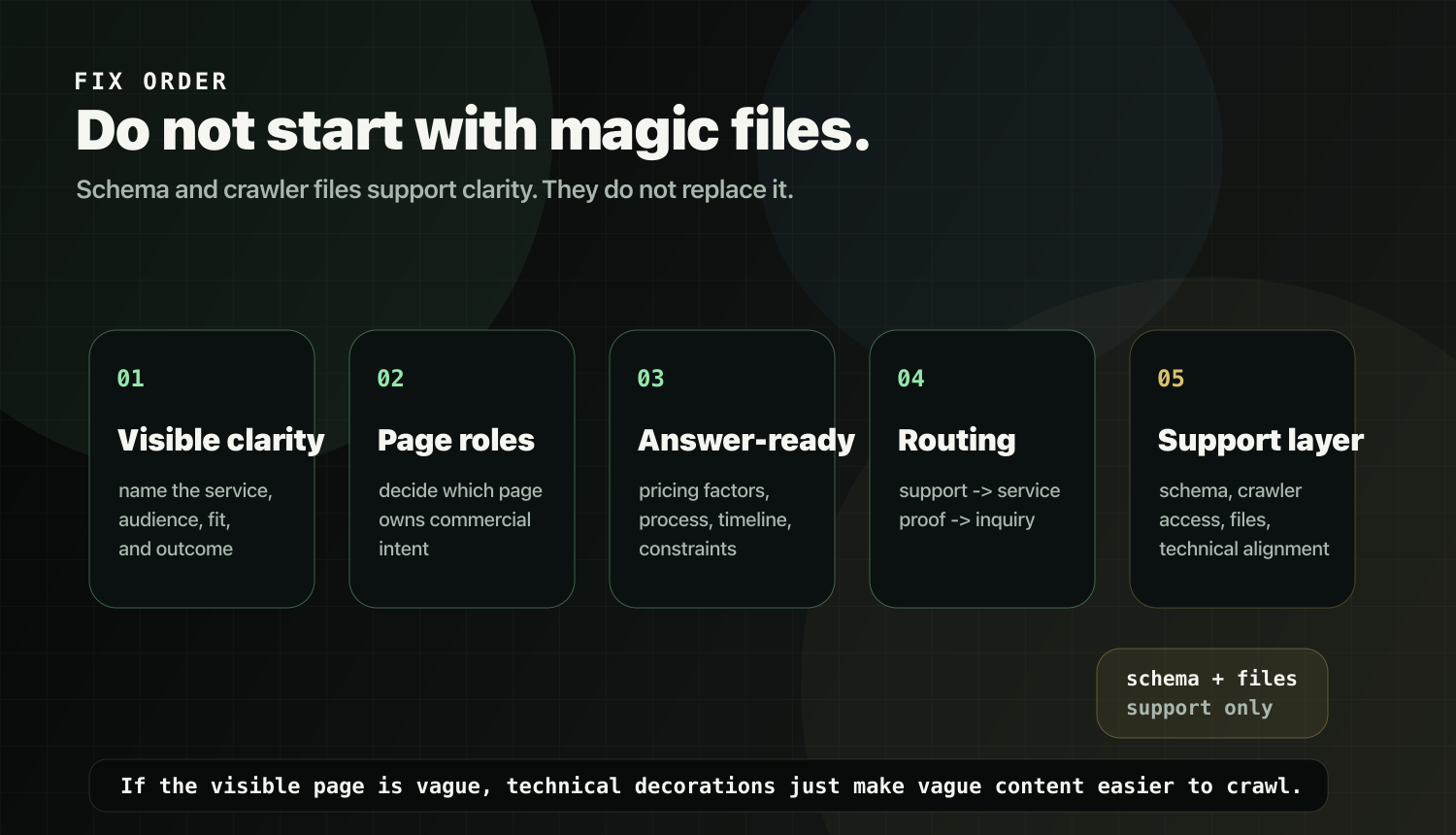
Short answer: do not start there.
Most service-business visibility problems are not missing a file. They are:
- unclear services,
- thin commercial pages,
- inconsistent terminology,
- overlapping content,
- no conversion routing.
llms.txt
A file cannot compensate for unclear services and messy page roles. If your visible content is vague, your system is still ambiguous.
Also, do not confuse crawler access with strategy. OpenAI documents OAI-SearchBot as the crawler used to surface websites in ChatGPT search features, but allowing crawler access is not the same as building a page that clearly explains your service. OpenAI crawler documentation
Schema
Schema can support clarity when it matches visible content, but there is no special AI schema that replaces good pages. Google's structured data guidelines are explicit that structured data must represent the visible page content, and Google does not guarantee a rich result just because markup is present. Google structured data guidelines
Focus order that stays stable:
- Visible content clarity
- Page roles and boundaries
- Answer-ready structure
- Internal linking and routing
- Schema and technical alignment as the support layer
How to choose your next move
Use this to avoid buying the wrong AI optimization work.
If you do not rank at all or key pages are not even visible
Start with fundamentals:
- technical access,
- crawl and index checks,
- structural hygiene.
If you rank but leads are weak
You likely need:
- stronger service pages,
- decision sections,
- proof modules,
- routing improvements.
You may need a rebuild first:
If your site is mostly fine but interpretation and meaning are inconsistent
This is where Search + AI Visibility fits:
If your foundation is strong and you want compounding growth
Use content funnels to expand semantic coverage:
Frequently asked questions
Is AI SEO just SEO?
Mostly, yes, with more emphasis on clarity, explicit sections, and routing. The fundamentals did not disappear.
Does AEO replace SEO?
No. AEO is a layer of how you structure answers. SEO is still the foundation of discovery.
What is GEO in SEO?
GEO is a common label for improving how content performs in generative summaries. In practice, it usually means clearer structure, specific answers, credibility, and reduced ambiguity.
Do I need llms.txt?
Not as a starting point. If service clarity and page roles are weak, a file will not fix interpretation. Start with visible clarity and routing.
Do I need AI schema?
There is no special schema that replaces a strong service page. Use schema to support what is visibly true on the page.
Will this guarantee AI citations or mentions?
No. Anyone promising guaranteed citations is selling certainty that does not exist. Focus on what you can control: clarity, structure, proof, and routing.
Should service businesses publish AI content?
If AI content means generic AI-themed posts, most of the time, no. Publish decision support:
- pricing factors,
- comparisons,
- fit guidance,
- process,
- timelines,
- proofs.
How do I measure progress?
Measure what changes outcomes:
- the right page owning commercial intent,
- better-fit impressions and entries,
- conversion paths to inquiries,
- lead quality.
Glossary
SEO: improving discoverability and relevance in search engines.
AEO: structuring content so answers are easy to extract.
GEO: improving usefulness and eligibility in generative summaries.
LLM visibility: assistants can access, interpret, and trust your service information.
Page roles: which page owns intent versus which pages support it.
Entity clarity: stable names and definitions for your services and related concepts.
Next step: apply this to your site without guessing
If your team is hearing AI SEO from every direction, the fastest way to stop guessing is a clarity-first diagnosis.