If you are investing in "AI visibility" – AI SEO, AEO, GEO, AI Overviews, ChatGPT discovery, or whatever label gets slapped on it next – the fastest way to get disappointed is to measure the wrong thing at the wrong time.
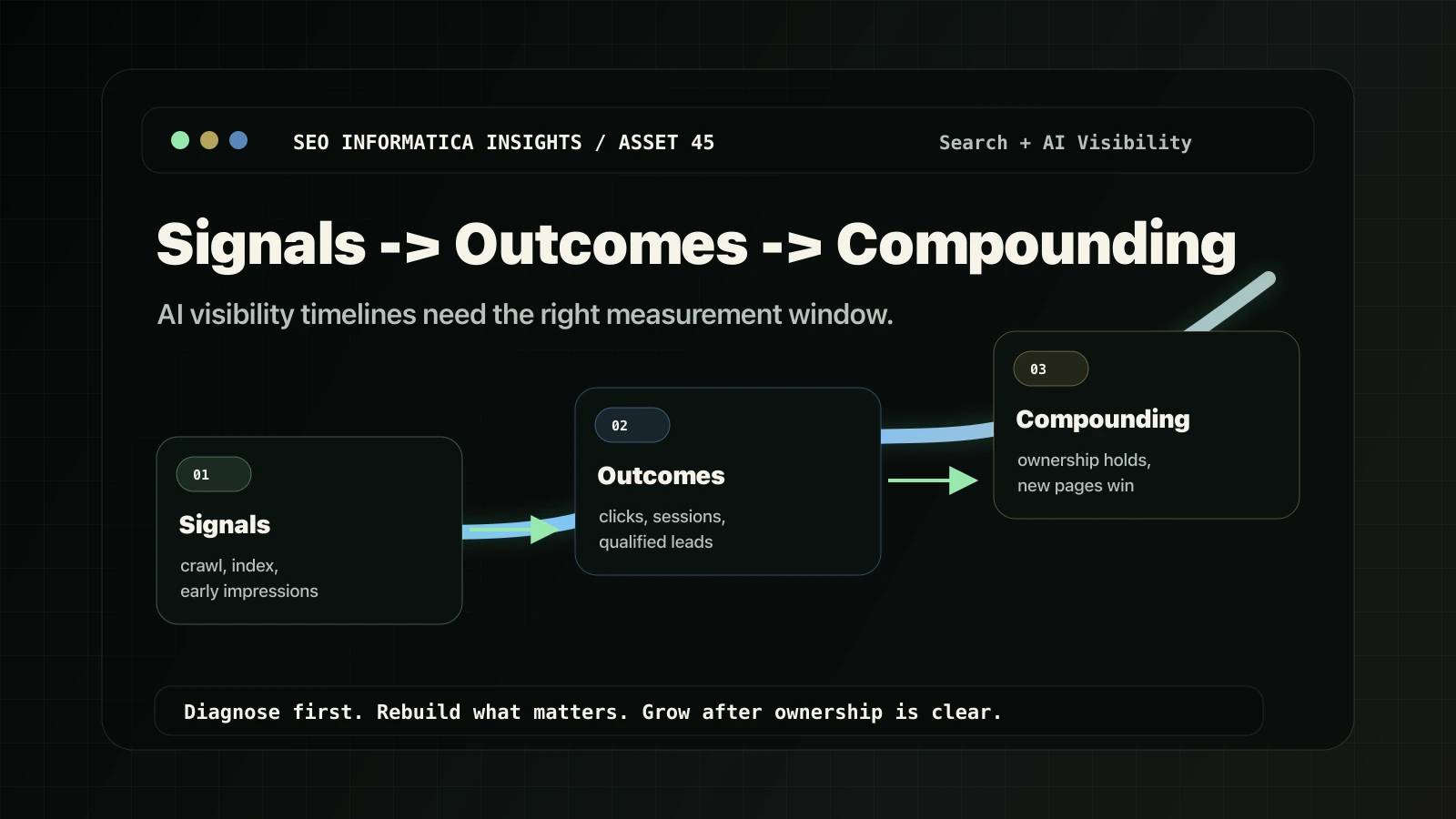
A better approach is to separate progress into three layers:
- Signals: systems can crawl, index, interpret, and start showing early impressions.
- Outcomes: rankings, clicks, qualified visits, and lead actions move.
- Compounding: your site becomes easier to grow because page ownership, proof, and routing start working as a system.
This guide explains what to expect without hype. If you want this applied as an implementation-ready plan, explore Search + AI Visibility or start with a Free Website Lead Leak Diagnosis.
Diagnosis summary
- AI visibility progress is not linear. If your plan depends on smooth week-by-week growth, the plan is fragile.
- Early signals are useful, but they are not business outcomes. Crawled, indexed, and impressions do not equal leads.
- Service businesses usually need page ownership before content volume. Publishing more pages into an unclear structure is how cannibalization spreads.
- The fastest practical win is often conversion routing, not ranking lift. If existing traffic already lands on support content, route it into the owner service page and inquiry.
- Compounding starts only after the system has stable roles. Owner page, support content, proof, and CTA routes have to reinforce the same decision path.
The most important rule: progress is not linear
Even when you do useful work, results can look uneven because:
- crawling and reprocessing take time,
- Search Console can show preliminary recent data,
- rankings fluctuate while systems re-evaluate page meaning,
- and stronger improvements may require broader confirmation across page quality, links, proof, and user behavior.
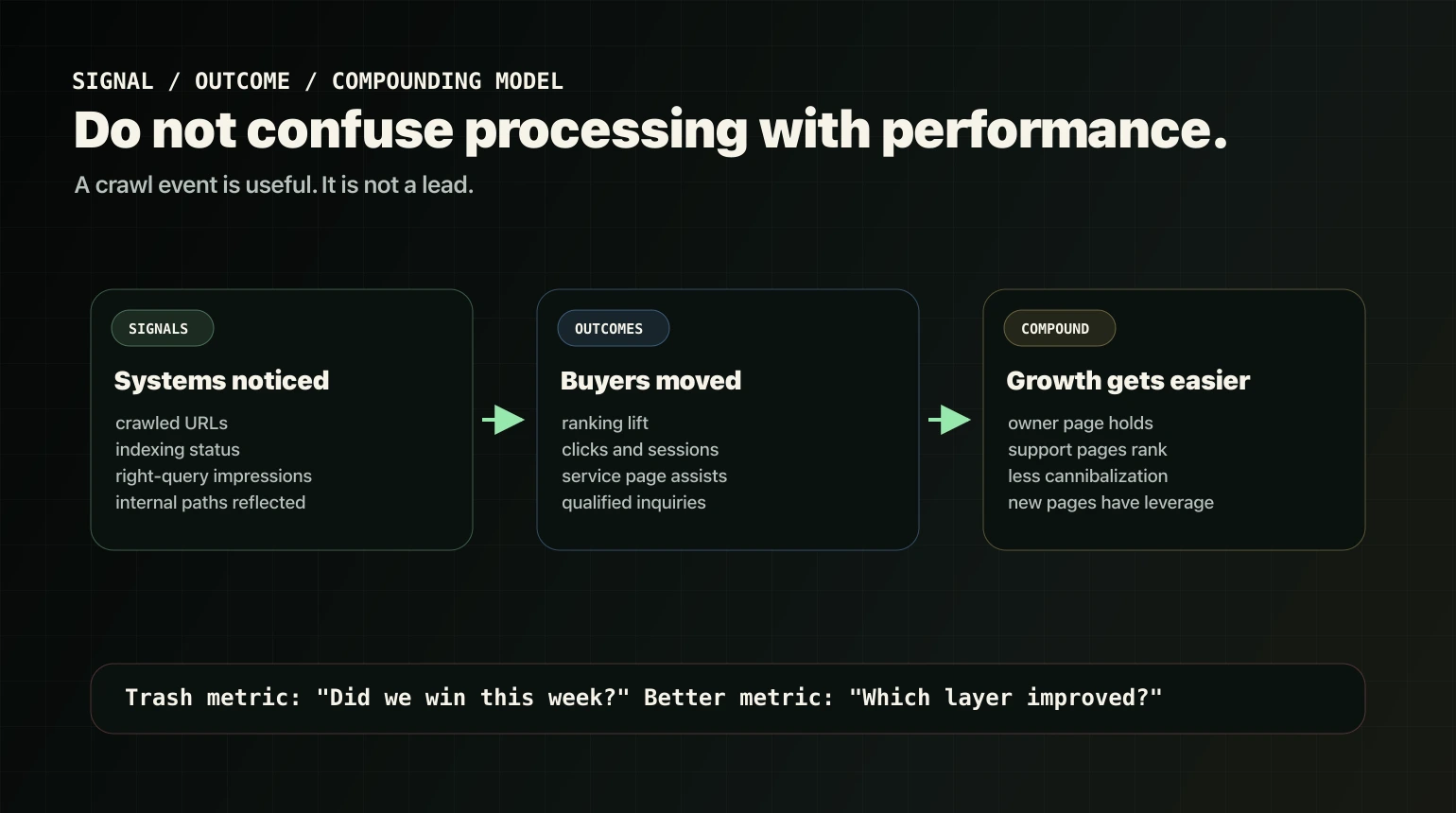
So the question is not "Did we win in two weeks?"
That question is too shallow.
The better question is:
Which layer improved: signals, outcomes, or compounding?
The 3 layers
1. Signals: systems noticed the change
Signals are technical and interpretability indicators.
Examples:
- Google crawled and indexed the updated URL.
- The right page starts earning impressions for the right query set.
- Internal linking changes are reflected in crawl paths.
- A service owner page begins appearing for commercial-intent terms, even at low positions.
Signals mean the work is being processed.
They do not mean the work has produced revenue yet.
2. Outcomes: buyers and metrics moved
Outcomes are business-facing.
Examples:
- rankings improve for priority intents,
- clicks increase on the right pages,
- service-page assisted paths increase,
- lead quality improves,
- conversion rate improves on existing traffic.
Outcomes mean visibility is becoming useful.
For service businesses, a ranking lift that does not send buyers toward inquiry is not a win. It is noise with a nicer chart.
3. Compounding: growth gets easier
Compounding happens when the site becomes a stronger system.
Examples:
- new support content starts earning impressions faster,
- fewer wrong pages rank for commercial queries,
- the owner service page stabilizes as the destination for hire intent,
- proof and internal links support the same conversion path,
- topic expansion becomes more predictable.
Compounding means you are no longer forcing every page to work alone.
The AI visibility timeline by window
These are expectation windows, not guarantees. Site size, technical health, implementation speed, service complexity, competition, and proof quality all change the timeline.
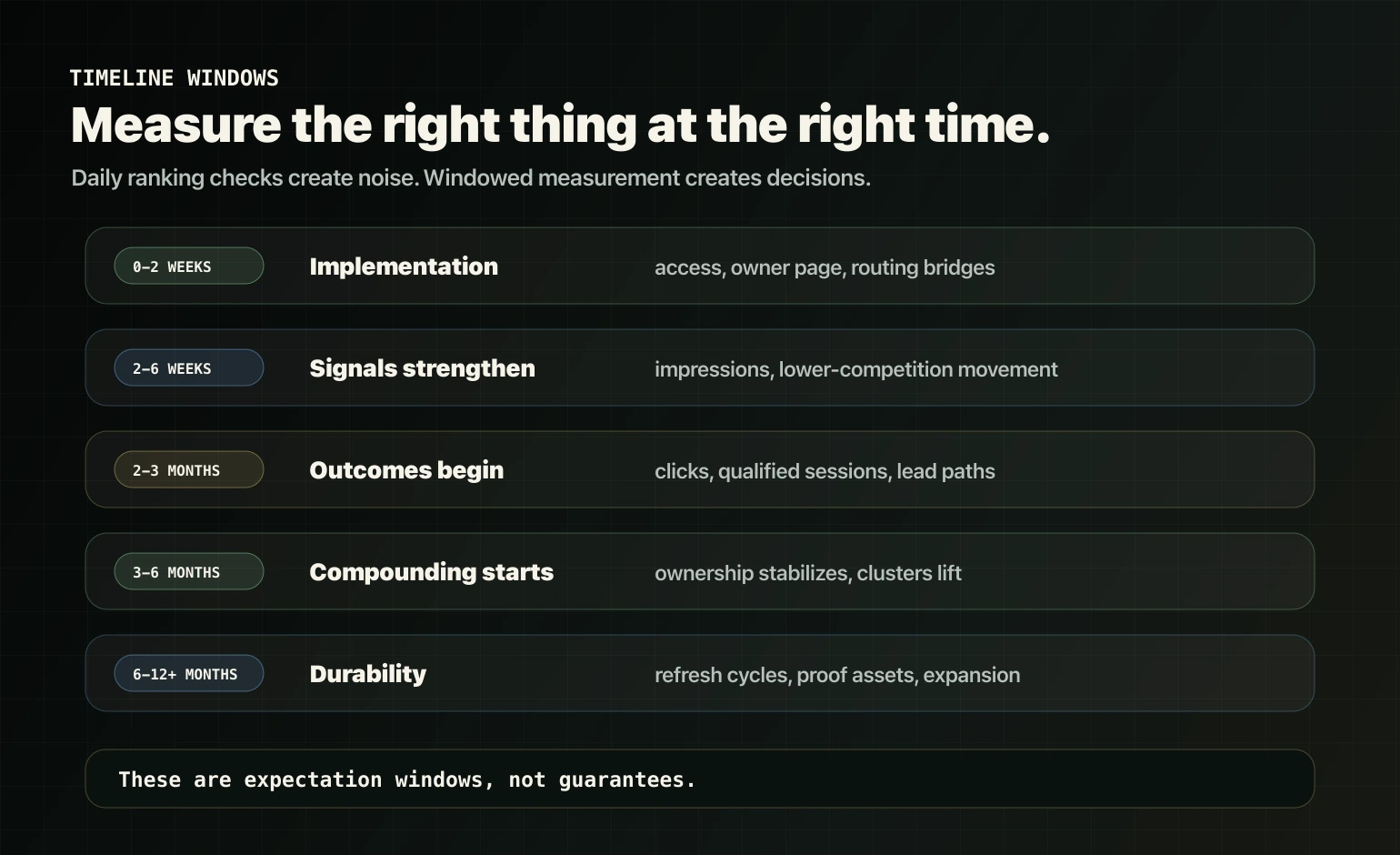
Week 0-2: implementation and early signals
What you are doing:
- fix discoverability blockers,
- confirm important pages are crawlable and indexable,
- strengthen one owner service page,
- add routing bridges from existing traffic posts,
- remove obvious broken routes and duplicate paths.
What you may see:
- pages recrawled after updates,
- indexing status stabilizes,
- small impression movement on long-tail queries,
- early "right page appears" behavior for service intent.
What to measure:
- URL Inspection status,
- Page indexing status,
- Search Console impressions for updated URLs,
- GA4 engagement and lead events as micro signals.
Common mistake:
Refreshing rankings every day and changing strategy because a chart twitched.
That is not measurement. That is anxiety with a dashboard.
Week 2-6: signals strengthen and early outcomes may appear
What you are doing:
- upgrade answer-ready sections,
- add fit, process, pricing-factor, timeline, and proof modules,
- tighten internal routing from support content to the owner service page,
- reduce overlap where support pages compete with commercial pages.
What you may see:
- more consistent impressions for target topic clusters,
- early ranking movement for lower-competition queries,
- better click-through rate if titles and snippets became clearer,
- first measurable service-page assists from blog or guide traffic.
What to measure:
- query groups mapped to a service cluster,
- landing-page conversion rate for the owner service page,
- support-page clicks into service pages,
- lead actions by landing page.
This is where weak teams make the dumb mistake: they see impressions and immediately publish ten more generic AI posts. Do not do that. If ownership is unclear, more content just creates more overlap.
Month 2-3: real outcomes begin if fundamentals are solid
What you are doing:
- build 3-6 support assets around real buyer questions,
- refresh existing pages that already have impressions but weak routing,
- keep one page responsible for hire intent,
- strengthen proof and CTA clarity.
What you may see:
- measurable click and qualified-session movement,
- the owner service page winning more commercial-intent visibility,
- better lead quality because fit and proof reduce bad inquiries,
- fewer wrong-page ranking incidents.
What to measure:
- Search Console clicks and impressions by owner page and support cluster,
- GA4 leads by landing page,
- assisted paths into the service page,
- inquiry quality from CRM notes or manual lead review.
If your site already has traffic, this window can show conversion improvement before major ranking improvement. That is not a consolation prize. For a service business, better conversion from existing demand is often the most immediate money.
Month 3-6: compounding starts
This is the window where many service businesses start to feel the system working:
- publishing becomes more predictable,
- upgrades hold longer,
- support content has a clearer role,
- and the owner page does not have to fight its own site.
What compounding looks like:
- new support pages get indexed and earn impressions faster,
- the owner service page stabilizes as the commercial destination,
- internal links create cluster-level lift,
- fewer consolidation emergencies appear because borders are clearer.
If the market is competitive, the site is technically messy, or the service language is vague, significant impact can shift toward 6-12+ months.
That delay is not always a failure. Sometimes it is the cost of fixing a structure that was left to rot for years.
Month 6-12+: durable visibility
This is where you stop feeling like you are starting over every quarter.
The useful signs:
- refresh cycles work,
- proof assets keep paying back,
- the site can expand into adjacent topics without losing focus,
- brand and service language become easier for buyers and search systems to understand.
This is the point of AI visibility work.
Not gimmicks. Not special files. Not fake certainty.
A site that is easier to crawl, easier to understand, easier to cite, and easier to buy from.
Why your timeline might be faster
Timelines are faster when:
- you improve existing pages that already have impressions,
- one owner service page clearly owns hire intent,
- proof, process, and fit details already exist,
- implementation happens quickly,
- internal links already have a logical structure,
- overlap is handled before publishing more content.
If you already have demand but weak conversion paths, the fastest improvement may come from routing and proof. For broader structural issues, see Lead Gen Rebuild.
Why your timeline might be slower
Timelines are slower when:
- the site has crawl or indexing blockers,
- pages describe the same service in inconsistent language,
- several URLs compete for the same commercial intent,
- proof is thin or generic,
- the CMS or dev workflow slows implementation,
- the team keeps publishing support content before fixing owner pages.
If access, crawlability, rendering, redirects, or indexation are the bottleneck, see Technical SEO.
If support content exists but does not route into service pages, see Content Funnels.
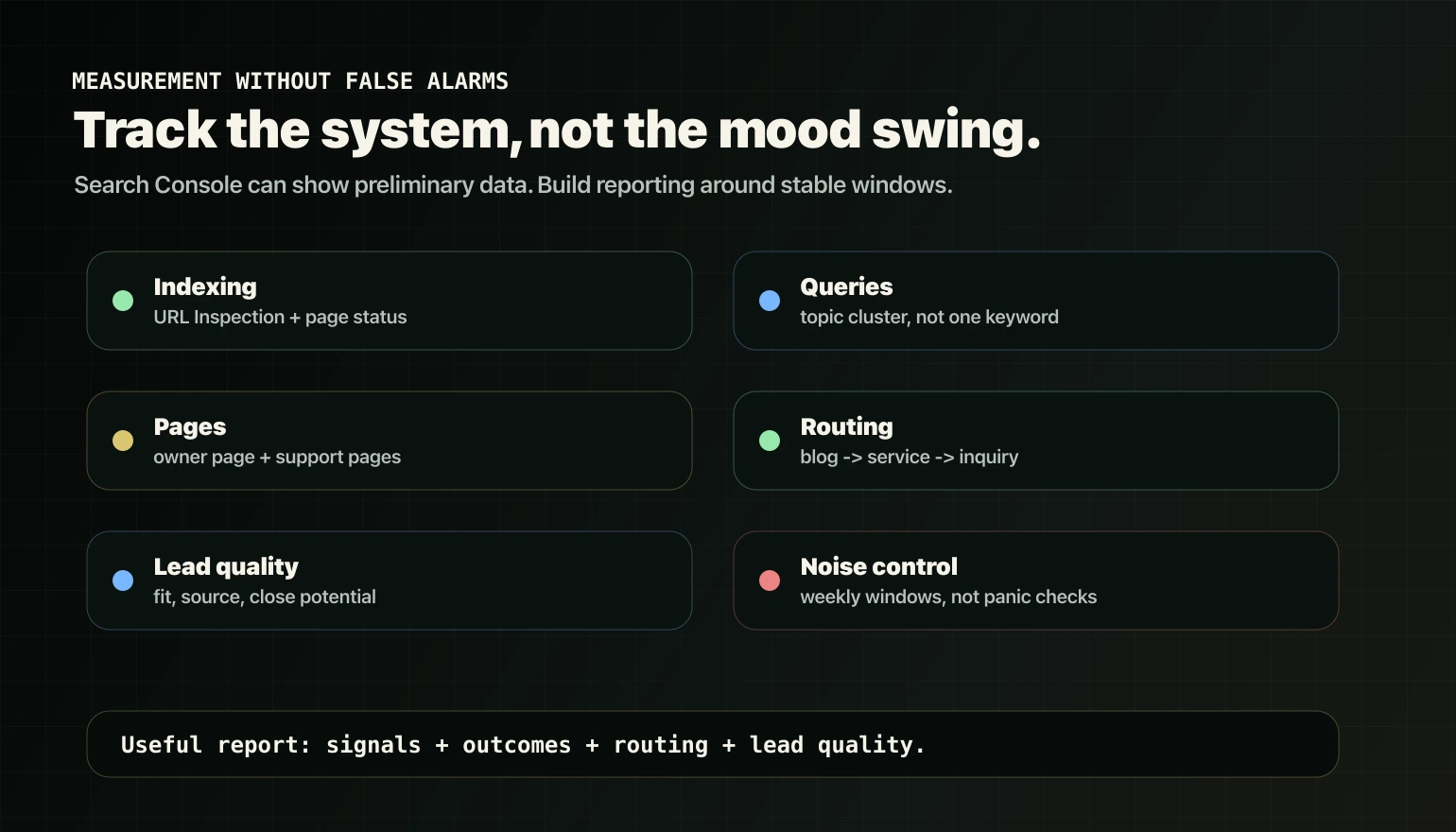
Measurement: how to avoid false alarms
1. Remember Search Console data can be preliminary
Google's Performance report can show preliminary recent data, and the 24-hour view includes preliminary data by default. Recent data can change.
So do not make strategy changes from yesterday's partial numbers.
Use weekly windows for operational checks and monthly windows for trend decisions.
2. Measure by cluster, not one keyword
AI visibility and SEO improvements usually show up as:
- more query coverage,
- more pages earning relevant impressions,
- better alignment between intent and ranking URL,
- and stronger routes from support pages into service pages.
One keyword is too narrow. A service cluster tells you whether the system is improving.
3. Track routing, not just traffic
For service businesses, the win is not "more visitors."
The win is:
support content -> owner service page -> proof -> inquiry
Track:
- support-page clicks into service pages,
- service-page CTA clicks,
- form starts and bookings,
- assisted conversion paths,
- lead quality by source and landing page.
Traffic without routing is vanity. Routing without proof is friction. Proof without a CTA is wasted trust.
The stakeholder expectation framework
Use this in client or internal updates:
- Weeks 0-6: signals, structure, and early movement.
- Months 2-3: early outcomes, especially for existing pages and lower-competition queries.
- Months 3-6: measurable lift and early compounding.
- Months 6-12+: durable advantage, especially in competitive niches.
Then add the sentence most teams conveniently avoid:
We control clarity, access, page roles, proof, routing, and implementation speed. We do not control when every search or AI system fully re-evaluates the site.
That is the honest frame.
FAQ
What's the difference between signals, outcomes, and compounding in AI visibility?
Signals are early indicators that systems crawled, indexed, and interpreted your changes, such as indexing status and impressions. Outcomes are business results: clicks, qualified sessions, and leads. Compounding is when growth becomes easier over time because page roles, proof, and routing create a durable system.
How long does AI visibility work usually take to show results?
Timelines vary, but many service businesses see early signals in weeks, early outcomes around months 2-3, and more measurable, consistent improvements around months 3-6. Competitive markets or weak foundations can shift impact toward 6-12+ months.
Why can't I trust day-to-day fluctuations in Search Console?
Search Console reporting can be delayed and can show partial data for recent days. Use weekly windows, measure by topic cluster and page role, and avoid reactive strategy changes based on short-term noise.
What makes timelines faster for service businesses?
Timelines are faster when you improve existing pages that already have impressions, define one owner service page for hire intent, add decision-ready sections and proof, fix overlap early, and implement changes quickly.
What's the fastest practical win if we already have traffic?
Strengthen one owner service page with clarity, process, fit, proof, and a CTA. Then add routing bridges from your top traffic posts to that owner page. This often improves conversions before major ranking lift.
Next step: get the timeline scoped to your starting condition
Generic timeline advice is useful only up to a point.
The real question is:
- Do you already have pages with impressions?
- Is the right page ranking for commercial intent?
- Are support posts routing into service pages?
- Is proof strong enough to reduce doubt?
- Are technical blockers slowing crawl, indexation, or interpretation?
For a scoped plan, explore Search + AI Visibility or start with a Free Website Lead Leak Diagnosis.