

If you are about to invest in SEO, a rebuild, or ongoing growth, you should ask uncomfortable questions before the call.
Weak buyers avoid objections. Serious buyers ask them early.
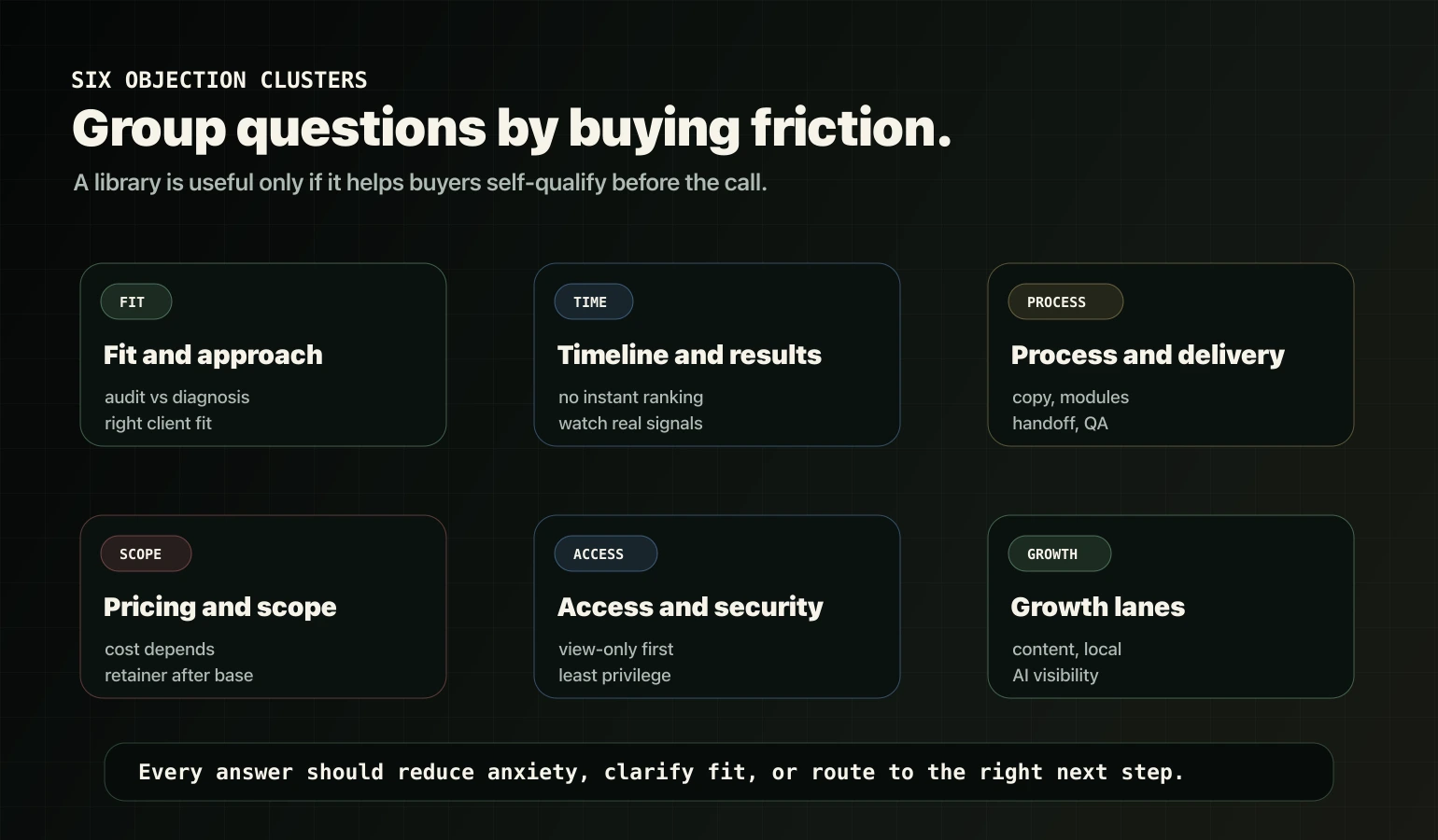
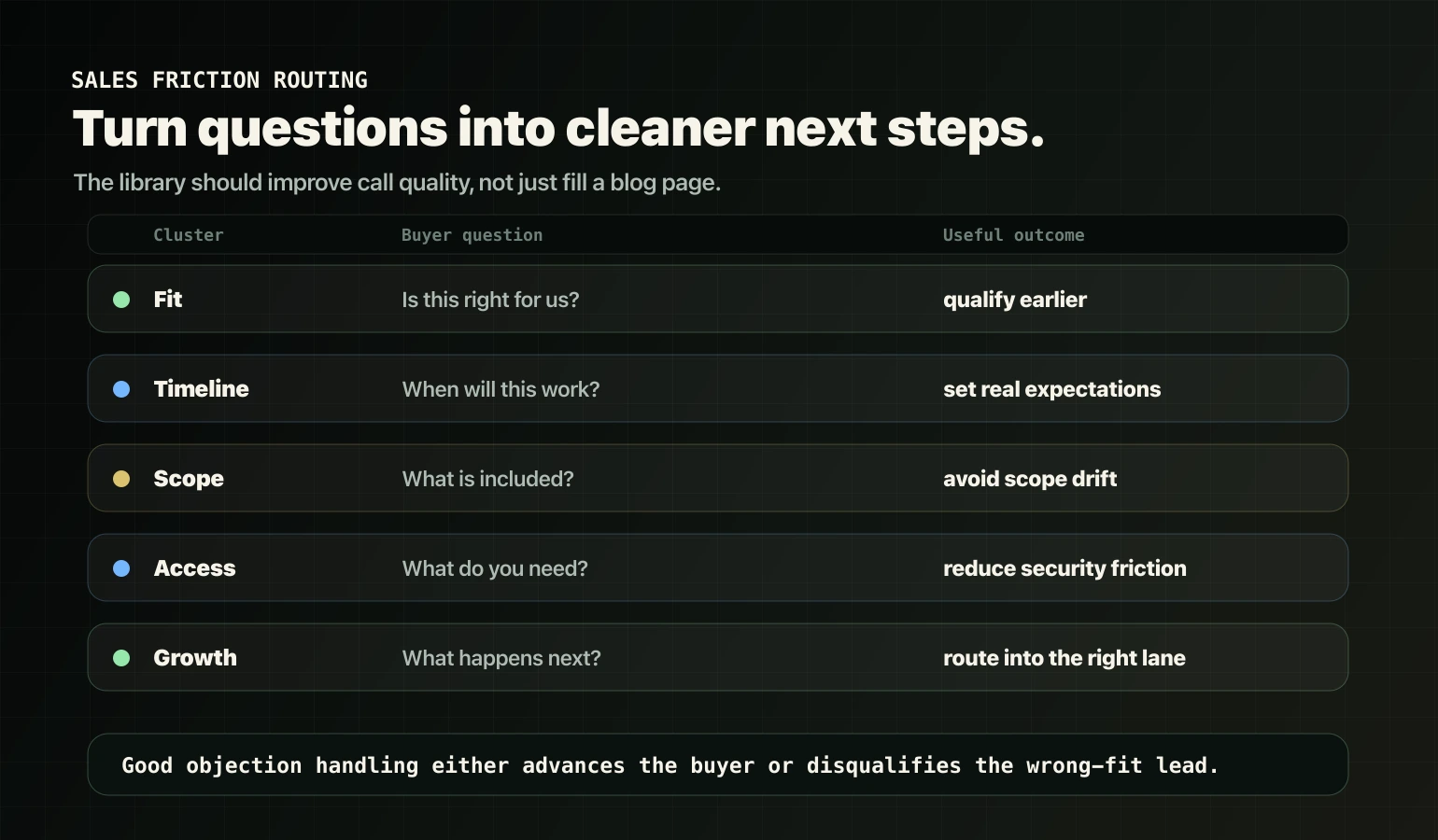
This library answers the questions that usually create friction in BOFU conversations: fit, timelines, guarantees, scope, implementation, pricing, access, content, local pages, and AI visibility.
Use it to:
- qualify leads before calls,
- reduce unprepared diagnosis calls,
- answer pricing and guarantee objections without sounding evasive,
- give sales or marketing a shared answer library,
- protect retention by setting realistic expectations.
If you want the shortest path to clarity, start with a Free Clarity Call.
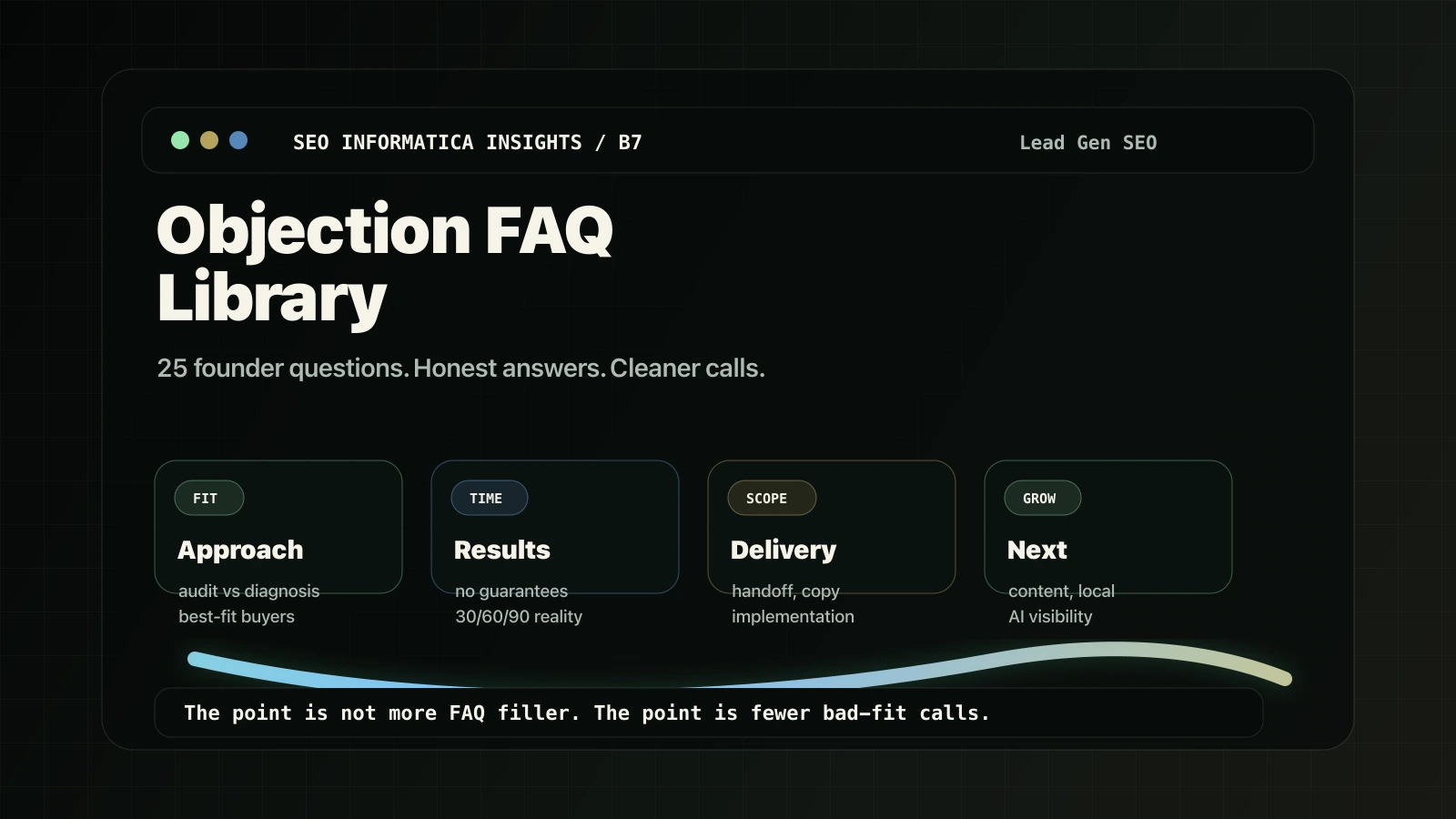
Download the PDF: Objection FAQ Library
Quick navigation
- Fit and approach
- Timeline and results
- Process and deliverables
- Pricing and scope
- Access and security
- Content, local pages, and AI
How to use this library
Do not treat this as generic FAQ filler. That would be trash.
Use each answer in three places:
- On-page: reduce anxiety before a buyer books a diagnosis.
- Sales calls: answer objections without improvising.
- Handoff: keep the client clear on what is included, what is not included, and what happens next.
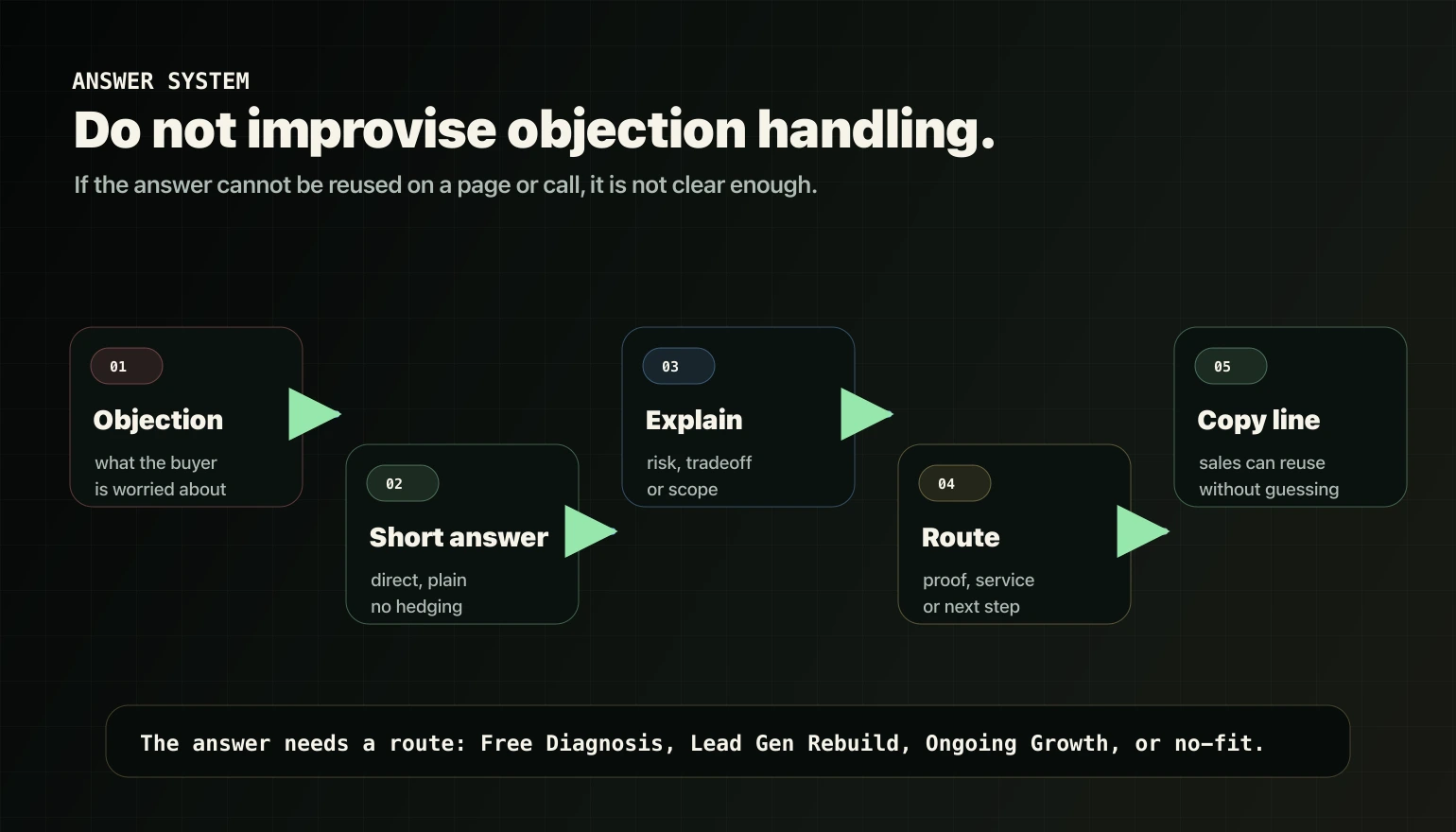
The useful answer format is:
- Give the short answer.
- Explain the risk or tradeoff.
- Route to the right proof, service page, or next step.
- Leave a simple copy line sales can reuse.
Fit and approach
1. Is this just an SEO audit?
Short answer: No. An audit lists issues. A diagnosis identifies the bottleneck and the first move that changes outcomes.
Most audits leave you with a pile of tool output and no priority. Diagnosis is different: it decides whether the real blocker is clarity, page ownership, structure, local setup, technical access, proof, or routing. If a rebuild is needed, the output should be implementation-ready, not another vague deck.
Reusable line: "We do not start with a 60-page audit deck. We start by diagnosing the bottleneck and the first move that changes lead outcomes."
For the wider approach, see AI SEO.
2. What's different about an SEO diagnosis versus a typical audit report?
Short answer: Diagnosis prioritizes what matters for leads: what is broken, what to fix first, and what implementation should look like.
A tool-led audit asks, "What issues exist?" A diagnosis asks, "Which issue is actually blocking qualified inquiry?" That difference matters because service businesses do not need more noise. They need a first move that changes the site system.
Reusable line: "A diagnosis is not a list of issues. It is a prioritization system that turns 'we are stuck' into a clear first move."
3. Are you a fit for my business?
Short answer: Best fit is service businesses that want qualified inquiries and are willing to fix foundation before scaling activity.
The strongest fit is a business with demand, but weak conversion because the site is unclear, overlapping, thin, or poorly routed. If someone wants random blogging forever without fixing the site foundation, this is probably not the right path.
Reusable line: "We are a fit if you want lead quality and clarity, and you are open to fixing the foundation first."
4. What if we have multiple services or multiple locations?
Short answer: That is exactly where ownership rules and architecture matter most.
Multi-service and multi-location sites often fail because service, city, and industry pages compete with each other. The fix is not more pages. The fix is page ownership: one URL owns one intent, and every supporting page reinforces that owner.
Reusable line: "Complexity is not the problem. Lack of ownership rules is."
5. We already have an agency or in-house marketer. Can you work alongside them?
Short answer: Yes. We often deliver the foundation and rebuild direction your team implements.
Many clients keep their agency, developer, or in-house marketer. The missing piece is usually diagnosis-first structure: page roles, ownership, rebuild copy, modules, consolidation, and QA guardrails. That is the lane for Website Rebuild.
Reusable line: "Keep your team. We provide the clarity and dev-ready direction so implementation is clean."
Timeline and results
6. When will we see results?
Short answer: Timing depends on go-live speed, crawl and index cycles, and competition. Early signals can appear within weeks; stability typically develops over 30, 60, and 90 days.
The clock starts when changes are live, not when a document is delivered. Early movement usually shows up in indexing, query alignment, behavior, and lead quality. Stable visibility and compounding outcomes take longer.
Reusable line: "We do not promise instant rankings. We build a stronger foundation that can compound once it is live."
7. What changes can happen in the first 30 days after go-live?
Short answer: Indexing and ownership stabilize, the right pages start showing for the right queries, and lead quality often improves before lead volume.
The first month is usually noisy. You may see ranking volatility while Google reprocesses pages, redirects, canonicals, and internal routes. The useful early question is not "Did one keyword jump?" It is "Are the right pages starting to own the right intents?"
Reusable line: "The first wins are usually clarity and lead quality. Bigger visibility gains tend to compound as indexing and ownership settle."
8. Do you guarantee rankings or leads?
Short answer: No. We do not guarantee rankings, lead volume, or AI citations.
Guarantee language is a red flag. The controllable work is structure, page ownership, clarity, proof placement, internal routes, and technical access. Those inputs improve odds and measurement. They do not let anyone control Google, market demand, or buyer timing.
Reusable line: "No guarantees. Better foundations, better execution, better odds, and clearer measurement."
9. What if rankings drop after changes?
Short answer: Some volatility is normal after consolidation and major updates; the key is whether the right pages become the long-term winners.
When pages are merged, redirected, rewritten, or repositioned, search systems need time to reprocess the site. A short-term dip is not automatically a failure. The signal to watch is whether owner pages gain clearer ownership over the right queries.
Reusable line: "We expect reprocessing. We measure whether the site moves toward clearer ownership and better conversion routing."
10. What if we need leads immediately?
Short answer: Use a parallel channel short-term such as referrals, partnerships, or paid acquisition while the rebuild stabilizes long-term conversion performance.
A rebuild is not a next-week lead switch. It improves the foundation so demand converts more consistently. If cash flow needs leads now, keep a short-term channel active while the site foundation improves.
Reusable line: "Short-term leads may require a parallel channel. The rebuild makes long-term lead generation more efficient."
Process and deliverables
11. What exactly is included in a Website Rebuild?
Short answer: A foundation engagement: ownership map, dev-ready copy and modules, consolidation plan, routing guidance, and implementation handoff.
The exact scope depends on the site, but the work usually includes service definition, page-role mapping, rebuild copy, module direction, keep/merge/remove/create recommendations, navigation refinements, internal linking guidance, schema guidance, and implementation handoff.
Reusable line: "It is not a vague strategy deck. It is an implementation-ready package that fixes ownership, clarity, and routing."
12. What do you need from us to start?
Short answer: Website URL plus your goal, what feels broken, and who will implement changes. Optional inputs include GSC or GA4 exports, GBP link, proof assets, and CRM notes.
You do not need a perfect brief. A good starting point is the website URL, core services, target market, what feels broken, what a good 90-day outcome would look like, and who owns implementation.
Reusable line: "We do not need a 10-page brief. We need enough context to diagnose the bottleneck correctly."
13. Who writes the copy?
Short answer: We provide dev-ready rebuild copy and module guidance as part of rebuild scope, aligned to your brand and compliance constraints.
The copy should clarify the offer, answer objections, place proof where buyers decide, and support one primary next step. If the business has regulated language or brand constraints, those are part of the approval process.
Reusable line: "Copy is not written to sound clever. It is written to clarify, qualify, and convert."
14. Do you implement the changes or just hand them off?
Short answer: Both options exist: handoff-first or guided rollout with QA and structural guardrails.
Some clients want their team to implement. Others need implementation support or review. Either way, the rebuild should be designed so the rollout does not reintroduce overlap, unclear CTAs, or broken routing.
Reusable line: "We can hand off a ship-ready package, or we can guide rollout so it ships correctly."
15. What happens after the rebuild?
Short answer: Once the foundation is stable, growth work compounds more effectively through funnels, local expansion where justified, and technical refinement.
Foundation first. Then scale. After the rebuild is live, the next layer is usually Ongoing Growth: buyer-question content, proof publishing, local architecture refinement, technical cleanup, and iteration based on real signals.
Reusable line: "Rebuild first. Then scale. Growth works better when the foundation is clear."
Proof matters here. If you want examples instead of abstract claims, see Case Studies.
Pricing and scope
16. How much does it cost?
Short answer: It depends on scope: core URLs, complexity, overlap, and implementation needs. Diagnosis clarifies what scope is actually required.
Pricing should not be guessed from a package grid. A five-page local service site, a multi-location site, and a legacy site with years of overlap do not need the same work. The diagnosis exists to prevent buying the wrong project.
Reusable line: "We price based on the scope needed to fix the bottleneck, not on a generic package."
17. Is this a monthly retainer?
Short answer: A rebuild is typically a focused engagement; ongoing work can follow once the base is stable.
Monthly retainers are often wasteful when the foundation is broken. If owner pages are weak, content is overlapping, and CTAs are unclear, ongoing activity just adds more weight to a bad structure. Fix the base first, then decide the right growth layer.
Reusable line: "Retainers work best after the base is correct. We do not want to SEO forever on a broken foundation."
18. What's included versus not included?
Short answer: Included: dev-ready direction and deliverables. Not automatically included: full custom design builds, unlimited revisions, or implementation support unless scoped separately.
A rebuild should deliver the structure, ownership decisions, copy/modules, and handoff needed to implement cleanly. A full design build is a different scope. Implementation support can be included, but it should be explicit.
Reusable line: "We do not hide behind strategy. We deliver what your team can implement."
Access and security
19. Do you need access to Search Console, GA4, or CRM?
Short answer: Not to start. Screenshots or exports are often enough for diagnosis. View-only access is preferred if deeper work is needed.
Start with the lowest-risk input that gives enough context. If deeper investigation is needed, use view-only access where possible. Measurement is important, but password chaos is not.
Reusable line: "No risky access to start. Exports or view-only access are usually enough."
20. Do you need admin access to our website?
Short answer: Usually not for diagnosis. For implementation support, it depends on your workflow.
Your team or agency can keep admin control. The rebuild can be delivered as structure, copy, modules, internal linking guidance, and QA direction. If direct implementation support is needed, use the least privilege role that works.
Reusable line: "You keep control. We provide ship-ready direction and guardrails."
21. How do you handle security and credentials?
Short answer: We do not request passwords by email. Use role-based access and secure sharing where necessary.
Credential hygiene matters. No passwords in email threads. Use view-only access when possible, role-based permissions when needed, and secure credential sharing only when implementation requires it.
Reusable line: "Least privilege, secure sharing, and no passwords over email."
Content, local pages, and AI
22. Should we keep blogging?
Short answer: Yes, if it supports the right owner pages and does not compete with them.
Blogging is useful when it answers buyer questions and routes readers into the correct owner pages. It becomes harmful when random blog posts compete with service pages. The useful lane is Content Funnels: support content that strengthens commercial routes.
Reusable line: "Blogging is not the enemy. Random blogging without ownership rules is."
23. How do you prevent keyword cannibalization?
Short answer: We assign page roles and ownership first, then consolidate duplicates and reinforce one winner per intent with internal links.
Cannibalization is usually an ownership failure. The fix is choosing the owner URL, merging or redirecting duplicates, aligning canonicals where needed, and using internal links to reinforce the winner instead of splitting signals.
Reusable line: "One intent, one owner URL. Everything else supports."
If the blocker is technical access, canonicals, or indexing, that moves into Technical SEO.
24. Do we need city pages or industry pages?
Short answer: Only when they add real unique value such as proof, constraints, or logistics. Mass-duplicated pages usually create thin content and overlap.
City pages can work when there is real local demand and the page includes unique proof, boundaries, logistics, and buyer context. Industry pages work when the industry changes the message or proof. Otherwise, keep the content as a module and protect ownership.
Reusable line: "If the page cannot be meaningfully unique, do not publish it. Consolidate and route instead."
If local structure is the bottleneck, see Local SEO.
25. How do you think about AI Overviews and AI visibility?
Short answer: You cannot force AI Overviews or guarantee citations. You can improve eligibility, clarity, cite-worthiness, and routing so visibility turns into leads.
AI visibility is not a hack layer. It is a clarity, structure, proof, and routing problem. If pages are unclear, duplicated, or not answer-ready, you reduce your odds of being referenced and waste the clicks you do get.
Reusable line: "We do not sell AI hacks. We build eligible, clear, cite-worthy pages with routes to conversion."
For the service lane, see Search + AI Visibility.
Want these answered for your specific site?
If these questions describe the friction in your sales process, the next step is not another generic SEO checklist.
Start with a Free Clarity Call and we will tell you what to fix first: foundation, local architecture, technical blockers, content funnels, or Search + AI visibility.