

Your service page is not just another page. It is the moment a buyer decides whether they understand you, trust you, and want the next step.
Most service pages fail for boring reasons:
- the offer is unclear,
- the page overlaps with other URLs,
- the proof arrives too late,
- the process feels vague,
- the page asks for too many different actions.
This template helps you plan one service page with clear ownership, useful copy prompts, the right modules, internal links, and QA before anything gets built.
Get the template:
Download the Service Page Brief Template (PDF)
If you want us to turn the brief into a dev-ready rebuild, start with Free Clarity Call.
Where this template fits
If you are rebuilding core pages and structure, this template reflects the page-planning work behind a Website Rebuild: https://seoinformatica.com/website-rebuild/
If you want the practical page-quality companion, use the Service Page SEO Checklist: https://seoinformatica.com/service-page-seo-checklist/
The template is not a magic doc. If your service offer is weak, the template will expose that. That is useful. A clean brief should reveal unclear positioning before a designer or developer turns it into a polished mess.
What is inside the PDF template
The PDF gives you a working brief for one service page:
- Page essentials: service name, CTA, buyer, location, and desired outcome.
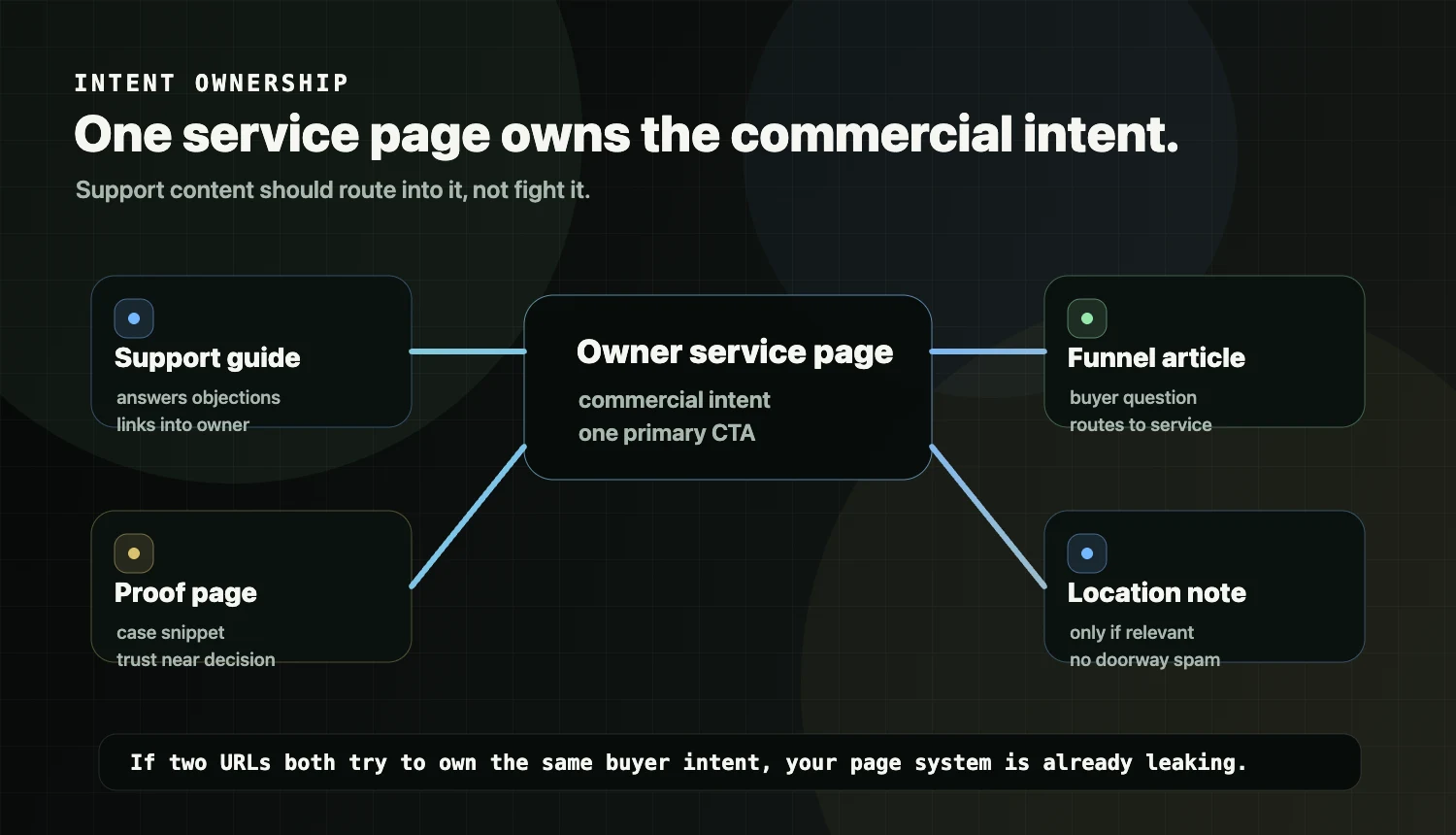
- Intent and ownership: what this page owns and what other pages must not compete with.
- Messaging: promise, differentiators, proof, qualification, and objections.
- Recommended page outline: clarity, proof, process, decision support, and CTA.
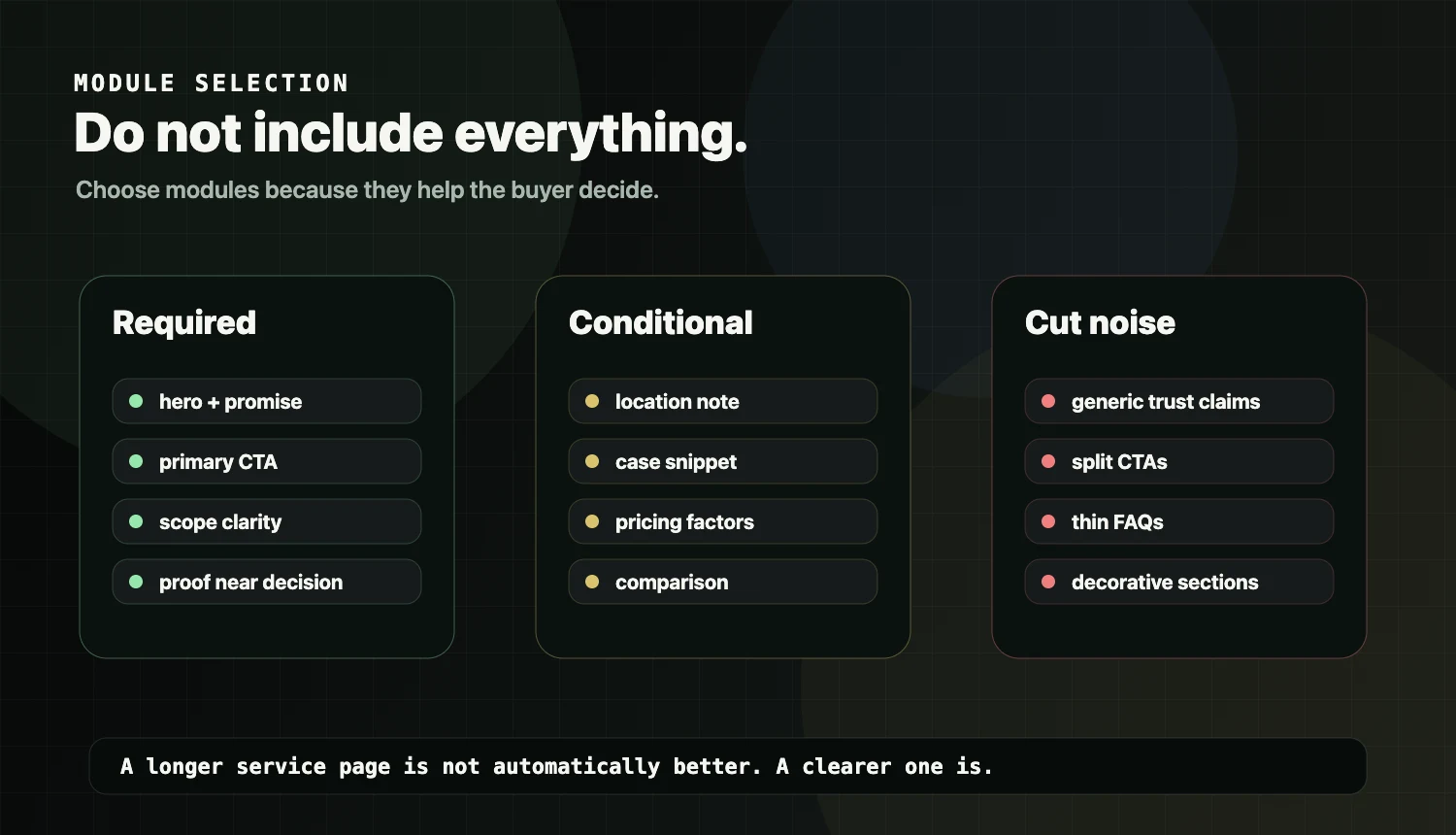
- Module checklist: choose only what supports conversion.
- Copy prompts: fill-in prompts for headline, subhead, bullets, process, proof, and qualification.
- SEO, internal linking, and QA: publish-ready checks for overlap, one CTA, proof placement, and mobile scan quality.
Extra modules are not a flex. They are usually clutter. The job is to include what helps a buyer decide, not everything you can think of.
How to use this template in 10 minutes
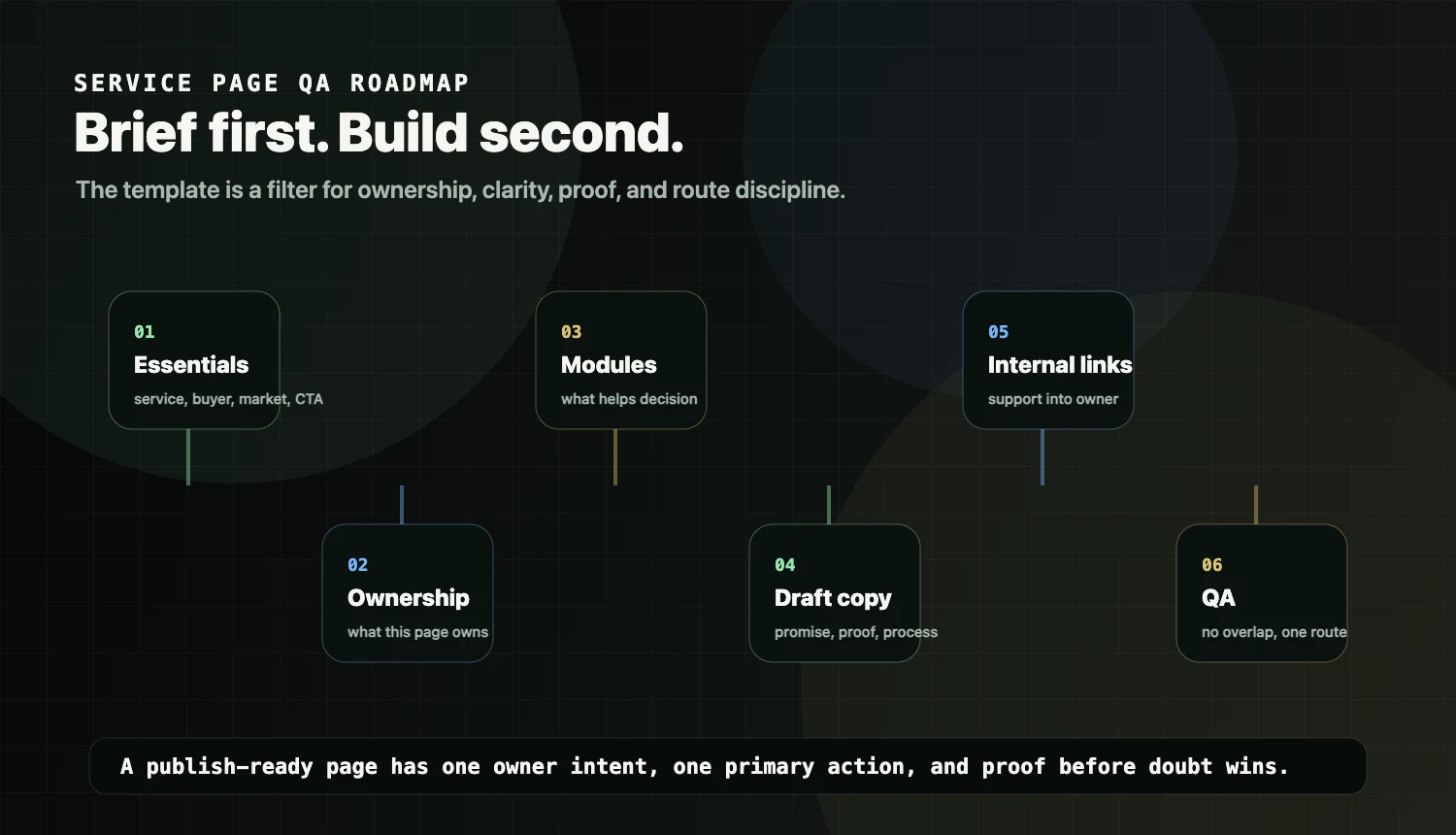
- Fill page essentials: name the service, buyer, market, and one primary action.
- Decide ownership: define the commercial intent this page owns and list any overlapping URLs.
- Select modules: keep what supports the decision and cut noise.
- Draft the copy: use the prompts with real proof, not generic claims.
- Plan internal links: route support content into the owner page without making it compete.
- QA before publishing: check one CTA, proof placement, process clarity, and mobile scan quality.
If you are building support content around the owner page, pair this with Content Funnels: https://seoinformatica.com/content-funnels/
Quick copy version
Copy this into your notes if you want the short version before using the PDF.
SERVICE PAGE BRIEF

1. Page essentials
- Service name:
- Primary CTA:
- Target buyer:
- Primary location:
- Primary outcome:

2. Intent and ownership
- Primary intent:
- Secondary intents:
- Competing pages:
- Ownership decision:

3. Messaging
- One-sentence promise:
- Top 3 differentiators:
- Proof to include:
- Qualification:
- Top objections:

4. Modules
- Hero and CTA:
- Proof:
- Who it is for / not for:
- What is included / not included:
- Process:
- Case snippet:
- FAQs:
- Location note:
- Final CTA:

5. Internal links
- Links into this page:
- Links out:
- CTA destination:

6. QA
- Clear in 10 seconds?
- One primary CTA?
- Proof before decision points?
- No overlap with other URLs?
- Process is concrete?
- Skimmable on mobile?
Want us to build the dev-ready version?
If your site has overlapping service pages, unclear structure, or traffic that does not convert, this is usually a foundation problem, not a "write more content" problem.
Start with a Free Clarity Call: https://seoinformatica.com/start/
If the right move is a rebuild, we will say that. If the right move is to expand support content around the correct owner page, we will say that instead.
Frequently Asked Questions
Should I include every module on every service page?
No. Extra modules become noise. Use the checklist to choose only what supports clarity and the decision to contact you.
How do I prevent service page cannibalization?
Decide ownership first: one page owns the main commercial intent for that service. Any overlapping pages should be merged, repositioned as support, or removed. Then internally link support content into the owner page.
How does this relate to content funnels?
Your service page is the owner page. Content funnels are the support layer: buyer-question pages that answer objections and route to the owner page without competing with it.
Can I use this template even if my site is small?
Yes. Small sites benefit the most from clear ownership and a single route to conversion. This prevents messy expansion later.
Can SEO Informatica review my brief or turn it into a dev-ready page?
Yes. Start with the Free Clarity Call and we will recommend the right first move based on what the site needs.