

If your website gets traffic but no leads, the problem is usually not visibility alone. The problem is that the wrong traffic is arriving, the wrong page is receiving the click, the page does not build enough confidence, or the next step feels too hard.
Traffic and lead generation are different jobs. A page can rank and still fail to convert if it does not match buyer intent or help the visitor decide. Our diagnosis process starts here if you want to compare your site against this framework. https://seoinformatica.com/start/
Why does a website get traffic but no leads?
Because search visibility and lead generation are not the same thing. One gets the click. The other has to turn that click into trust, clarity, and action.
The simplest way to diagnose the gap is to check four things in order: intent, page, proof, and path.
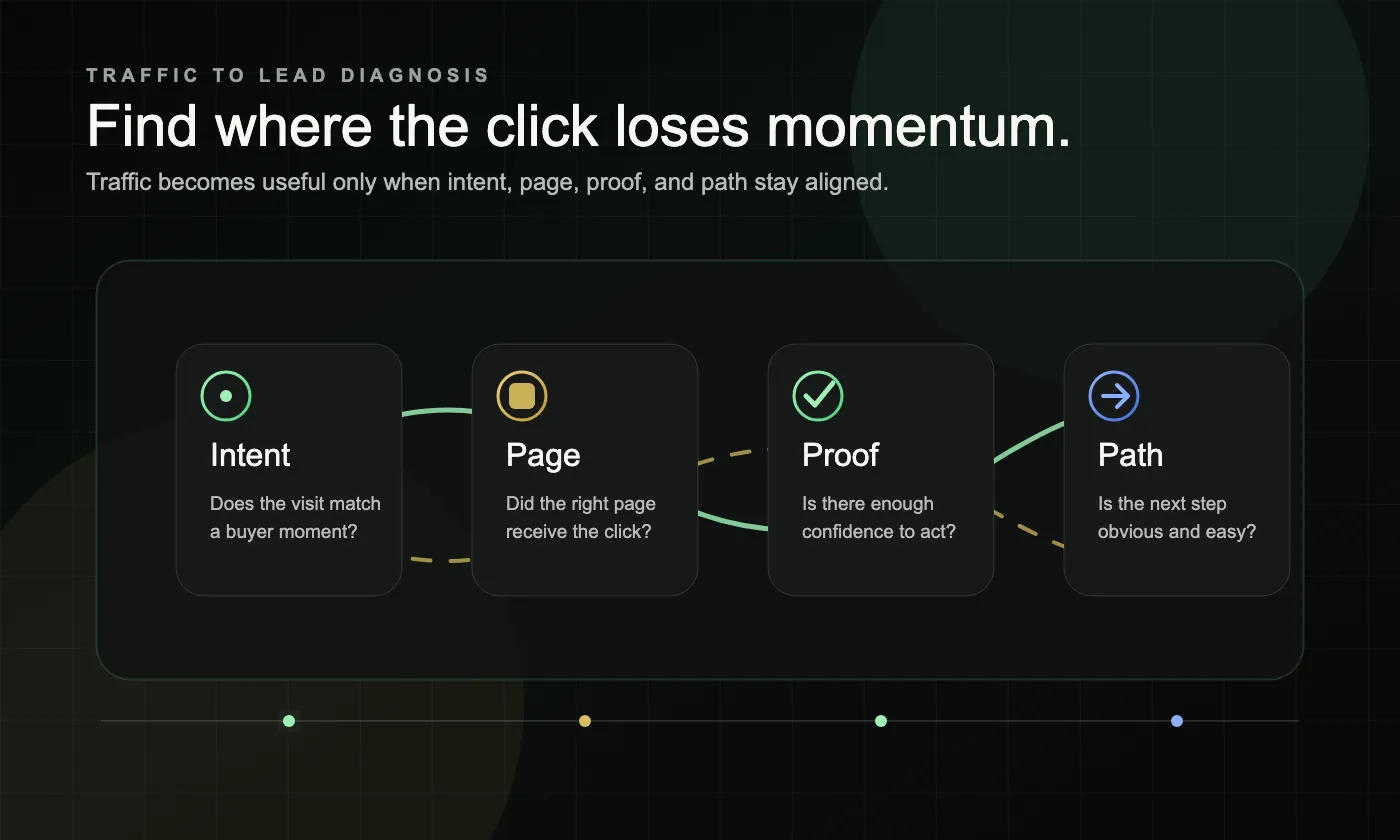
Intent
The traffic has to match the kind of visitor you want. Informational traffic can be useful, but it will not behave like decision-stage traffic unless it has a clear route forward.
Page
The right visitor still needs to land on the right page. If a service query lands on a generic homepage or an educational article, the visit often ends there.
Proof
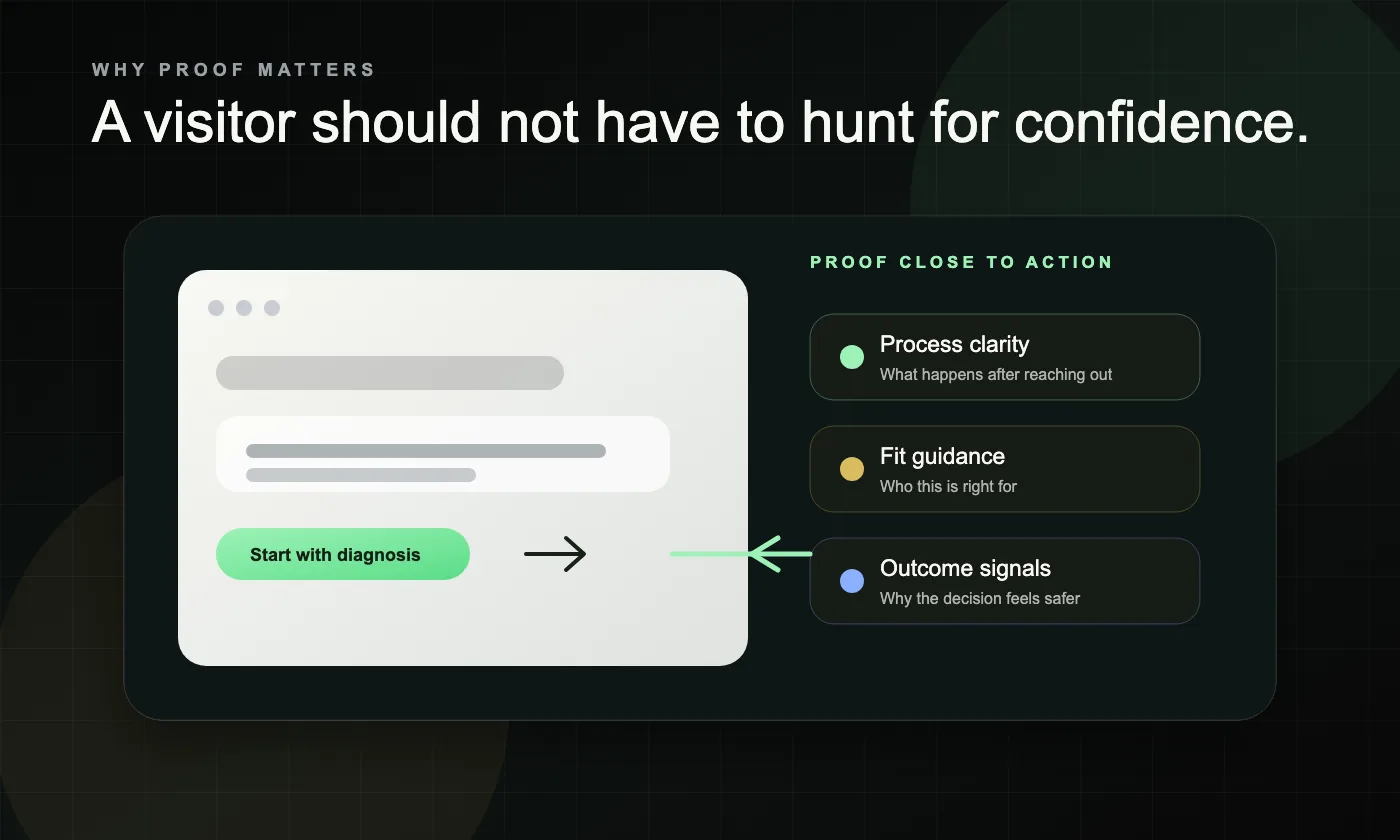
A service page has to remove doubt. If there is no process, no fit guidance, no trust signals, and no reason to believe you can solve the problem, traffic stays passive.
Path
Even an interested visitor can stall if the CTA is buried, the form is too long, the mobile experience is awkward, or the next step is unclear.
If this pattern shows up across several important pages, compare it against the signs your site needs a rebuild, add proof blocks that reduce doubt, and build a founder objection FAQ before chasing more traffic.
Are you attracting the wrong traffic or losing the right visitors?
The first question is not how much traffic you have. The first question is what that traffic expected to find.
Use this quick diagnosis table on your top landing pages:
| What you see | What it usually means | What to fix first |
|---|---|---|
| Blog posts get clicks but almost no inquiries | Informational intent is winning, but commercial routing is weak | Strengthen the service page and add clear internal bridges from blog to service |
| The homepage gets most non-branded traffic | Google is unclear about page ownership | Build or improve dedicated service pages and reduce homepage overload |
| A service page gets traffic but low contact rate | The visitor is interested, but the page does not help them decide | Rewrite the above-the-fold message, add proof, clarify process, and tighten the CTA |
| Contact page visits are high but submissions stay low | Lead friction is too high | Shorten the form, offer a lower-friction next step, and improve mobile usability |
| Mobile traffic is strong but engagement drops quickly | Performance or layout friction is blocking action | Test the page on mobile, improve load performance, and reduce clutter |
In practice, most sites have more than one issue at the same time. That is why guessing from traffic alone usually leads to the wrong fix.
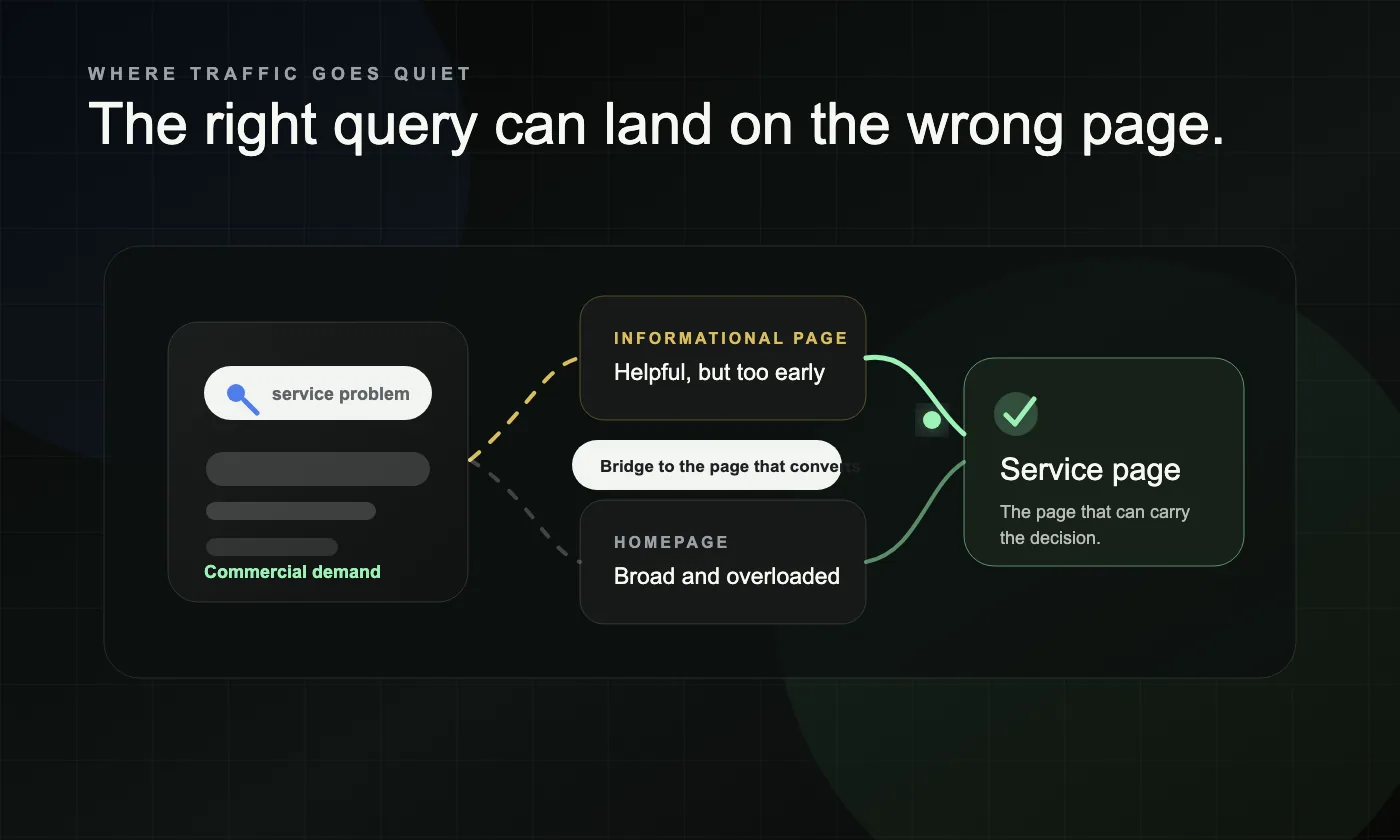
What is the diagnosis framework for a website that gets traffic but no leads?
Use a simple four-part clarity diagnosis: Intent, Page, Proof, and Path. If one of these breaks, lead generation gets weaker even when traffic looks healthy.
Start with Search Console and review which queries are driving clicks, which pages are receiving them, and whether the landing page matches the searcher’s likely intent. https://support.google.com/webmasters/answer/7576553
Then review the pages that matter most on mobile. Slow loading, layout shift, and other real-world friction can quietly reduce form fills and calls. Use PageSpeed Insights to spot obvious performance issues. https://developers.google.com/speed/pagespeed/insights/
Use this checklist on your top three landing pages:
- Does the headline say what you do, who it is for, and why it matters?
- Is the visitor on the best page for that query, or did they land somewhere too broad or too early?
- Is there one primary CTA that is obvious without scrolling?
- Is there proof near the CTA, such as reviews, outcomes, process clarity, or fit guidance?
- Does the page explain what happens next after someone reaches out?
- Is the form short enough, and is there an easier fallback option for people not ready to fill it out fully?
What does this look like in a real service business example?
A common service-business pattern looks like this: traffic is growing, but the growth is landing in the wrong places or arriving without enough decision support to convert.
Composite example 1: A local emergency repair company published helpful blog posts around symptoms and quick fixes. Those posts attracted visits, but the emergency service page had a vague headline, weak trust cues, and no clear after-hours CTA. The diagnosis was not “we need more blog traffic.” The diagnosis was that commercial intent had no strong landing page to complete the job.
Composite example 2: A founder-led B2B service business had a homepage getting most of the search traffic. Visitors could tell the company was credible, but they could not quickly tell which service solved which problem, who the offer fit, or what the next step looked like. The first move was to separate service intent, strengthen the relevant service page, and shorten the conversion path instead of publishing more articles.
These examples look different on the surface, but the underlying issue is the same: traffic arrived, and the website did not make the decision easy enough to continue.
What should you fix first if your website gets traffic but no leads?
Fix page ownership and decision clarity before you try to scale traffic. More visits into a weak page system usually create more waste, not more leads.
In most service businesses, the right order is:
- Identify the main commercial queries and decide which page should own each one.
- Strengthen the top service pages first: headline, offer clarity, trust, process, fit, and CTA.
- Remove friction from the next step: forms, click-to-call options, mobile layout, and response expectations.
- Use blogs to support service pages, not replace them.
- Only after that should you expand content production or push harder on traffic growth.
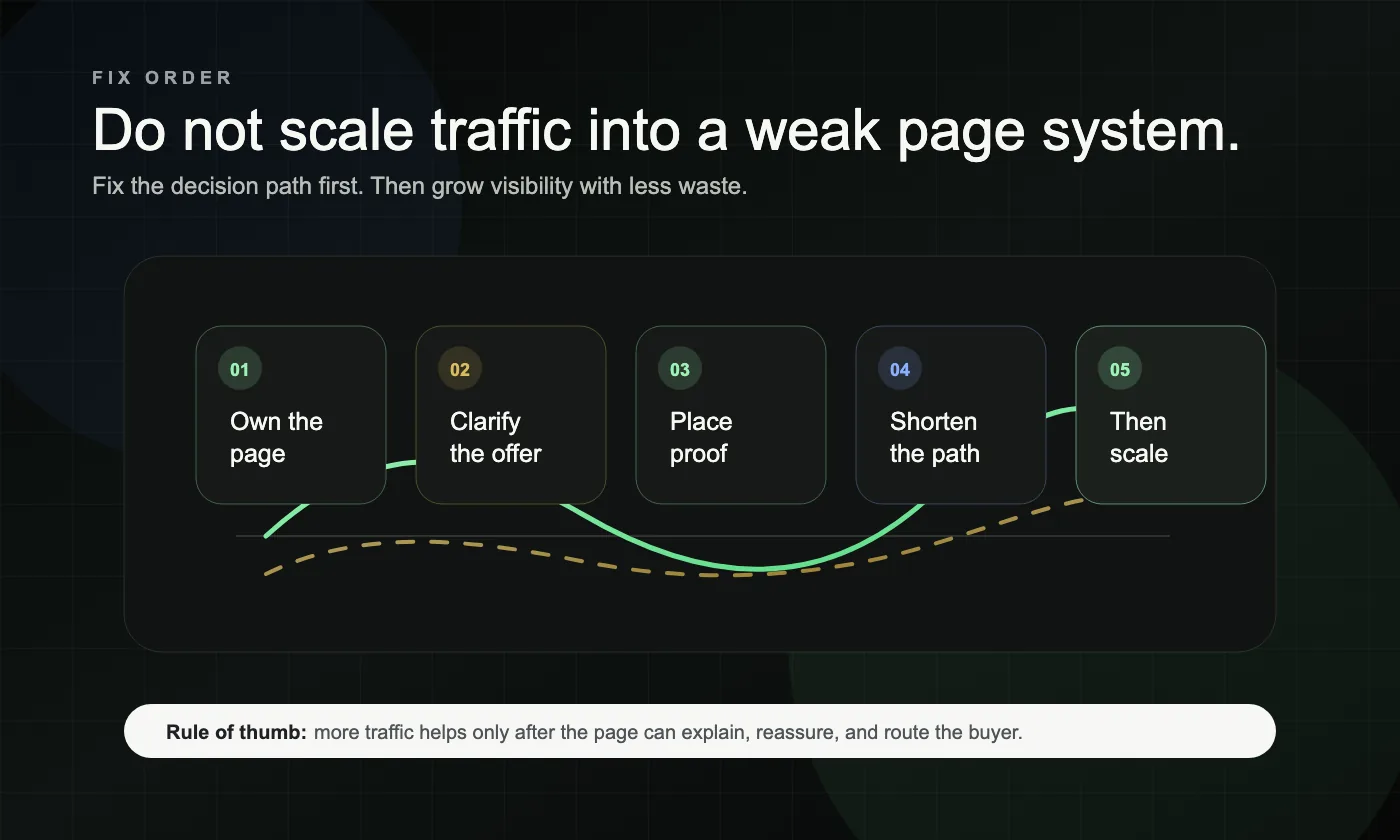
You can see how clarify, rebuild, and grow fit together.
What mistakes keep this problem in place?
The biggest mistake is treating every lead problem like a traffic problem. That usually creates more activity around the real bottleneck instead of fixing it.
Common mistakes include:
- Publishing more top-of-funnel blog content while core service pages stay weak
- Letting the homepage absorb too many different intents
- Using generic headlines that never say who the service is for
- Placing proof too far down the page or leaving it out entirely
- Giving every page multiple competing CTAs instead of one clear next step
- Assuming a visual redesign will solve structural page-ownership problems
A useful red flag is this: if someone lands on the page and cannot tell within a few seconds what the service is, who it is for, and what to do next, the problem is probably clarity before it is traffic.
What should you check before publishing more SEO content?
Check whether the content you already have is helping a buyer move closer to a decision. If it is not, publishing more usually grows visits faster than it grows inquiries.
Before you publish another post, check three things:
- Is the service page strong enough to receive decision-stage traffic?
- Does the new article answer one painful question that supports that page?
- Does the article have one clear internal route to the next step?
Helpful content still matters, but it should be written for a real audience, add something useful, and support a clear site purpose rather than exist only to attract clicks. Google’s people-first guidance is a good quality filter before adding more content. https://developers.google.com/search/docs/fundamentals/creating-helpful-content
When the underlying issue is structural rather than cosmetic, our Website Rebuild approach is the better next step. https://seoinformatica.com/website-rebuild/
Frequently asked questions
Can I fix this without a full redesign?
Yes. Many sites do not need a visual redesign first. They need clearer page ownership, stronger service-page messaging, better proof, and a simpler path to contact.
Should I fix the page first or try to get more traffic?
Fix the page first when traffic already exists. More traffic into a weak page system usually multiplies waste instead of multiplying leads.
Does page speed matter for lead generation?
Yes, but it is rarely the only issue. Speed matters most when it adds friction to a page that already has weak clarity, weak proof, or a clumsy CTA path.
What if my blog posts get all the traffic?
That usually means your informational content is easier for search engines to understand than your commercial pages. The fix is not to stop blogging. The fix is to make the service-page system stronger so the right page can own the right intent.
Get a free clarity call.
If your website gets traffic but no leads, the next step is not guessing. Get a free clarity call. https://seoinformatica.com/start/